
Bali remains a sanctuary of traditions where dance and music play an essential role in social and community life, even provoking certain states of trance. These dances, rooted in Balinese spirituality, are performed during festivals and religious ceremonies. As well as being an astonishing and spellbinding spectacle, so much appreciated in the West, they embody the profound link between man, nature and the divine, integrating mythological stories, Hindu beliefs derived from the Ramayana and animist elements.
Table of Contents
In Bali, the border between the visible and invisible worlds is porous. There are around 20,000 sanctuaries and temples, from majestic gardens perched on cliffs to family altars in private gardens. It's impossible to escape the sense of spirituality everywhere: black basalt statuettes adorned with offerings, flowers, small baskets of coloured rice left at every corner, women in saris on their way to the temple, a scaffolding of offerings carried on their heads, brassy notes wafting from a temple where a gamelan (1), the orchestra of every village, is rehearsing, setting the tempo for all life.... Everything here is so imbued with religiosity that every act that escapes from everyday life seems to be carried out according to a liturgy that is innate in everyone...
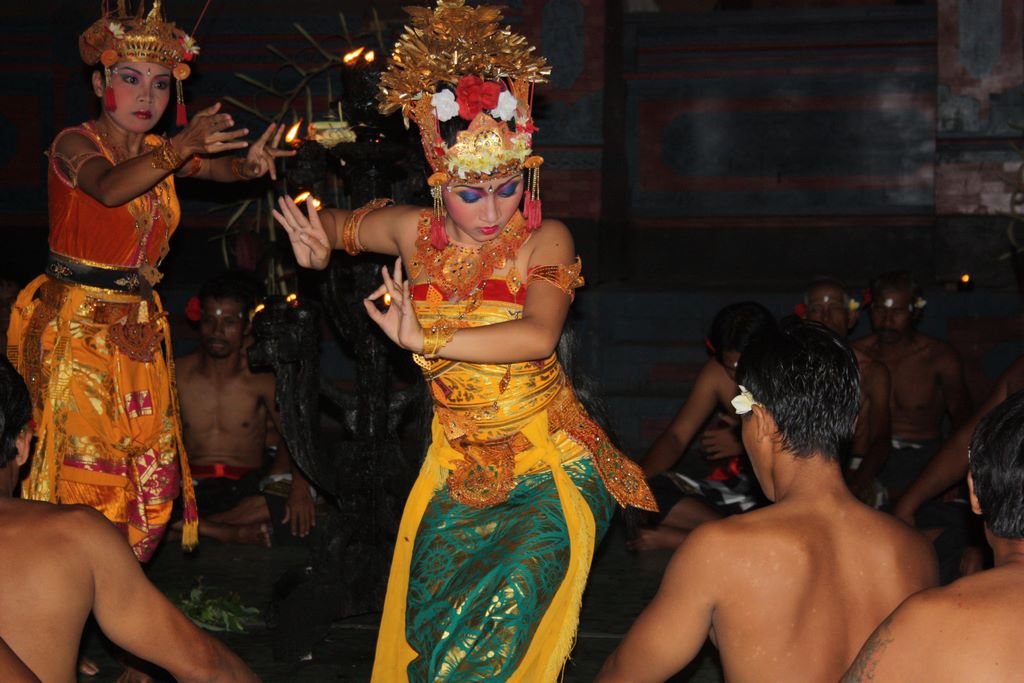
Night falls quickly in Bali, at around six o'clock all year round, and it is in the evening, after a day's work, that the Balinese move seamlessly into the sacred world: dance, music, theatre and puppetry fill the night with embodied prayers, and art is born out of everyday life, ignoring what belongs to the profane or the spiritual.
Many forms of dance use trance to establish communication between our material world and supposed spiritual or occult forces, with the aim of achieving personal elevation, purification, protecting the community from evil spirits, or even expressing ancestral warrior energy. Gamelan music, with its repetitive percussion and haunting melodies, sometimes accompanied by a choir, plays an essential role in driving the choreography and inducing a state of trance.
The Sanghyang or fire trance

When the light fades and the shadows stretch across the black stone walls, another Bali awakens. In these suspended moments, Bali reveals its most invisible, most sacred side. We're in the centre of a village in the Karangasem region, east of Bali (2), and we're about to witness a Sanghyang Jaranwhich can be translated as the "sacred mount". The space is ritually delimited by the pemangkua temple priest. It should be noted that the chosen location is oriented according to Balinese cosmology, in relation to the sacred cardinal points. Each direction is associated with a divinity, a colour, a natural element and an aspect of spiritual life. For example, the mountain is the direction of the sacred, in particular Mount Agung, the most sacred point in Bali. The sea is the direction of the impure, the symbol of chaos, etc.
The purification ritual or melukat aims to symbolically cleanse the site.
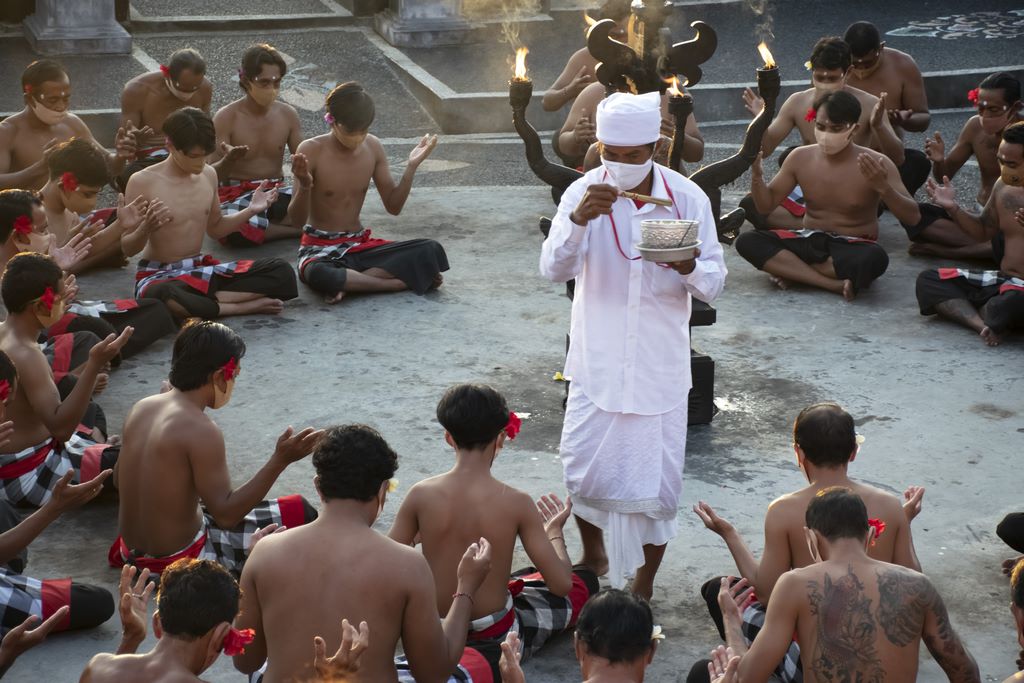
The priest sprays the space with tirta (holy water), and uses flowers, palm leaves and incense smoke to purify the air and ward off impure forces, while reciting mantras - often in Sanskrit or ancient Balinese - to sanctify each direction of the space (north, south, east, west, centre). He then draws a physical boundary with bamboo fibres and white cords (sometimes with braided young coconut leaves), marking the separation between the sacred and profane worlds. This 'barrier' prevents negative energies or wandering spirits from entering during the trance. The square thus becomes a temporary sanctuary, a sacred theatre for the spirits.
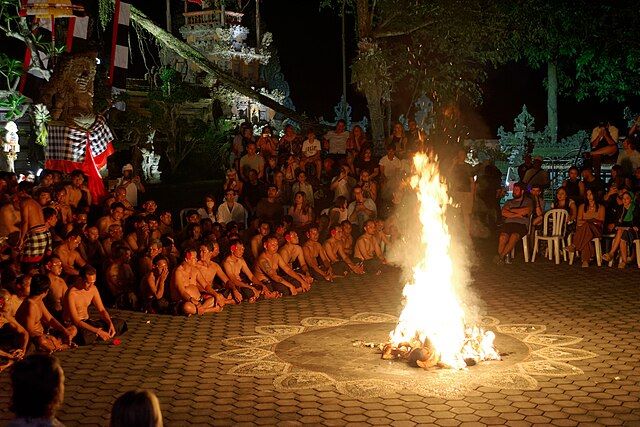
A pyre of coconut shells, the only source of light for this night-time ceremony, is lit: these will be the embers on which the trance dance will take place. Offerings are placed at the four corners of the perimeter, offerings of protection, of a call to the protective spirits or of a call to the gods. hyang and balance between the forces of good and chaos. With space purified and delimited, the pemangku invokes guardian spirits and ancestors, sings words of welcome and openness and invites the hyang to descend into the bodies of the dancers. The musicians settle in. The ceremony begins with traditional songs (kekawin). The gamelan comes to life, metal percussion and gongs respond to each other in a hypnotic rhythm. A choir Kecak (see box), with its rhythm, intonations and cries, provides energetic support for the rise into trance. Around the sacred circle, the community has gathered. The heat is rising. No one speaks. This is not a performance, but a spiritual act (3).
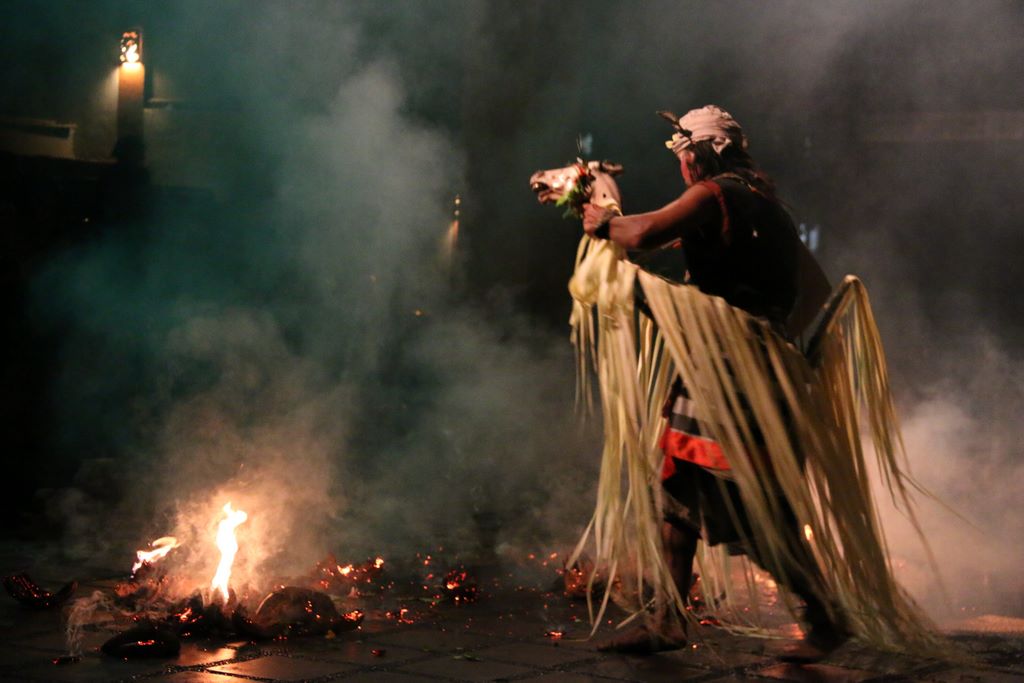
The dancers symbolically ride a horse made of wicker or woven coconut fibres, wedged between their legs. Through songs, invocations and ritual breaths, the priests and shamans (balian) open the channel to the protective spirits. The dancers begin to move more and more briskly. Once in a trance, the dancers start trotting, neighing and jumping: they embody divine horses, ridden by the spirits. They move around the brazier, crossing the flames several times barefoot, without feeling or showing any pain. The glowing embers are spread out on the ground. They then walk across the carpet of embers, sometimes kicking them with their feet, carrying embers to their mouths and spitting them out. They may fall, roll in the ashes, get up again, seemingly unaffected by the burning. It was an impressive moment, and the tension in the crowd was palpable. To our amazement, a young Balinese man whispers " During the Sanghyang Jaran, fire does not burn, it purifies ". So be it!
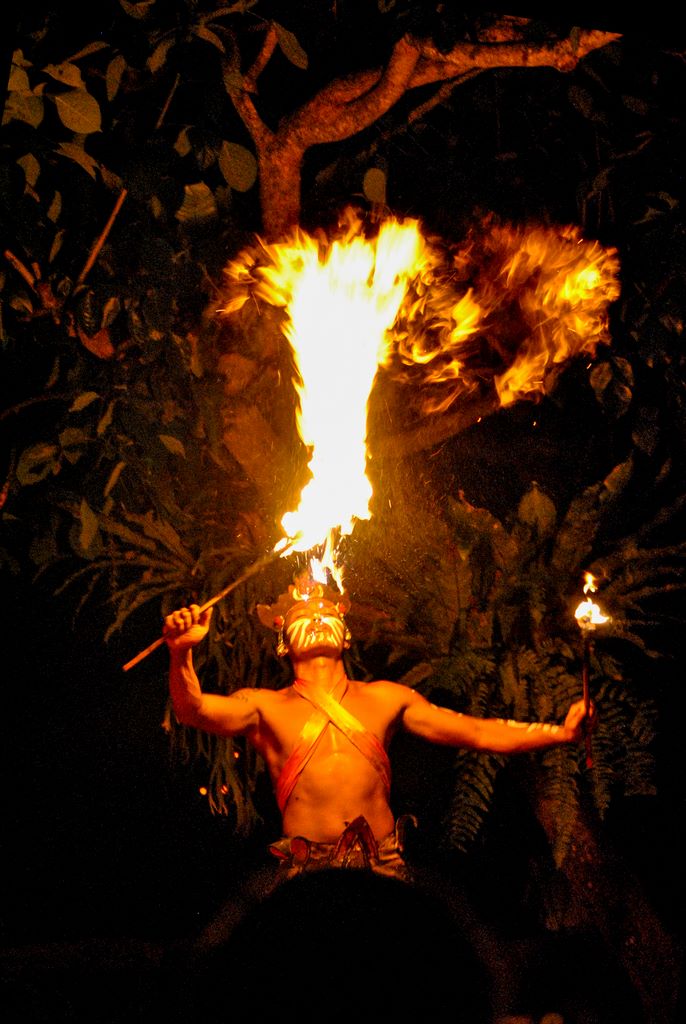
Then the choir slows down and the singing becomes gentler. The ritual guides help the dancers out of their trance by touching them, blowing on them or reciting mantras. The dancers slowly come to their senses, and are often disorientated. The trance is 'safe' but can lead to extreme fatigue or, in rare cases, a temporary emotional imbalance. The dancers generally have no recollection of what happened during their possession. Offerings are then made to thank the spirits and seal the ritual.
The Sanghyang Dedari, a celestial trance of virgin girls
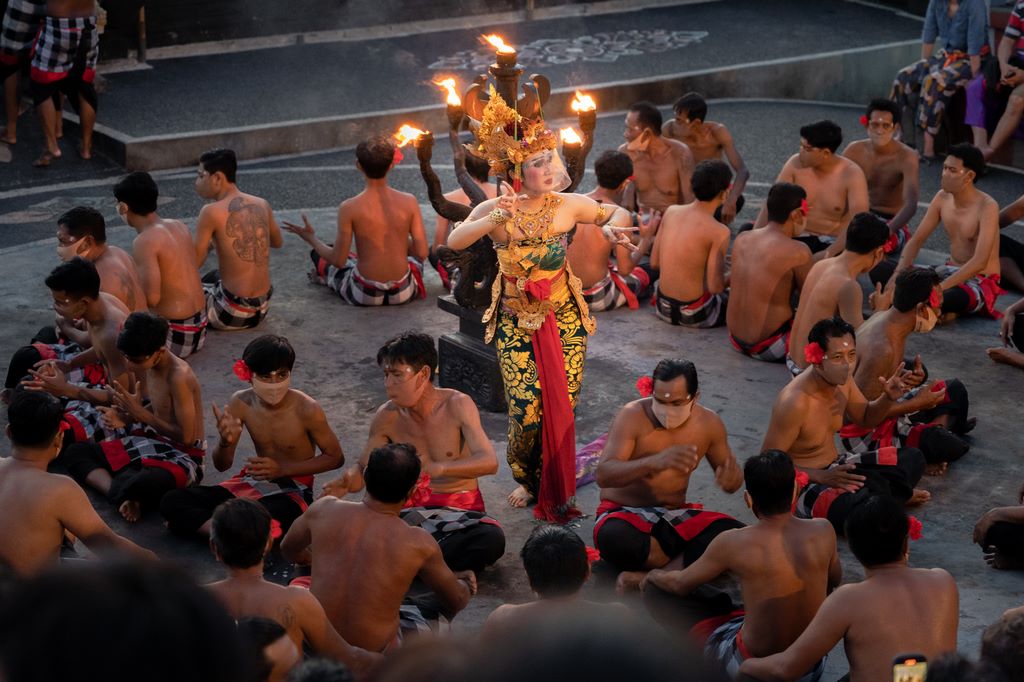
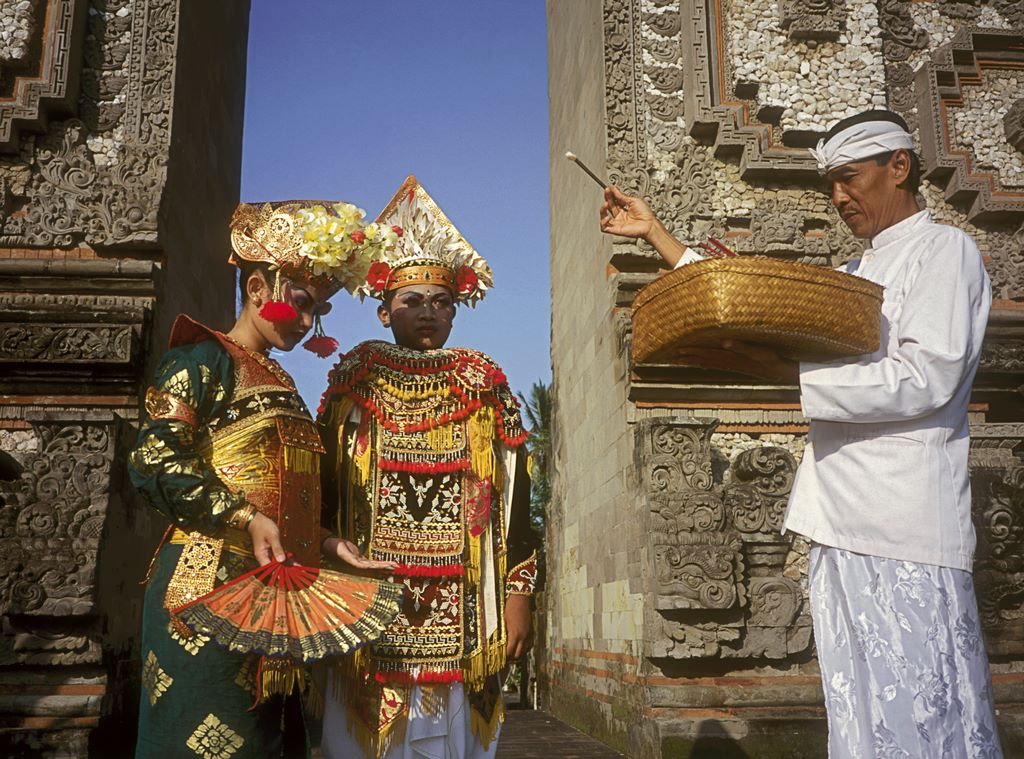
Another more common dance is the Sanghyang Dedari. Dedari comes from Javanese dedara "meaning "celestial nymph" or "female spirit from heaven". It is a ritual of divine possession, intended to purify a community, prevent illness or restore spiritual balance after an epidemic, drought, etc. The Balinese believe that hyang can descend temporarily into the bodies of pure young girls, to bless a place or a people. These young girls are ritually prepared, including a purification bath and daily prayers before the ceremony. The ritual is similar to that of the Sanghiang JaranIt's all about the purification of the space, the offerings and the music.
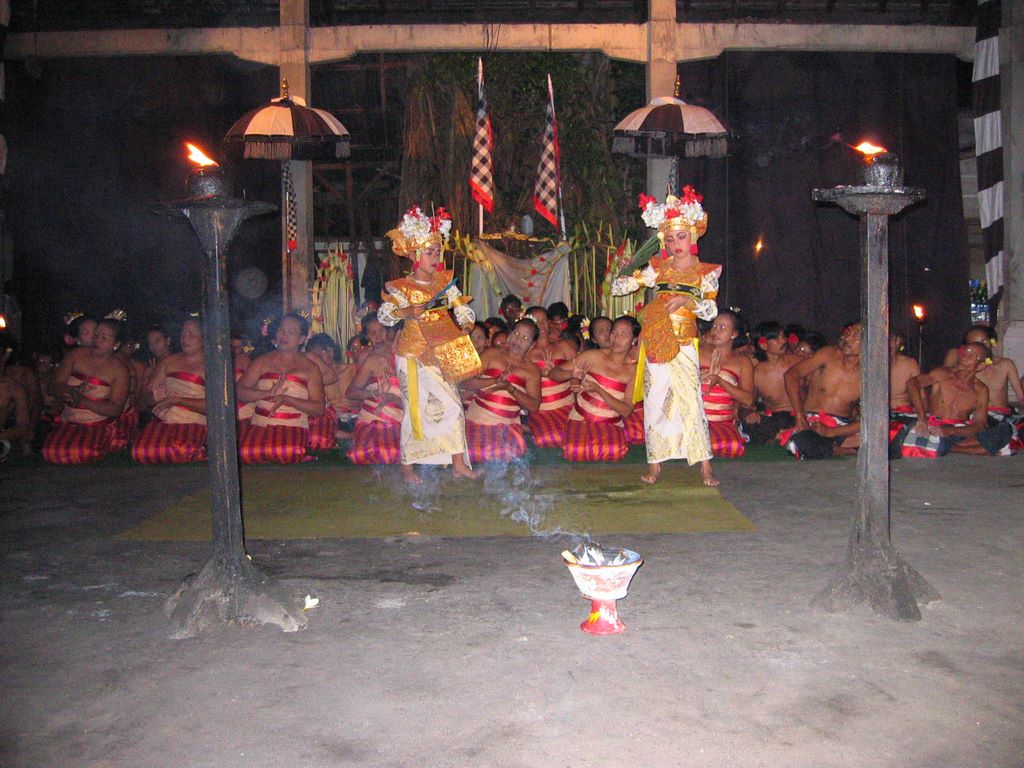
The two girls (sometimes three) stand with their eyes closed. A chorus of women sing repetitive chants. A priest or shaman accompanies the performance and guides the dance with invocations. The dancers enter a state of semi-consciousness after long incantations by the shaman. Their bodies move with ethereal grace, as if carried by higher forces. Passed down from generation to generation, this dance enables the dancer to become the medium through which a protective or healing entity manifests itself. The end of the trance is orchestrated by precise ritual gestures, the sprinkling of holy water and soothing prayers.
The Sanghyang
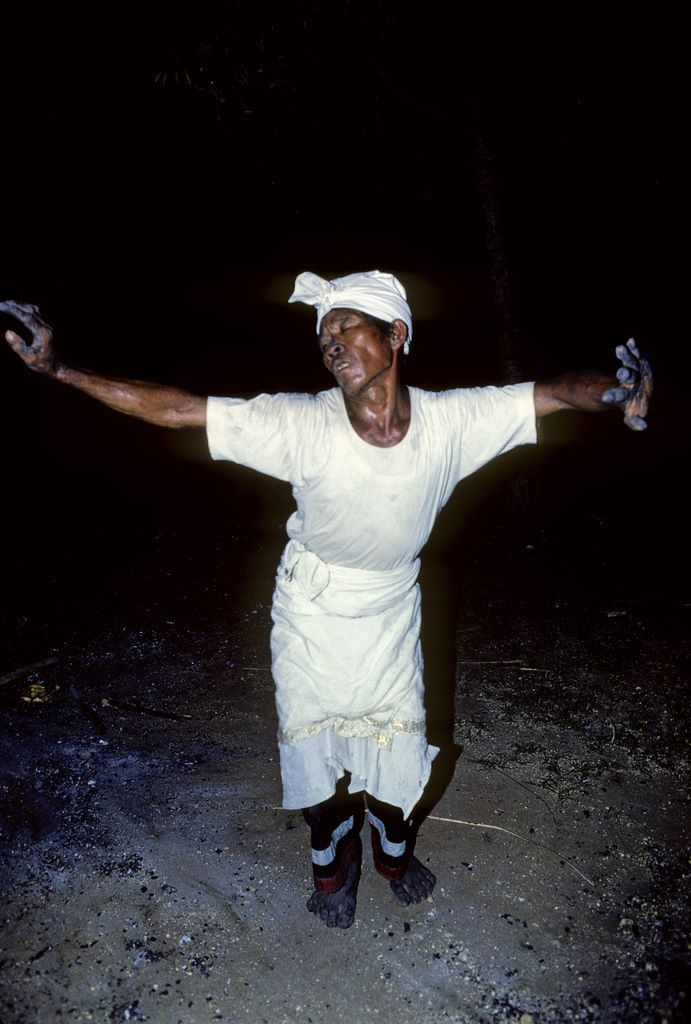
"Sang" is a Balinese honorific prefix, marking respect or sacredness, and "Hyang" is an ancient term (Sanskrit/Balinese) designating a divine entity, a higher spirit or an invisible sacred force. The term refers to danced trance rituals in which performers enter an altered state of consciousness known as kerawuhan (descent, arrival) or nadi (becoming). This particular ritual dates back to well before the arrival of Hinduism on the island (between the 5th and 8th centuries). It is one of the oldest mystical rituals, an animist rite designed to communicate with the protective spirits (the hyang) who watch over people and nature. It is based on the belief that participants become temporarily possessed by these entities who use their bodies as vehicles to bless or cleanse space, expel harmful influences, purify a community or ward off disease.
Shaman in trance. © Sylvain Grandadam.
Kecak or Ketjak: the "monkey dance
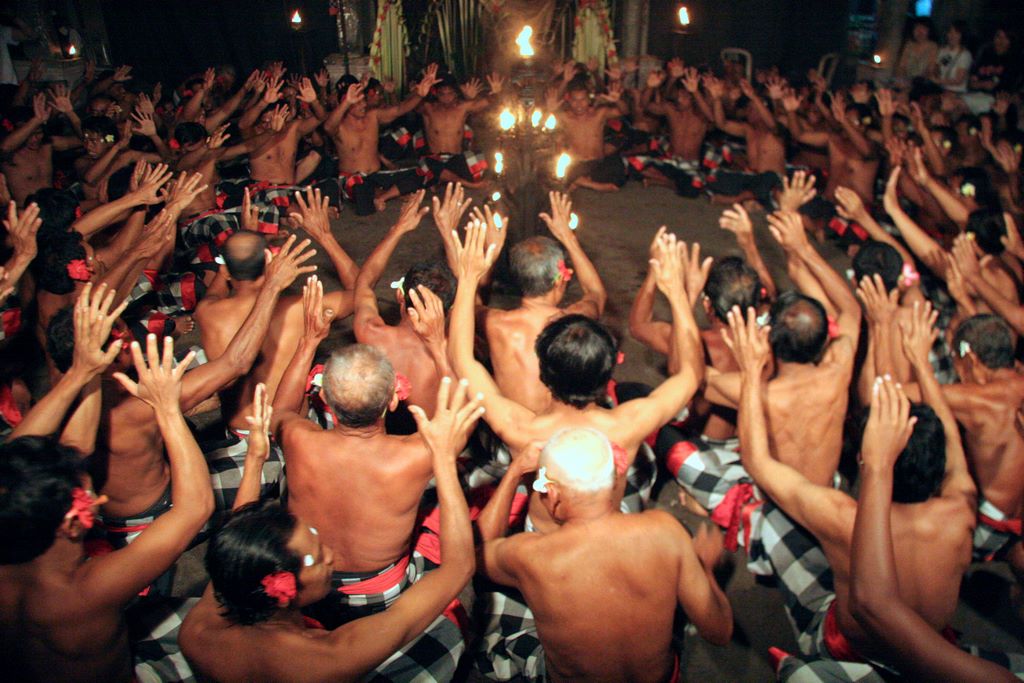
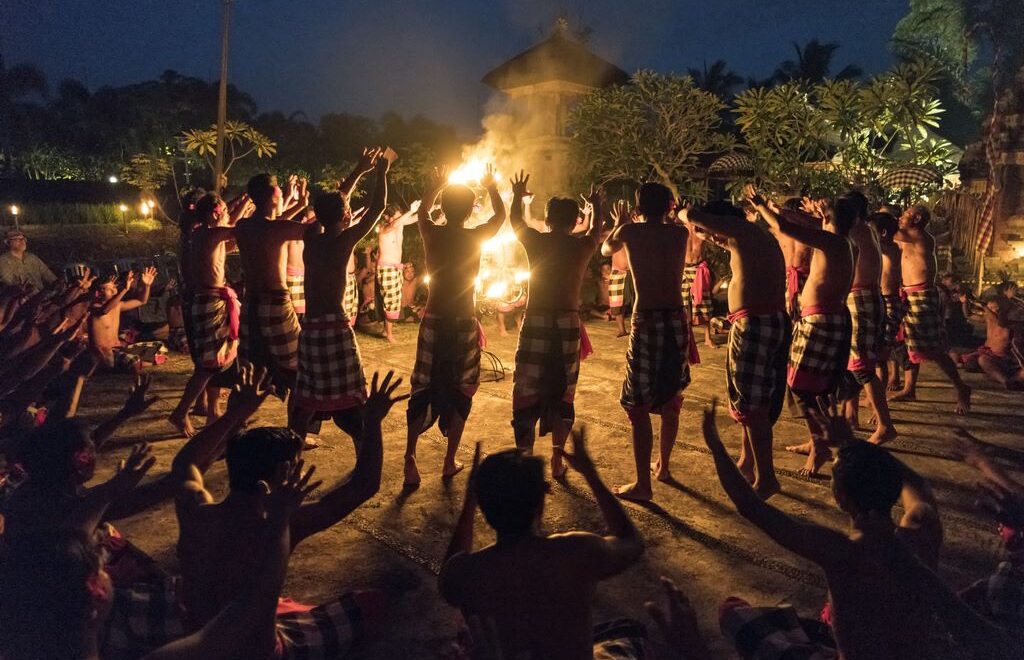
It is a very spectacular dance, often performed in the courtyard of a temple, which can also lead to a trance. Merry Ottin and Alban Bensa (4) describe it as follows in their book "The sacred in Java and Bali Around a torch planted in the ground, a hundred or so men sit in concentric circles, bare-chested and wearing a red flower in their ear, shrugging and dropping their shoulders and shouting in cadence: "Ketjak... Ketjak..." while a narrator recounts the epic Ramayana, shouting. The dancers represent Sugriwo's army of monkeys (5). Their singing soon becomes spellbinding. The men flinch and all raise their arms in the air, so that in the glow of the torch, red flames are waving. Then suddenly they all lie on their backs like the petals of a flower that has bloomed too quickly.
The dancers' voices are very guttural and the Ketjak quickly takes on the dimension of a fantastic sabbath, a sort of macabre and disturbing rite". Although the original purpose of repeating the word Ketjak was to induce trance, or even ecstasy, it is only recently that this ceremony has become a ballet featuring episodes from the Ramayana. The authors conclude: "The Ketjak proves that the boundary between the sacred and the profane is very thin in Bali, and that the emotions of the Balinese turn every event into a religious manifestation.
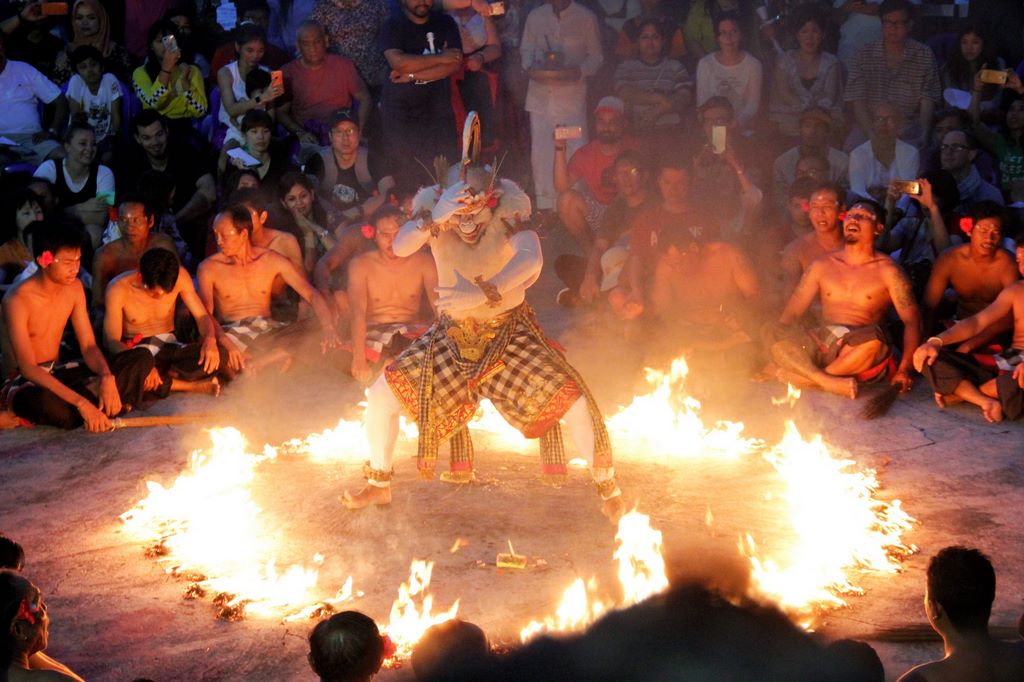
Although this dance is not always a trance, some dancers reach an altered state of consciousness, particularly during scenes of possession. In some Ketjak (often at the end of the show), Hanuman is captured by Ravana and thrown into a ring of fire. He escapes, dances in the flames and triumphs: this scene is an adaptation of the myth of the sacred fire and recalls trance dances like the Sanghyang Jaran. Raymonst/Commons.
1 - The gamelan
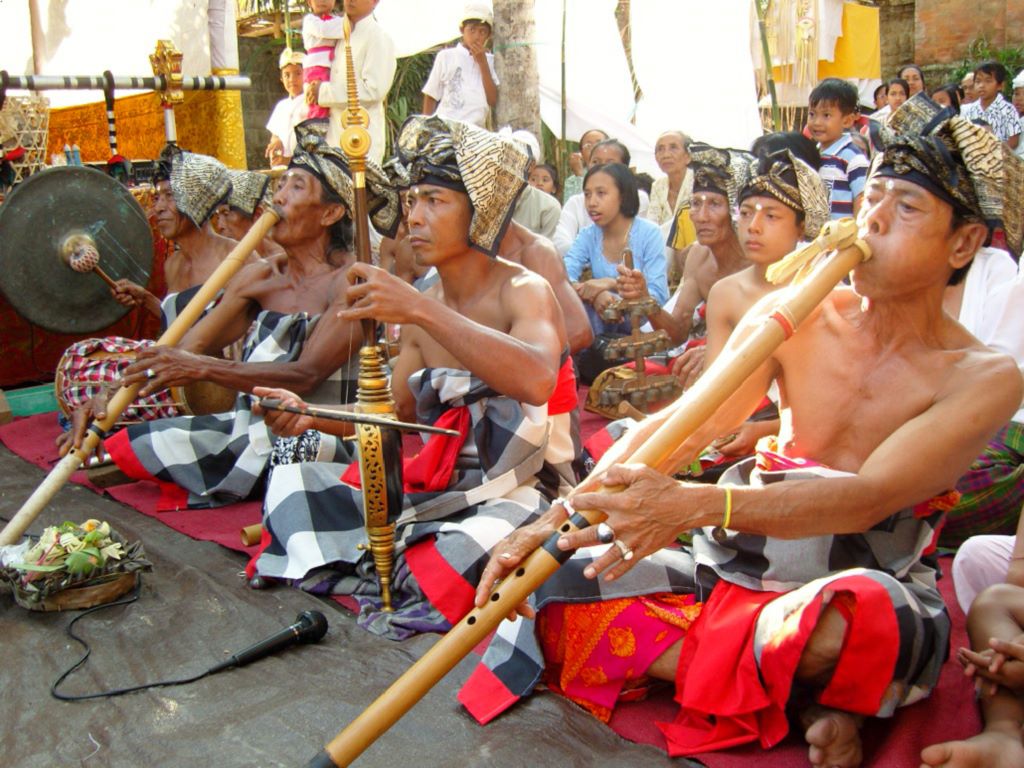
The Gamelan is made up of traditional instruments (gongs, metallophones, flutes, zithers and drums), and plays a key role in inducing trance. It is used to call the spirits, give rhythm to offerings and open up the sacred space during ceremonies. The repetitive rhythms and haunting melodies create an atmosphere conducive to an altered state of consciousness. What's more, the dances are almost always led and guided by either a Pedanda of the Brahmin caste or, more simply, by the " Pemangku He is the guardian of the temple and of the liturgy, closer to popular celebrations than the "priest". Pedanda. © Sri Laksmi.
2 - This ritual can also take place in the courtyard of a temple.
3 - Some tourist shows visually reproduce the Sanghyang, but the real ritual takes place in a community setting, often inaccessible to outsiders without an introduction.
4 - Le sacré à Java et à Bali, chamanisme, sorcellerie et trance, Robert Laffont, 1979.
5 - Sugriwa (Sugriwo in Balinese) is the king of the Vanara monkeys, brother of Subali and ally of Prince Rama. He reigns over the monkey kingdom known as Kishkindha. In Bali, Sugriwo is often mentioned as the original leader of the monkey army, although it is Hanuman who is the most dynamic character in the narrative of the Ramayana epic and in performances. The monkey god, an ally of Prince Rama, helps him fight the demon Ravana to free his wife Sita. In the 1930s, the German painter Walter Spies and the Balinese dancer Wayan Limbak adapted this ritual into a theatrical form inspired by the Ramayana, making it accessible to the public but retaining a strong ritual and choral base.
Text : Sylvain Grandadam and Brigitte Postel
Photo Ouverture : Christopher Michel/Commons
National Tourist Office of Indonesia in France
5 Rue Jean Zay, Paris, France
+33 9 52 90 42 30