On Country: Photography from Australia is a landmark exhibition: it is the first regional showcase of Australian photography at the 56th Rencontres de la photographie d'Arles 2025, bringing together Indigenous and non-Indigenous artists.
Table of Contents
Organised by Photo Australia (a photography biennial based in Melbourne) in collaboration with curators Kimberley Moulton (Assistant Curator in the Aboriginal Art Department at Tate Modern and a member of the Yorta Yorta people), Pippa Milne and Brendan McCleary, the exhibition " On Country "Over 200 photographic works by some twenty Australian artists and collectives, both Indigenous and non-Indigenous, have been brought together here.
First peoples in the spotlight
It explores the concept ofCountry"This is a fundamental term for the First Peoples of Australia, referring to their spiritual, ancestral, cultural and ecological links to the land, water, sea and cosmos. Through their work, the exhibition explores the old and new relationships between Country and colonialism, community and identity in Australia today. Australia's complex history is underpinned by 60,000 years of continuous attachment by First Peoples to the land they never ceded by treaty - peoples comprising more than 250 language groups, or 'countries'. Since then, there have been two centuries of colonisation. The nation is therefore a shared space of collective and individual histories with multiple facets, and although colonialism tried to annihilate the First Nations peoples, notably through racist assimilation policies from 1924 to 1970, their culture has endured and remains alive and strong to this day.
Warakurna Superheroes
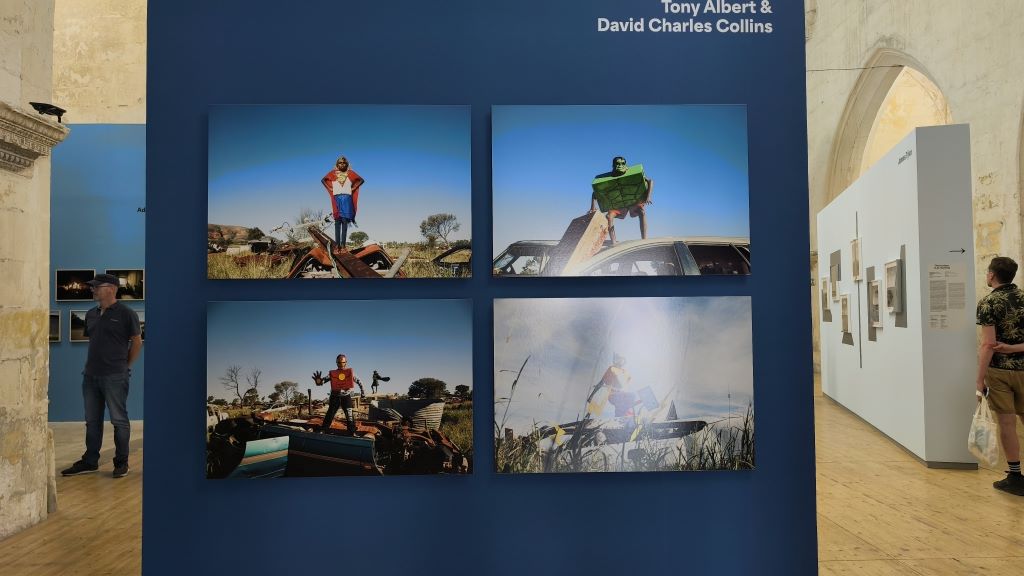
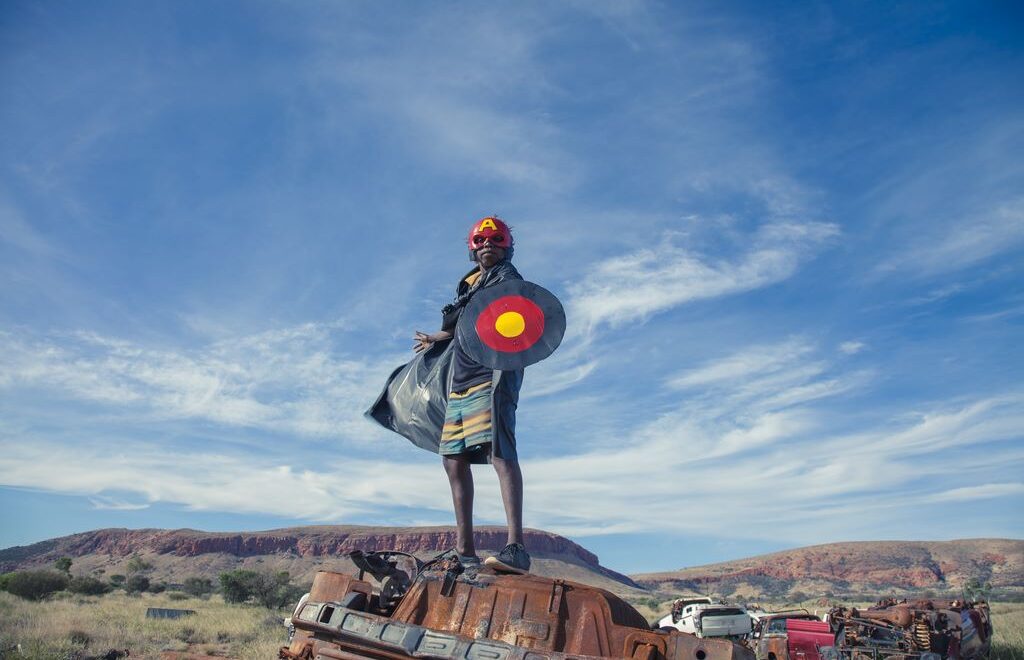
Some of the key works in the exhibition, Warakurna Superheroes (by Tony Albert, from the Girramay, Yidinji and Kuku Yalanji First Peoples, and David Charles Collins, who lives in Gadigal territory), including one that has become the emblematic image of the festival, visible on catalogues and posters: a little boy posing on a rusty car body, in a superhero costume, cape blowing in the wind. By featuring children from one of Australia's largest Aboriginal communities dressed in makeshift costumes from the Marvel franchise, the artists aim to link the power of play, popular culture and the relationship with ancestral times. Their photos invite us to reflect on the figure of the 'superhero' through an Aboriginal vision of the world: superheroes can be the Elders who carry knowledge; ancestral accounts of the creation of the earth; or even the children themselves who embody the heroes of tomorrow.
Majority Rule
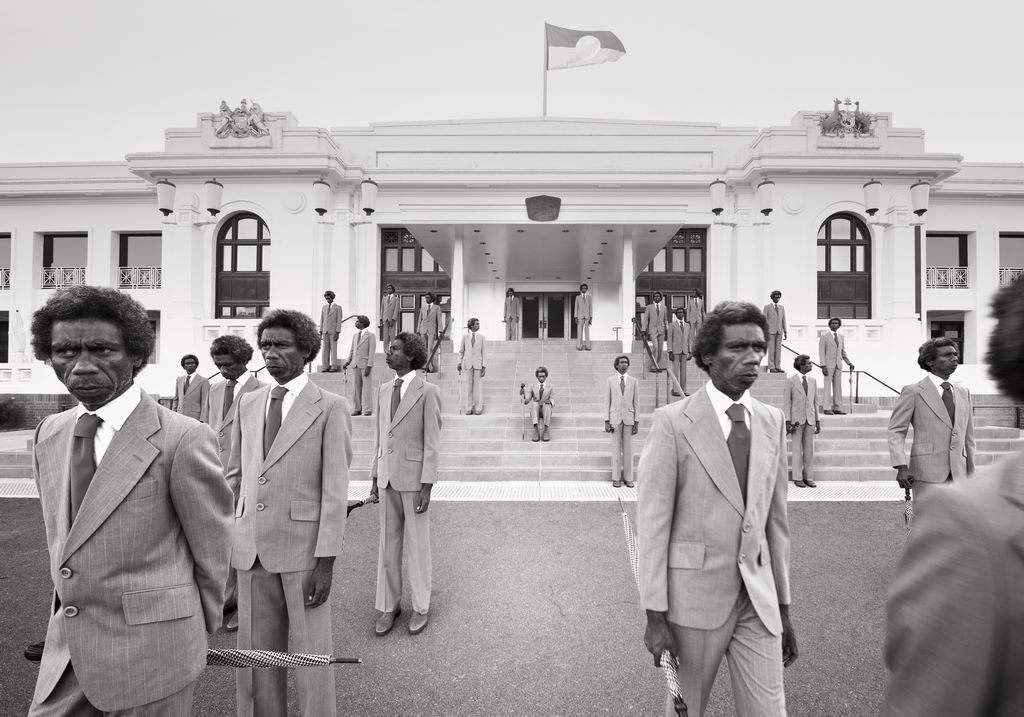
The latest series from photographer Michael Cook (Bidjara, lives in Kabi Kabi territory), Majority Rule (The Law of the Majority), testifies to his foray into new artistic territory. His works use images to ask a direct question. He invites the viewer to consider an Australia where Aborigines are in the majority. What if Aborigines represented 96 % of the Australian population and non-Aborigines represented the remaining 4 %, which corresponds to the current proportion of Australia's indigenous population?
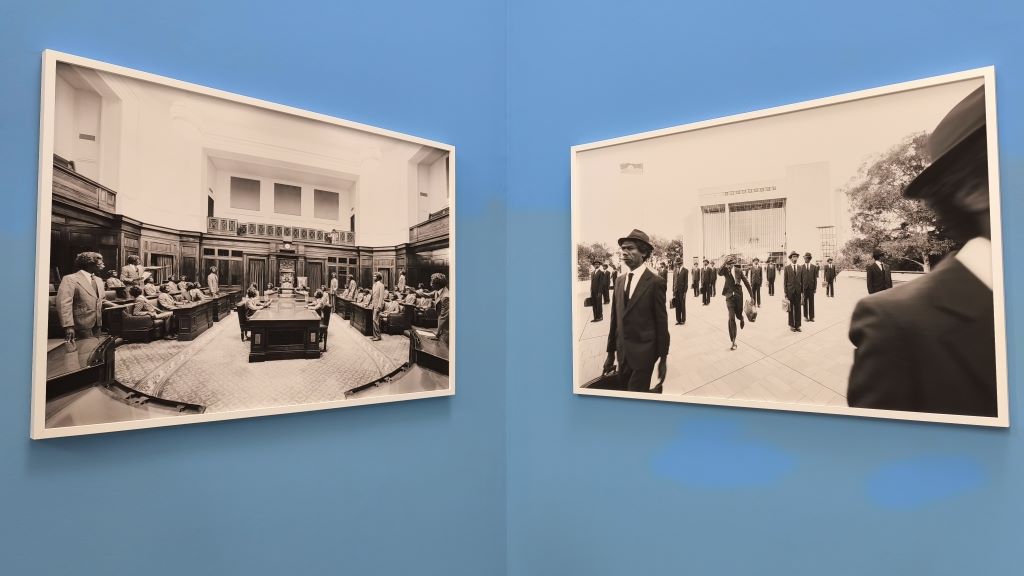
Addressing the discriminatory nature of society, Cook uses the same Aboriginal man, endlessly reproduced in each image, to communicate his message and paint a picture of an inverted societal structure. The multiple versions of the Aboriginal subject populate generic urban locations: a station tunnel, a vintage bus, iconic monuments and various streets. Cook's imagery challenges our deeply held belief systems, without passing judgement: they are observational, asking questions without drawing precise conclusions. Cook's interest in the impact of Australia's history on its early inhabitants is evident in this series of intensely choreographed and intentional images. Produced in 2024, the series can be read in the light of the 2023 referendum, A Voice to Parliament, which would have allowed Aboriginal councillors to be consulted on matters affecting them. The rejection of this proposal shows once again that the "Law of the Majority" continues to shape the Australian nation.
Ritual and Ceremony
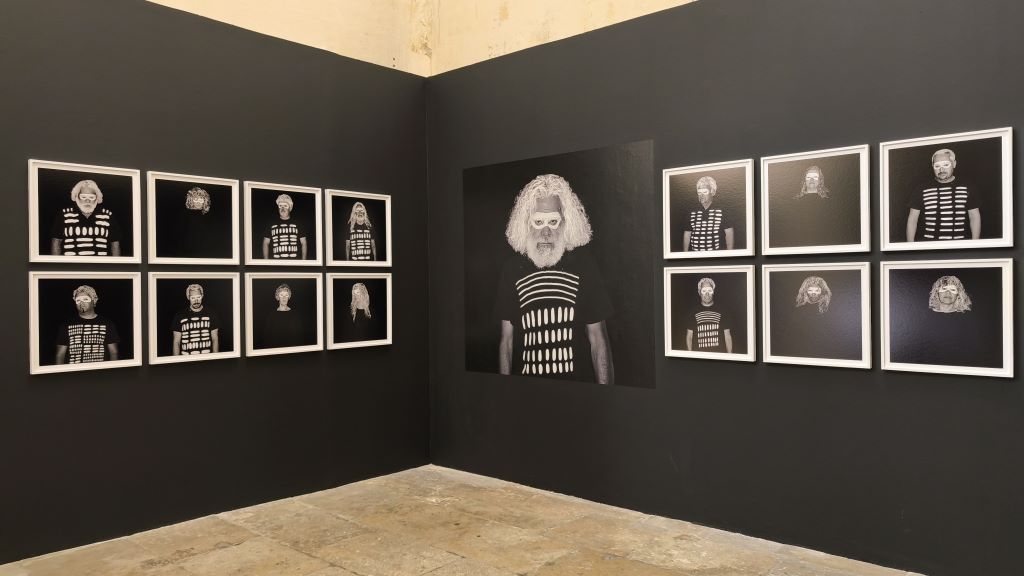
Through a series of black and white portraits, Maree Clarke (born in Swan Hill, in north-west Victoria, and linked to the traditional lands of the Yorta Yorta/Wamba Wamba/Mutti Mutti/Boonwurrung peoples) invites visitors to reflect on the erasure perpetuated by institutions. She uses white ochre painted on the faces and hair of women, as well as on the eyes and T-shirts of men, representing ceremonial body painting and scarification, to pay homage to all that has been lost. The white marks on the eyes of men and women represent traditional mourning practices.
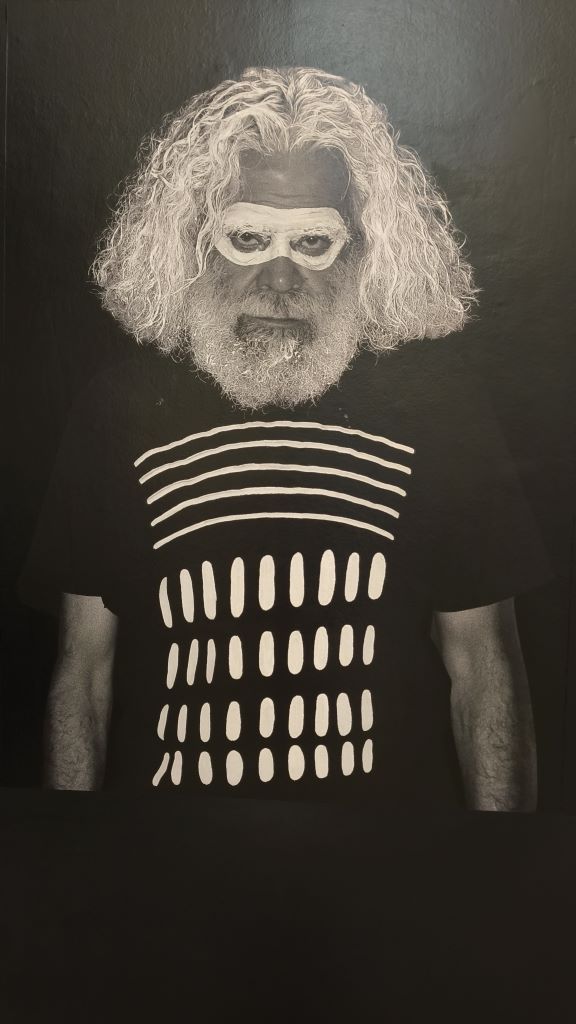
This series includes a portrait of Elder Uncle Jack Charles (1943-2022), a renowned Aboriginal actor, musician, activist and elder from the Bunurong and Wiradjuri peoples. He is one of the " Stolen Generations " He was separated from his mother at the age of 4 months by Australian government policies aimed at assimilating Aboriginal children. He grew up in state care homes, and later in an orphanage (Salvation Army Boys' Home in Box Hill). He did not discover his Aboriginal origins until the age of 17. In 1971, he co-founded the Nindethana TheatreAustralia's first indigenous theatre company, in Melbourne, with the committed actor Bob Maza.
Painted in white ochre, his three-metre-high portrait bears witness to a deep gaze and an ever-faithful memory. Mutti Mutti/Wamba Wamba/Yorta Yorta/Boonwurrung, born 1961. Jack Charles 2012; National Gallery of Victoria, Melbourne Purchased, Victorian Foundation for Living Australian Artists, 2018.
© B. Postel.
Ethnographic portraits " Naabámi (you will see) : Barangaroo (army of me)".
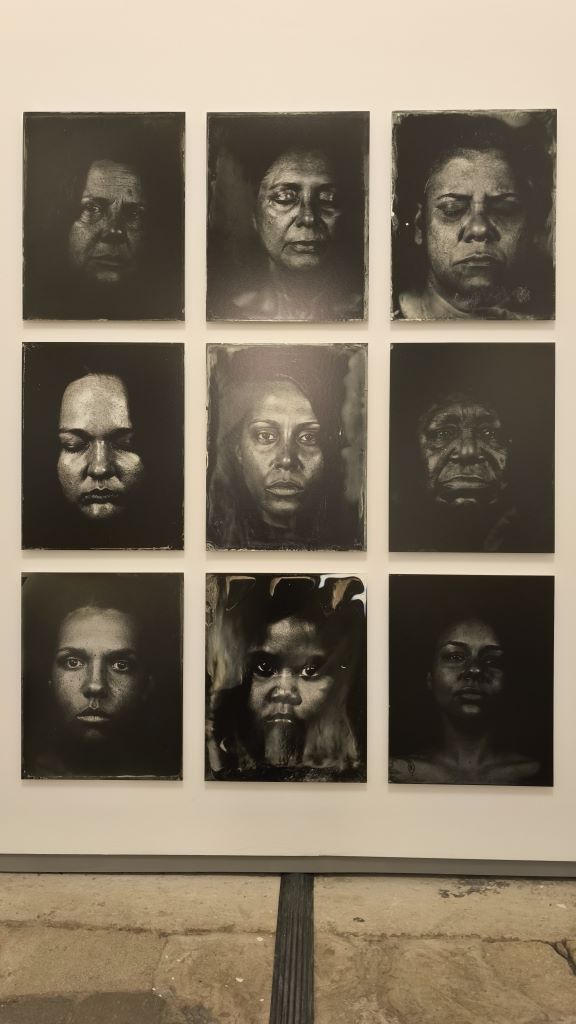
The portrait series by Brenda L Croft (Gurindji/Malngin/Mudburra), 'Naabámi (you will see): Barangaroo (Army of Me)", presents images derived from tintypes - (a type of photograph not uncommon in the nineteenth century) - and then printed on a large scale, of contemporary Australian First Nations women and girls, honouring Barangaroo, the Cammeraygal woman known for her firm stance as an unsubmissive sovereign First Nations woman during the first colonial contact. Croft's portraits interact with the voices of the Djinama Yilaga choir, singing in menero ngarigo and dhurga yuin. The sound fills the nave and we are gripped by the power of this exchange.
Capemba Bumbarra
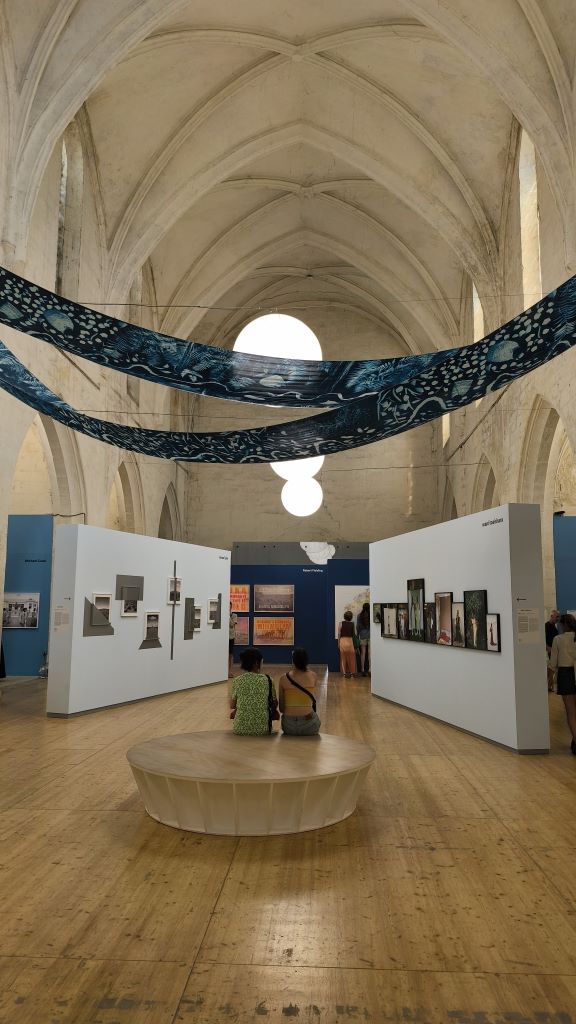
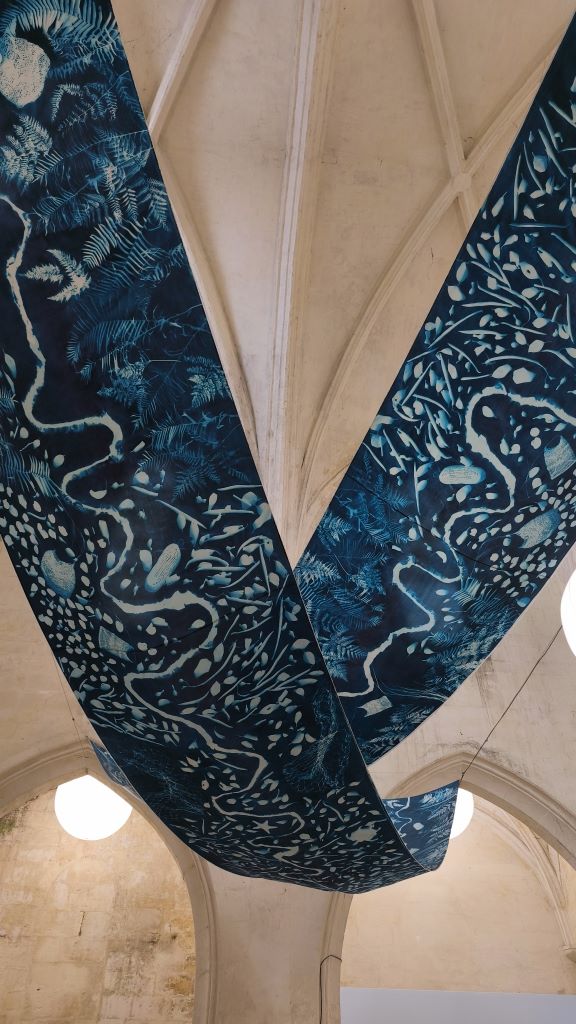
This installation features a monumental 38-metre cyanotype of suspended blue silk, designed by mother-daughter duo Sonja and Elisa Jane Carmichael (Ngugi/Quandamooka). The ribbon incorporates traditional motifs and flows through the church like a floating river, evoking the journey of fresh water from its source, through the bush and mangrove swamps, to the ocean. The spring provided drinking water and food for their ancestors.
Not forgetting the poignant work of James Tylor (Kaurna) on colonial erasure, whose images insist on absence: missing frames, voids that tell the story of colonial erasure. The images of Tace Stevens (visual storyteller of the Noongar/Spinifes peoples) invite us to reflect on the trauma suffered by Aboriginal children torn from their families to assimilate them into white culture. Or those of Barbara McGrady, who highlights the Aboriginal presence in public space.
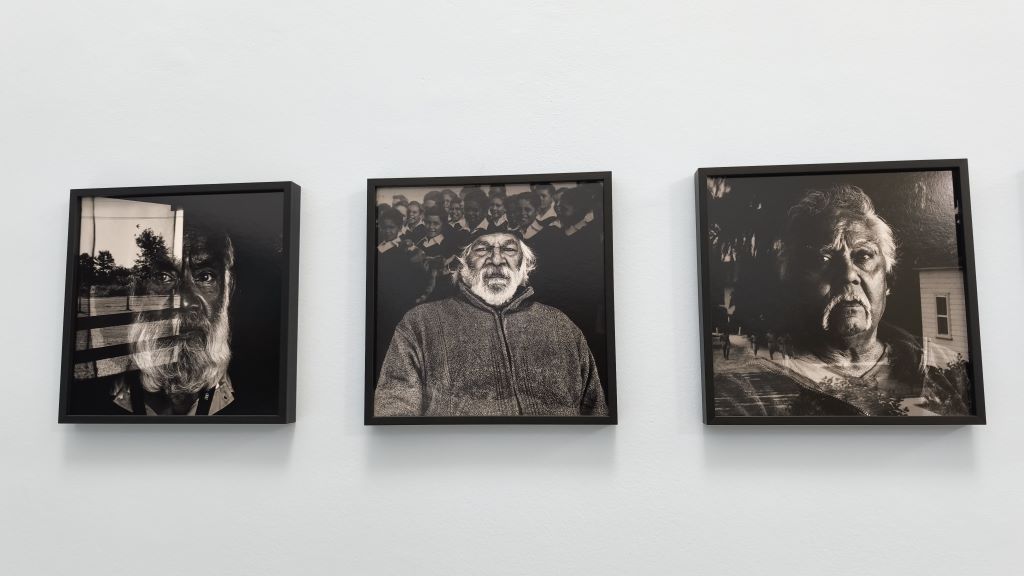
This exhibition is a landmark moment for the visibility of Australian photography on the international stage. It offers an opportunity to reaffirm the Indigenous narrative through art, and a space to explore the spiritual and environmental roots of Australia's First Peoples' relationship to the land.
The exhibition is set up in the heart of Arles, in the church of Sainte-Anne, a desecrated former 17thᵉ century church. It can be seen until 5 October 2025.
Curators: Elias Redstone, Kimberley Moulton (Yorta Yorta), Pippa Milne and Brendan McCleary.
Artists :
Tony Albert (Kuku Yalanji; 1981) and David Charles Collins (1988), Ying Ang (1980), Atong Atem (1994), Sonja Carmichael (Ngugi / Quandamooka; 1958) and Elisa Jane Carmichael (Ngugi / Quandamooka ; 1987), Maree Clarke (Yorta Yorta / Wamba Wamba / Mutti Mutti / Boonwurrung; 1961), Michael Cook (Bidjara; 1968), Brenda L Croft (Gurindji / Malngin / Mudburra ; 1964), J Davies (1994), Liss Fenwick (1989), Adam Ferguson (1978), Robert Fielding (Yankunytjatjara / Arrernte People of the West ; 1969), The Huxleys - Garrett Huxley (Gumbaynggirr / Yorta Yorta; 1973) and Will Huxley (1982), Ricky Maynard (Pakana; 1953), Lisa Sorgini (1980), Tace Stevens (Noongar / Spinifex; 1992), Wani Toaishara (1990) and James Tylor (Kaurna; 1986).
Text : Brigitte Postel
Photo opening : Tony Albert (Kuku Yalanji), David Charles Collins and Kirian Lawson.
Warakurna Superheroes #1, Warakurna Superheroes series, 2017. Courtesy of the artists / Sullivan+Strumpf.