



How did you come across trance?
My first encounter with trance was during an ethnopsychiatry consultation that I ran at the Georges Devereux Centre, a university centre providing psychological assistance to migrant families. In these consultations, we see patients in a group of co-therapists (doctors, psychologists, trainees, interpreters). A member of the team asked us to see a patient of Cameroonian origin from the Douala ethnic group. She was extremely depressed following the death of her father, refused to eat and no longer looked after her infant child. And the antidepressants prescribed for her were having no effect. I put her in a chair in the centre of the group and stood facing her. Then I started talking to her gently, telling her to close her eyes and relax. I suggested a moment of relaxation. All of a sudden, her eyes started to roll back, her lips started to tremble and a deep voice, a big man's voice came out of her mouth. Everyone was frightened. This voice asked me: "Who are you? As I talked to the entity, I realised that it was the voice of his dead father that had come out during this unexpected trance. I could have stopped there, but I answered the voice. I asked him: "But who are you? You're the one who's come to see me, it's up to you to introduce yourself"! And the voice replied: "I'm her father, I've found her a husband but she won't have him". And then I said: "And what kind of father are you to have found her a husband in the world of the dead! Do you think a father wants to see his daughter in the world of the dead? So I told him off, if you like. The patient came out of her state, a little dizzy with headaches, and asking to see me again. She came five times in all. At each session, it was the father who spoke through his mouth, asking that we summon his sons who were in Cameroon. All her children had to be persuaded to come to the consultation. In the end, the whole family came together and the two sons, who were big guys, were scared to death when they heard their father's voice and asked them to settle the inheritance... So I did a kind of notary work based on the trance moments of the Douala woman. After passing on the father's instructions to the family, she came out of her depression completely. I subsequently learnt that among the Douala, it is not uncommon for a family member to go into a trance at the time of burial to express his or her final intentions.
With this first trance experience, I understood that it's the invisible being that's important, not the trance. These invisibles can differ from one ethnic group to another, from one country to another; in this case, it was a dead person. When these invisibles enter the visible world, they act on humans. They are presences. In Arabic, to describe trance, we say hadrawhich literally means "presence".
This patient was permanently inhabited by entities from the world of the dead. As soon as I intervened and made an appointment with the father from session to session, I transformed a permanent, toxic relationship (with a dead person) into a one-off, reversible presence. This is the key to understanding the trance mechanism. It transforms a state of depression into moments of exchange.
Table of Contents
Cases of possession can be very different?
Some cases are psychopathological, but many have a sociological context and social function, such as the status of healer, seer-therapist or member of a brotherhood, each of whom can 'go into a trance' to carry out their work as therapists. Be that as it may, possession always consists of the occupation of a subject's 'interior' by a cultural being. Sometimes it refers to the occupation of a subject by a supernatural being that has a destructive effect. Sometimes it is the subject himself who seeks this occupation, either for therapeutic purposes for himself or others, or for clairvoyance or prophecy. The Gnawa of Morocco, for example, hold festive possession cults in which not only the local population take part, but also sick people who come for treatment. The priestesses and adepts go into a trance and pay homage to small local deities, "genies" who bring them success in acts of healing, but also in business and sometimes in politics. During the ceremonies, the trance involves a ritual in which every gesture, every musical instrument, every song and every dance step is performed according to a codified order. These actions developed during a ritual festival still enable these groups to survive, but they are under increasing threat, both from fundamentalist Muslims and from modern medicine.
In the Arab-Muslim world, the Middle East and the Maghreb, spirits are always present, and above all in language. In Ethiopia, Egypt and Sudan, brotherhoods used to organise rituals for the zars, the many invisible spirits, each with their own name, in which Christians, Muslims and Jews took part. Zar is an Amharic word; in Hebrew the same word means "stranger" and in Arabic "visitor". If we take all three words, we get a correct definition of zar: "A stranger who comes to visit".
In the first half of the twentieth century, my grandmother took part in such festive rituals in Cairo (eating, dancing, serving tea, joking...), often organised to treat people afflicted by a zar. In Egypt, these rituals also seemed to honour the "spirits of the earth", the owners of the land, and so transcended communities and religions. In fact, most of the time, they were called sayed, "the lord". In Morocco, the Gnawa call them mlouk, "the owners".

Does zar still exist in Islamic countries?
Today, in these countries, zar rituals, which are increasingly frowned upon by a rigorous Islam, have become clandestine. But a few decades ago, everyone in Egypt had at least one family member who practised zar. And there were many congregations. The authorities wanted to control them because they had a certain political power. From the time of the Khedives, the authorities tried to control the congregations. At the beginning of the xx century, the Khedive Abbas even created a post, the cheykh macheyikh al-turuq alsufiyyathe "sheikh of sheikhs, master of masters of the ways of Sufism", a sort of "pope" of rites to demons. Despite all their efforts, the rites proliferated. Today's Islam has succeeded in stifling them. But the phenomenon will certainly resurface, because it has existed for thousands of years.
As for traditional therapists, they often have to deal with djinns. However, if a therapist wants to have a foothold in a Muslim country, he will necessarily present himself as Koranic. They too trigger trances of some kind in their patients, but in this case it's more a case of exorcisms designed to expel the demon from the possessed person. This therapy is often ineffective because, in the presence of the therapist, the djinn pretends to leave the patient and returns as soon as the therapist has left. To cure a possessed person, you don't have to chase the djinn away, you have to establish a relationship with it, negotiate with it, and know what the invisible being demands of humans. It is important to remember, however, that you never say the word djinn in Arabic for fear of summoning them. We use euphemisms, words like : musleminMuslims", or é nass, "people" - meaning "people" (who are not people, not human). And everyone understands.
In fact, whatever the ritual, it's always the same mechanism that's at work: it's all about dealing with invisible entities. And with the invisible, you have to take concrete action. To practise specific rituals. This is what traditional therapists, often referred to as "spirit masters", do.
As for me, when I treat patients who seem to me to be possessed by spirits, I speak directly to them, to the non-humans who are tormenting them. As a result, I put patients in a position where it will be easier for them to heal, because at no time do I make them responsible for what happens to them.
Are there cases of spontaneous trance?
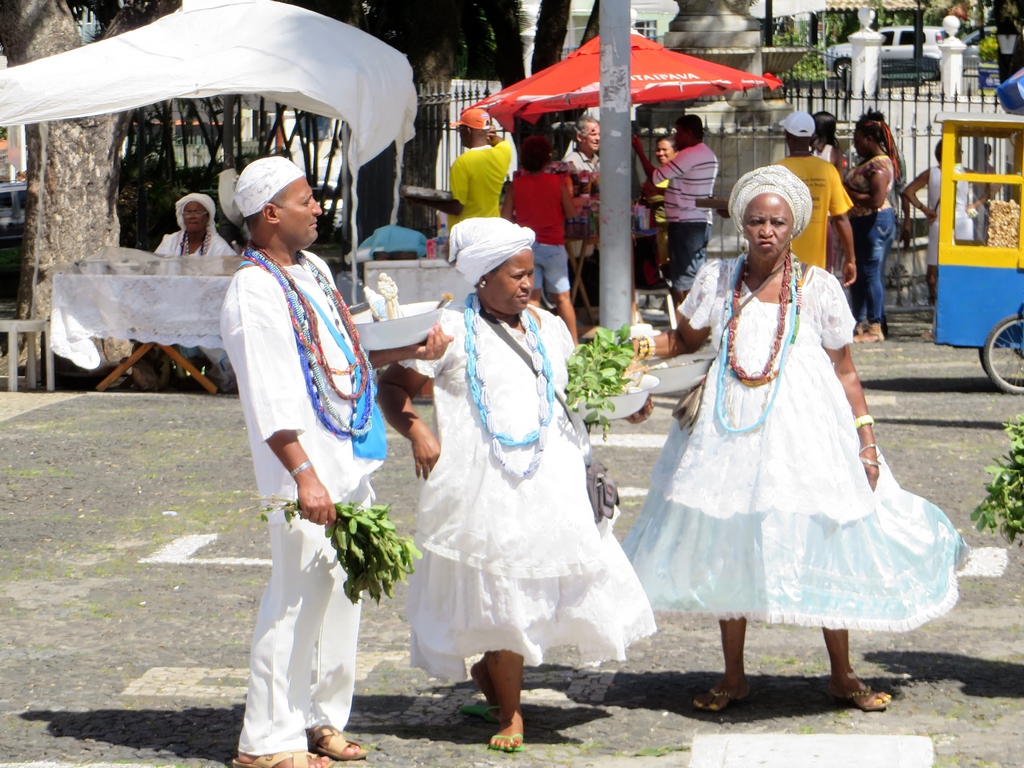
In Candomblé, practised in Brazil and brought by African slaves, mainly from Benin and the Congo, a participant's first trance is often spontaneous. It occurs in the terreiro (place of worship) where the ceremony celebrating one or more orishas (deities) takes place and often appears at the end of the first part of the session. The person is suddenly 'taken' by the deity and falls violently to the ground. They are then taken in charge by women whose role is to look after the possessed and led to a secret room where the initiatory reclusion phase takes place. On the other hand, the trances of the other initiates appear beforehand, in a codified manner, as they are ritually prepared to receive their divinity.
Can a person go into a trance outside a group?
No, it's always a group or family phenomenon. It's never a solitary phenomenon. Trance doesn't appear just anywhere, or at any time. Or even under the sole influence of music, chanting, the drum, the bell... Unless it's a healer who has been trained in this for a long time. For example, in the case of Muslim healers, after negotiating with the djinns of their patients, they sometimes keep them with them and honour them. Later, they may ask them to intervene on their own behalf or on behalf of other patients. Around the hut or house, they have places, small chapels of sorts, where they house their jinn. They are feared and sometimes even pursued by the villagers. To protect themselves and avoid being blamed for the misfortune that befalls the community, they often become Koranic teachers (fkih). But because of the fundamentalists, they can no longer hold their festivals. And if they stop honouring their jinn, they fall ill. Because the bond we form one day with an entity is destined to last a lifetime. And today, many people are sickened by not being able to honour them. In Algeria, this is becoming poignant.
Can trance be seen as a therapeutic device that both heals and restores the patient's place in the community?
It should be remembered that illnesses involving trance are often 'elections'. A patient remains unwell until he hears the entity's call. The most spectacular phenomenon I witnessed was in Brazil. In a supermarket, I met a man, a mestizo from the favellas, with whom I started chatting in a queue. As I was telling him what I did for a living, he told me that he had contracted furunculosis all over his body, which was resistant to antibiotics. The doctors had told him that his illness would progress to septicaemia and that he might die. In desperation, he went to a Candomblé ceremony where he was told by a priestess that Sakpata (or Obaloyé as he is known in Candomblé, the eldest son of the mother of the Orishas) was manifesting himself there. Sakpata is often depicted covered in smallpox pustules. After undergoing the rituals dedicated to this divinity, his boils completely healed, leaving scars that he was happy to show me. Surprising? By linking this person to the culture of his African ancestors, Candomblé had enabled him to be cured.
What is the link between possession and shamanism?
Shamans are also possessed, but unlike possession by 'cultural beings', where it is the unseen who come down to visit humans, the shaman goes 'up' to meet his 'guide'. In a sort of waking dream, he sets off in search of his entity, his spirit. Most of the time this is aided by tobacco, as the shaman will 'ascend' with the smoke, and by many other psychotropic substances.

Freudian psychoanalysis struggled to explain possession phenomena by referring to hysteria, while modern psychiatry refers to processes of dissociation and hallucination. What are your thoughts on this?
Charcot started it all! In the 1890s, he began to secularise the mechanisms of possession. It was he who described the demon-possessed of the Christian tradition as hysterics suffering from psychological problems. In doing so, Charcot clearly wanted to monopolise the market for women's psychological problems - which, incidentally, he succeeded in doing. Freud only continued in the same direction, even specifying that possessed women suffered from sexual problems. I have just one comment to make. Today, hysteria has disappeared from psychiatric textbooks, and trance phenomena are more prevalent than ever.
Interview by Brigitte Postel
This interview appeared in Natives n° 6 https://www.revue-natives.com/editions/natives-n06/
Biography
Tobie Nathan was born in 1948 to Italian-Jewish parents living in Cairo. The family emigrated to Italy in 1957 and then to France in 1958. In 1986, he became professor of clinical and pathological psychology at the University of Paris-VIII, where in 1993 he set up the Centre d'Aide Psychologique aux Familles Migrantes (psychological support centre for migrant families). Georges-Devereux - named after his professor, psychoanalyst and anthropologist, founder of ethnopsychiatry.
He is the author of numerous scientific works and essays, including La Folie des autres (1986), Nous ne sommes pas seuls au monde (2001), Du commerce avec les diables (2004), The New Interpretation of Dreams (2011), Love potion (2013), The souls errantes (2017) and novels including Saraka Bô, (1993), Ethno-novel (2012), The country that looks like you (2015), La société des Belles Personnes (2020).
And, to be published in October 2021 by Editions L'Iconoclaste: Therapist secrets.