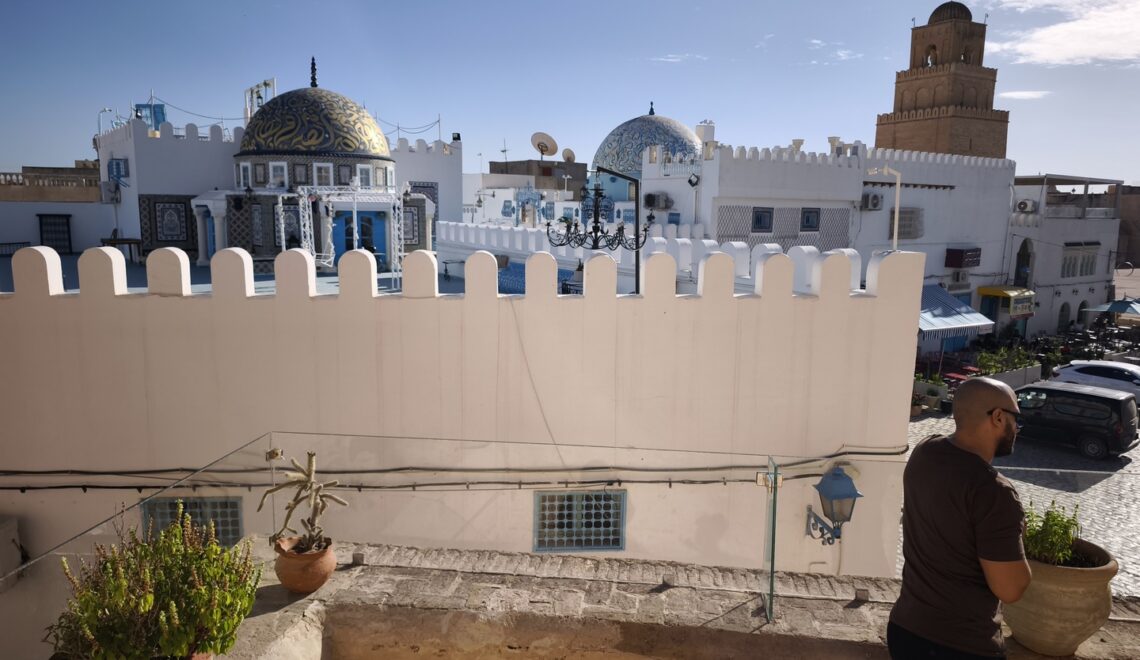
In the heart of Tunisia, far from the bustle of the seaside resorts, Kairouan retains the prestige of a city that profoundly marked the history of the Maghreb. Founded in the seventh century, it was one of the great religious, intellectual and artistic centers of the Muslim world. Its Grand Mosque, its white or gilded domes, its alleys lined with houses with ornate doorways and its weaving workshops tell the story of thirteen centuries of history. Kairouan is also revealed in the atmosphere of its souks, with shops displaying dazzling colored carpets and glazed ceramics, but also from the terraces overlooking the medina. A city where heritage still dialogues with living traditions.
Table of Contents
Kairouan, the first holy city of the Maghreb
Some 160 kilometers south of Tunis and about fifty kilometers from Sousse, Kairouan occupies a unique position in the plains of central Tunisia. Here, there are neither the sea nor spectacular mountains; instead, the landscape consists of agricultural fields and olive groves, where the city appears as an oasis of white and ochre stone. This situation, located inland, is not foreign to its history. It was driven by both strategic and religious concerns.
In 670, according to the chronology adopted, the Arab military leader Oqba Ibn Nafi (622-683), also transcribed Okba Ibn Nefaa, founded Kairouan during the conquest of North Africa. The name of the city would derive from the Persian kārvān, passed in Arabic qayrawān, which designated a camp or a place of military assembly. The location was intended to allow the conquerors to have a permanent base, sufficiently distant from attacks coming from the sea. From this military camp would emerge one of the most influential cities of the Muslim West. Kairouan gradually became a center of the dissemination of Islam to the Maghreb, and then a center of knowledge where the study of the Quran, Muslim law, theology, and sciences developed. Under the Aghlabides, who ruled Ifriqiya From 800 to 909, the city experienced a remarkable architectural and cultural boom.
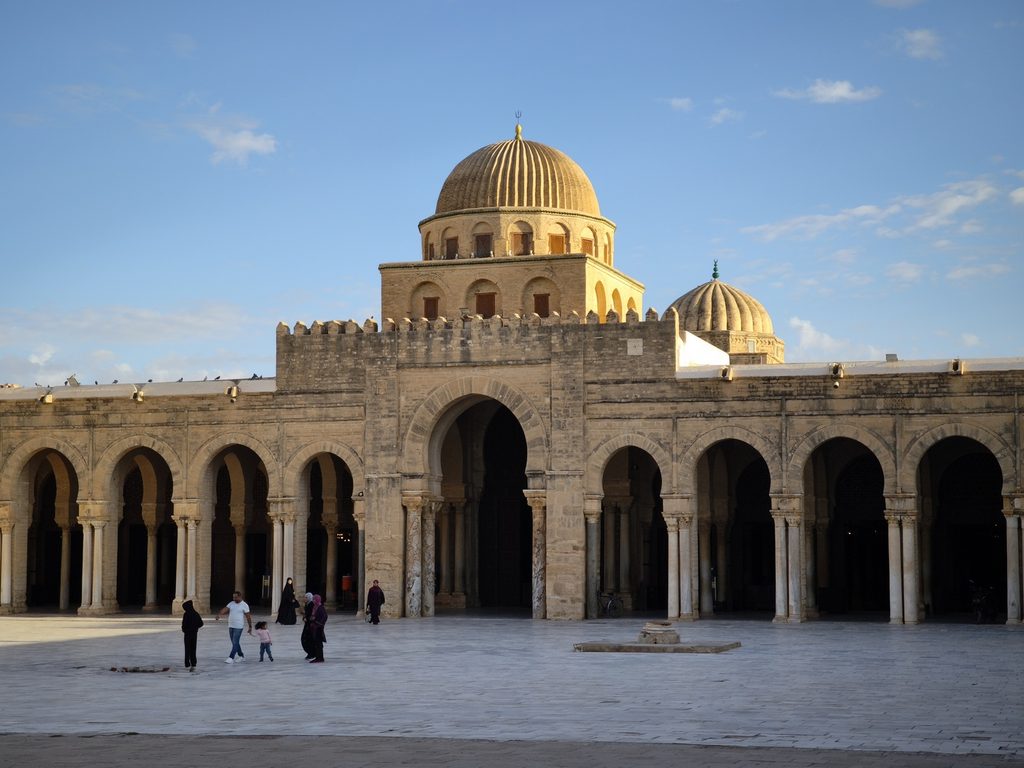
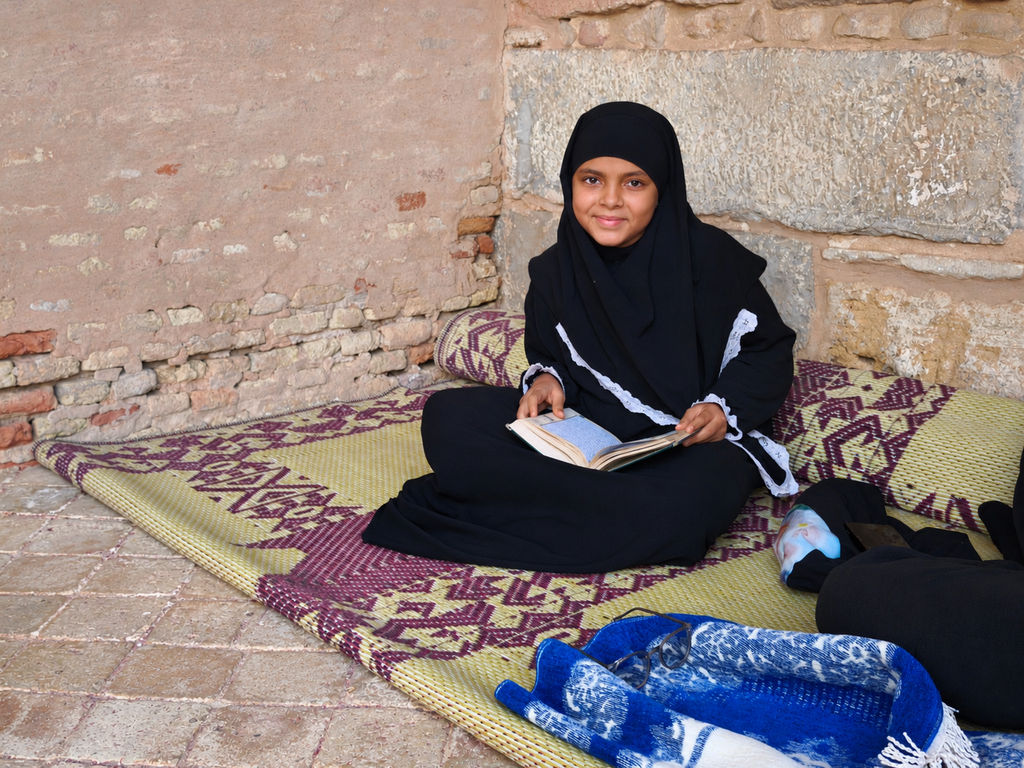
Considered the first great holy city of Islam in the Maghreb, Kairouan still retains considerable religious prestige today. It is particularly associated with tradition. Sunni Maliki, It is one of the main legal schools of Islam. Its historical importance has led to it sometimes being referred to as the fourth holy city of Islam, an honorific and traditional designation that does not correspond to a universally recognized religious classification.
Listed on the UNESCO World Heritage List in 1988, Kairouan has preserved an exceptional architectural ensemble. Behind its walls, the mosques, the zaouïas, The old houses and souks bear witness to a history of which the Great Mosque is the most emblematic monument.
The Great Mosque of Okba Ibn Nefaa, a masterpiece of Islamic architecture
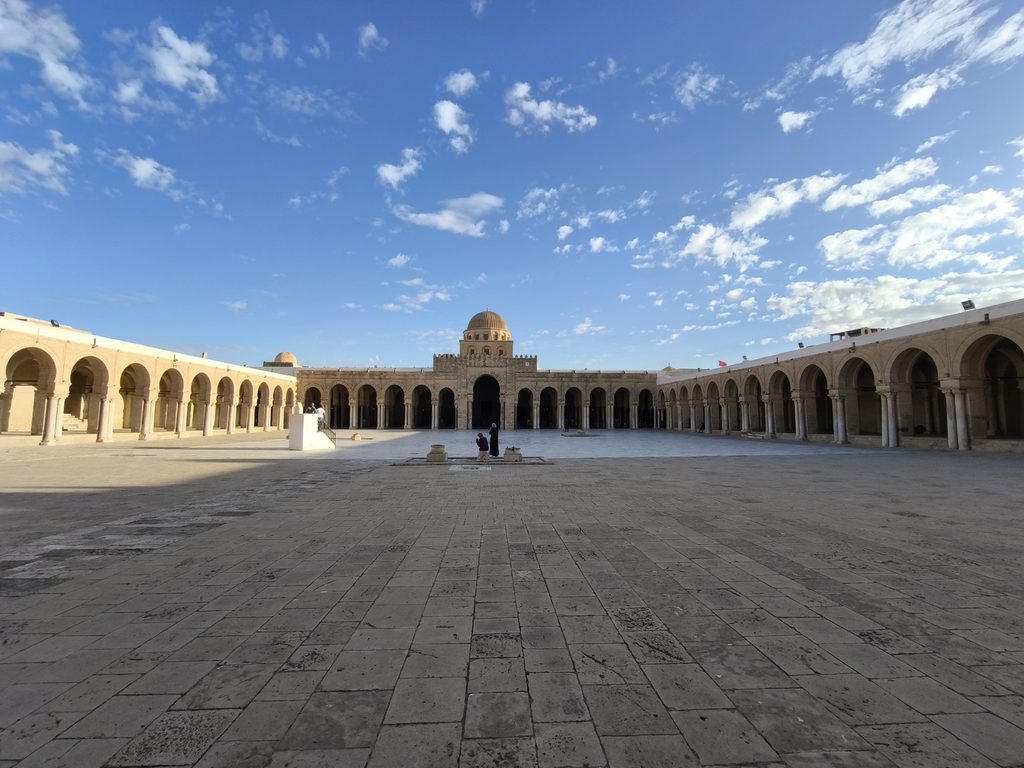
It is impossible to talk about Kairouan without mentioning its Grand Mosque, also known as the Mosque of Okba Ibn Nefaa, named after its founder. Originally built around 670, at the time the city was founded, it is considered one of the oldest Muslim sanctuaries in the Maghreb. However, the current building is no longer that of the seventh century. Enlarged several times, partially destroyed and rebuilt, the mosque owes much of its architecture to the large-scale renovation undertaken in 836 by the Aghlabid emir. Ziyadat Allah I, Then to the embellishments made during the 9th century.
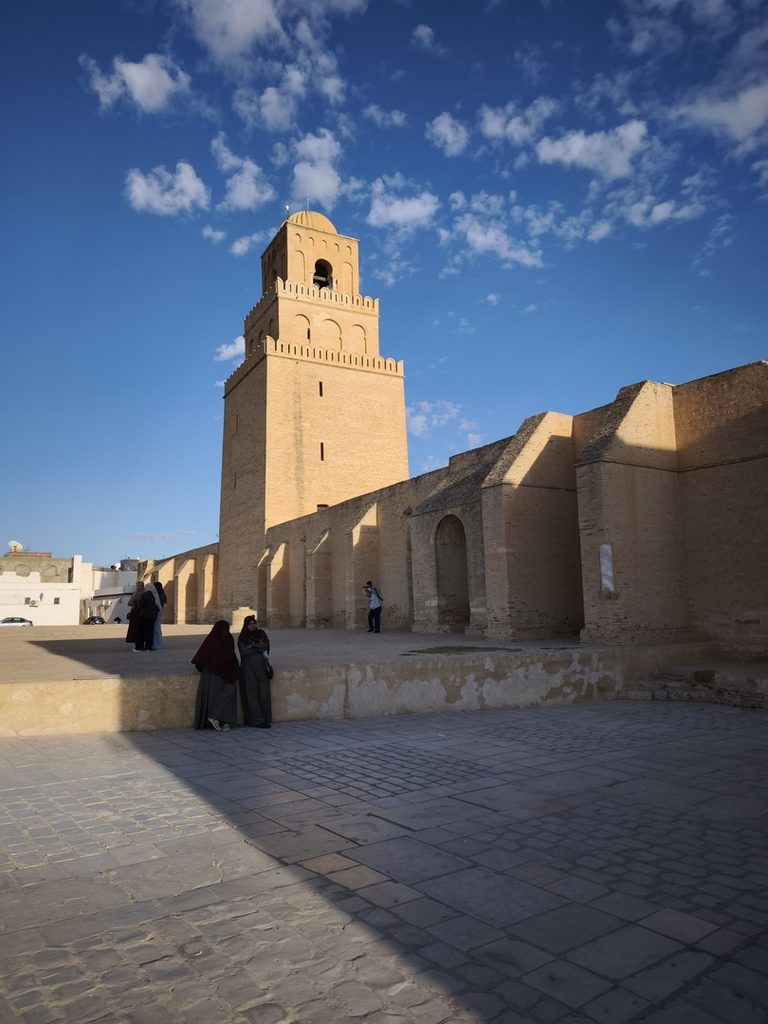
From the outside, it almost evokes a fortress. Its powerful stone walls, reinforced with buttresses, form a monumental enclosure with austere lines. The absence of large openings, the massive volumes, and the cupolas that rise above the roofs give it a particular majesty.
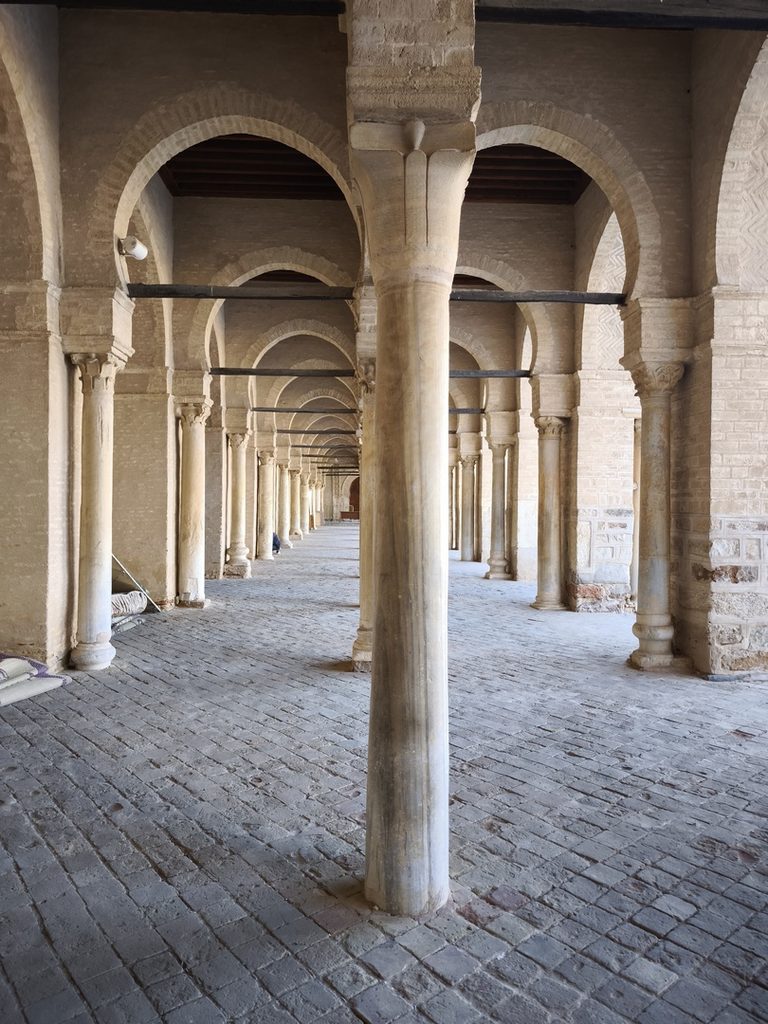
The galleries are supported by columns of marble, granite and porphyry, most of which come from ancient Roman and Byzantine monuments. Corinthian capitals, barrels of different colors and sizes: these decorations, common in the early centuries of Islamic architecture, testify to the builders’ ability to integrate the architectural heritage of Antiquity into a new language.
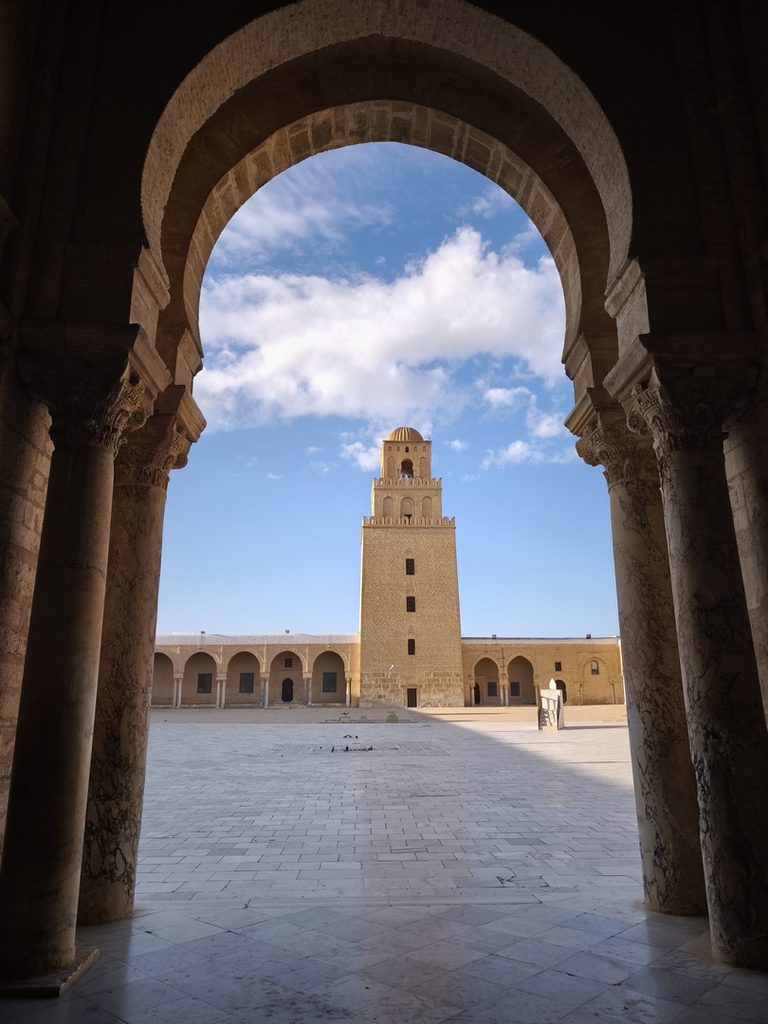
At the northern end of the courtyard stands the minaret, one of the most recognizable silhouettes of Kairouan. At a height of about thirty meters, it consists of three superimposed square levels, of decreasing dimensions, crowned by a small dome. Its robust, almost military architecture contrasts with the slender minarets found elsewhere in the Muslim world. The different phases of its construction date back to the eighth and ninth centuries, and its shape exerted a considerable influence on the religious architecture of the Maghreb.
© B. Postel.
A forest of columns and carpets
But it is undoubtedly the prayer hall that holds the most beautiful surprise. Behind the large doors opening onto the courtyard there is an area of remarkable depth, where the columns seem to multiply infinitely. Seventeen aisles, separated by rows of arcades in a completely outmoded horseshoe design (made of horse-drawn iron), form a skillfully arranged perspective. The central aisle, which is wider, leads the eye towards the mihrab, at the back of the room.
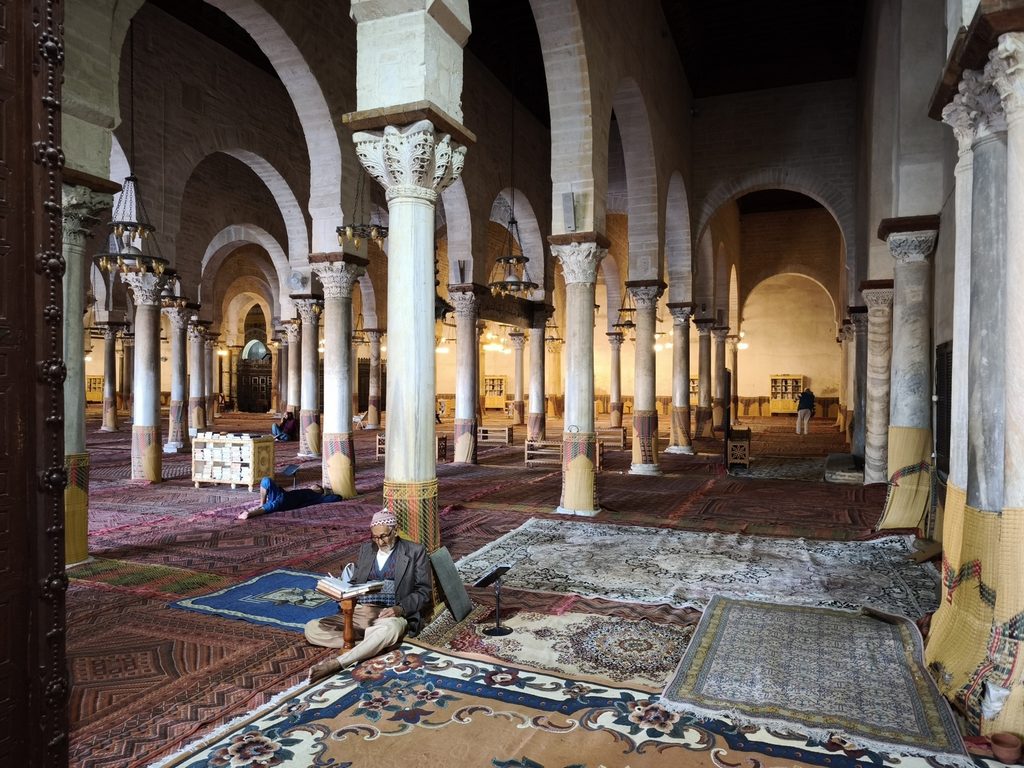
The light penetrates with moderation into this immense sanctuary. It glides over the chapiters, emphasizes the curves of the arches, and is lost in the darkness of the columns. The columns, all different, form a veritable mineral forest. Some are made of white marble, others have pink, gray, or greenish nuances. The materials, taken from ancient buildings, reflect the long history of this region, successively marked by the Punic, Roman, Byzantine, and Arab-Muslim civilizations.
The floor, for its part, disappears beneath the carpets. Placed side by side to accommodate the faithful, they form a textile surface that contrasts with the stone of the columns and the wooden ceilings. Their presence also corresponds to a practical necessity: insulating the faithful from the cold of the stone slabs on which they kneel and prostrate themselves during prayer. Their presence recalls a tradition deeply rooted in Tunisian mosques: that of the carpets offered by the faithful, who thus participate in the design and maintenance of the place of worship.
This space must be imagined during the great Friday prayer, when the faithful gather, aligned in rows, all facing the same direction. The architecture here meets the requirements of worship: the aisles allow for the organization of the assembly, while the mihrab Indicates the direction of Mecca, towards which Muslims turn to pray.
The wooden ceilings are another treasure of the mosque. Carved or painted in different eras, they retain decorative elements that testify to the evolution of woodcraft in Ifriqiya. Their observation reveals a repertoire of vegetal and geometric motifs of great finesse, sometimes difficult to perceive from the ground.
The mihrab, a jewel of marble and ceramics
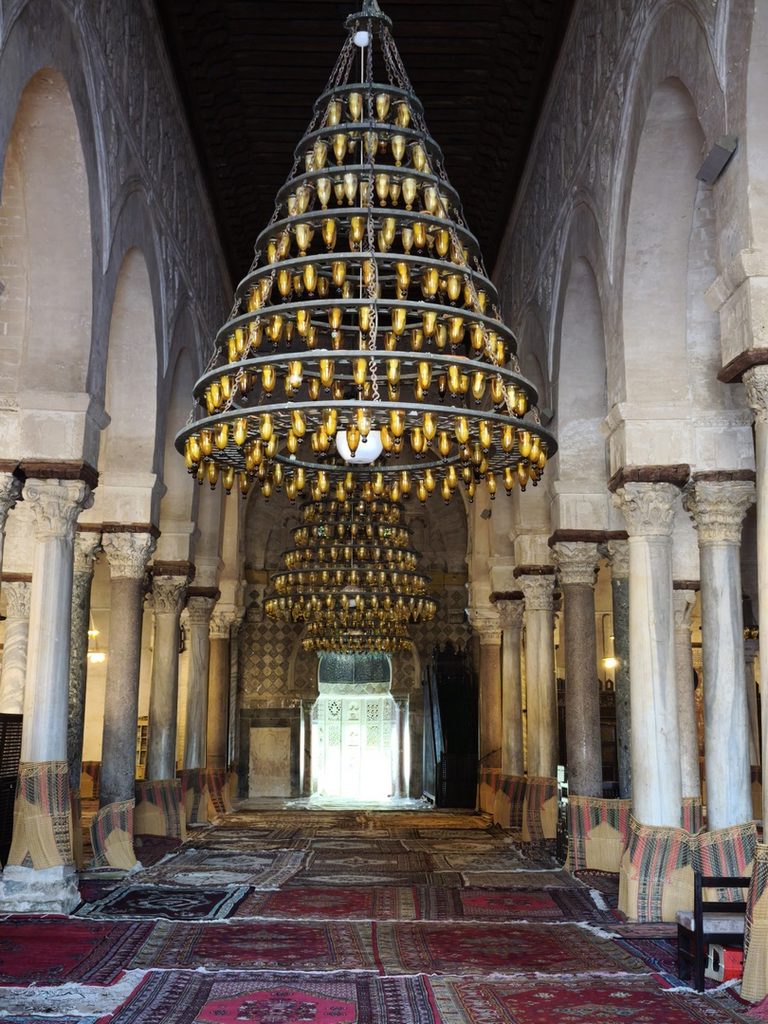
At the bottom of the central nave is one of the treasures of the Great Mosque: its mihrab. This niche is built into the wall of the qibla is a masterpiece of 9th-century Islamic art.
The current mihrab, dating from 862, features particularly refined decoration. Its niche is covered with carved and arched marble panels, displaying vegetal and geometric motifs. Above, a painted wooden half-dome completes the composition. But it is especially the ceramic tiles that attract attention. Arranged around the niche, they feature golden, brown and copper tones, obtained through a particularly elaborate glazing technique.
© B. Postel.
Generally considered to be of Mesopotamian origin, probably from present-day Iraq, these tiles bear witness to the artistic and commercial exchanges that linked Kairouan to the major centers of the world at the time. Abbasid. Their presence in a mosque in North Africa illustrates the extent of these networks, which enabled the circulation of artisans, materials, and techniques.
The mihrab It also holds an essential place in the history of the sanctuary. Although its decoration dates back to the 9th century, its orientation perpetuates the orientation set during the foundation of the first mosque in the 7th century. Subsequent reconstructions have thus respected an arrangement inherited from the original sanctuary.
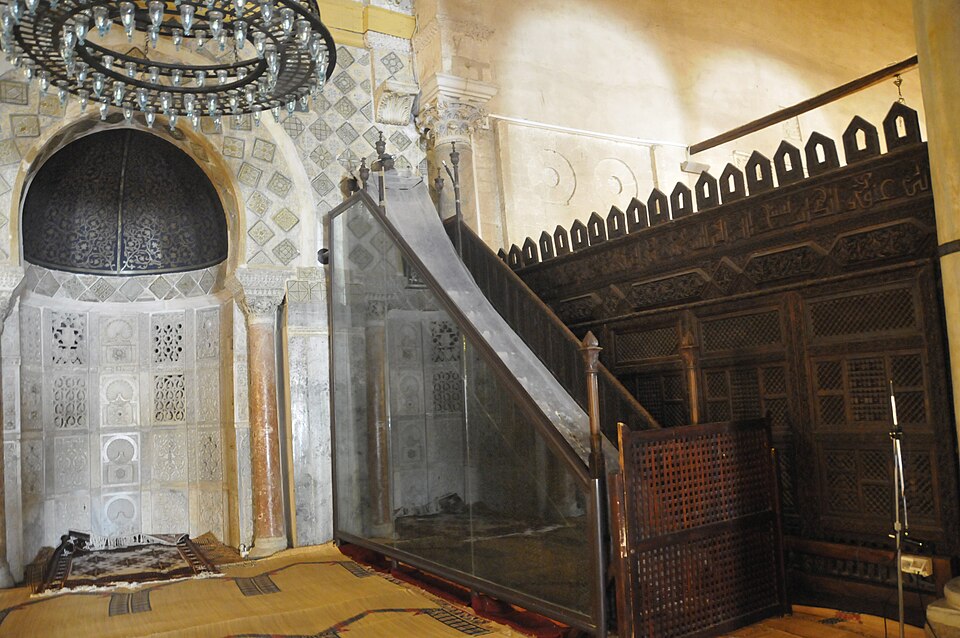
Nearby is the minbar, The pulpit used for the Friday sermon. Made in the 9th century in a teak wood imported from Asia, it is considered the oldest. minbar Wood preserved in the Muslim world. Its hundreds of carved panels, adorned with interlacing patterns, foliage, and geometric compositions, constitute an exceptional testimony to medieval woodworking.
In this room where ancient marbles, Mesopotamian ceramics, wood from the East and local traditional carpets meet, the Great Mosque of Kairouan appears as a synthesis of several artistic heritages. A monument that tells, better than any other, the extent of cultural exchanges in the medieval Mediterranean. However, it should be noted that the prayer room is forbidden to non-Muslims.
In the medina, the charm of the alleys and terraces
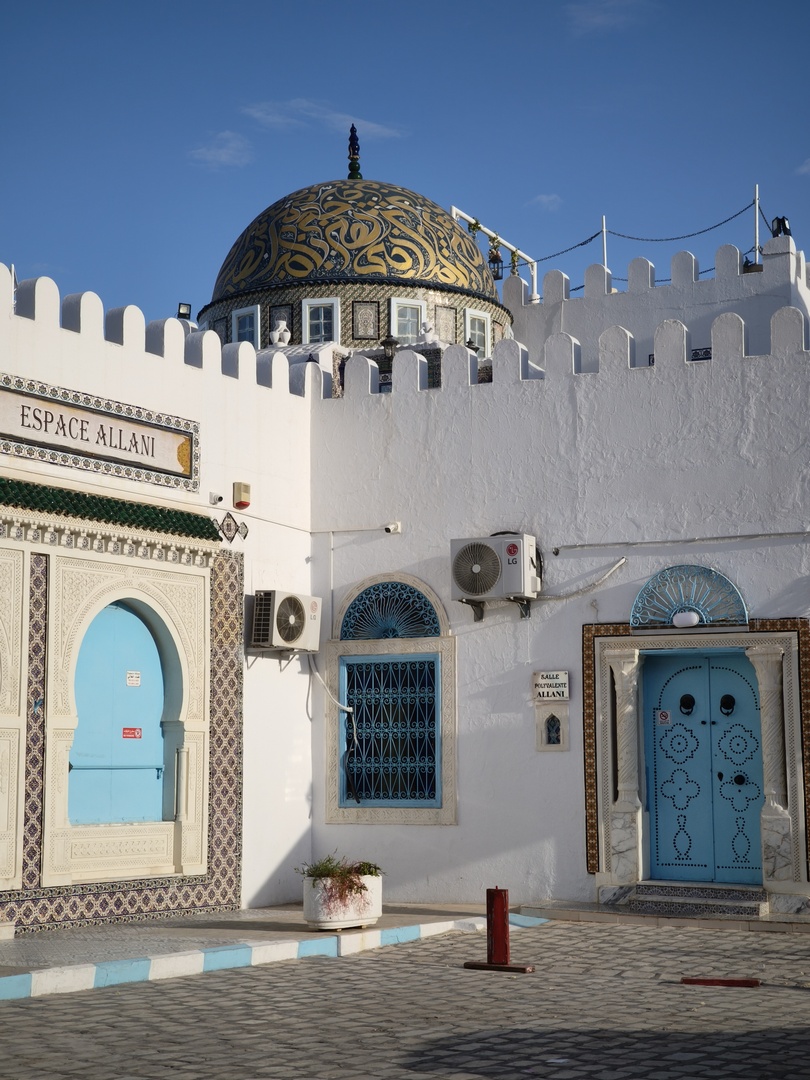
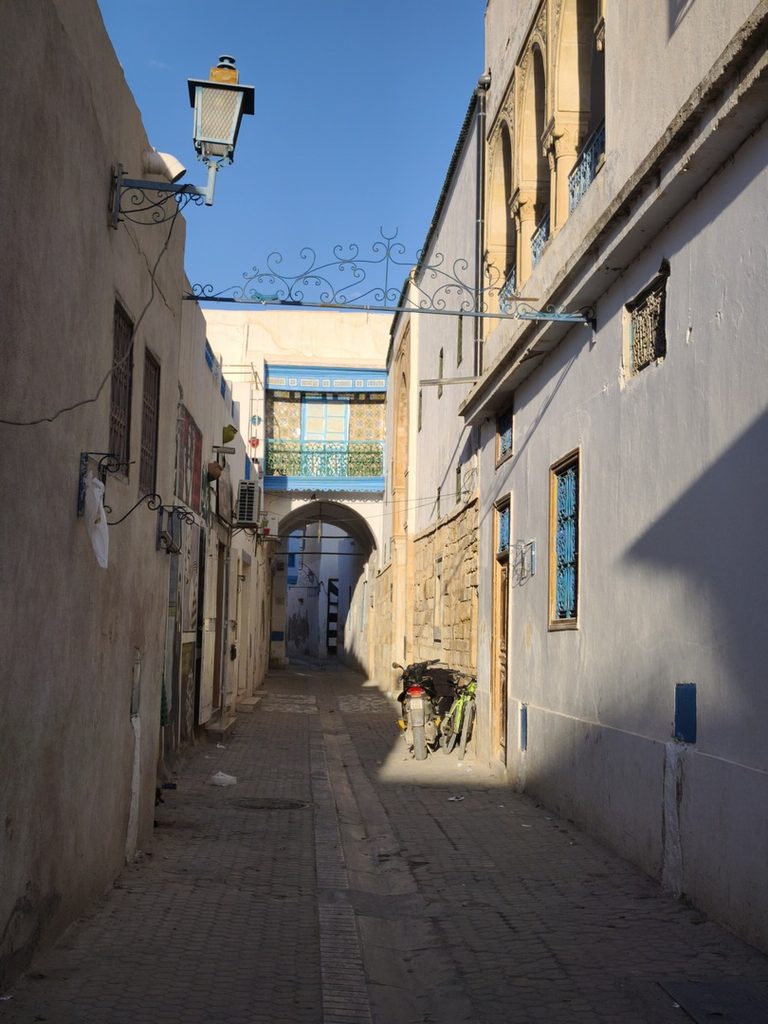
After the solemnity of the Grand Mosque, the medina reveals a more intimate and lively Kairouan. Hiding behind its walls that stretch over more than three kilometers, narrow alleys, vaulted passages, and small squares follow one after another among the houses with whitewashed limestone facades.
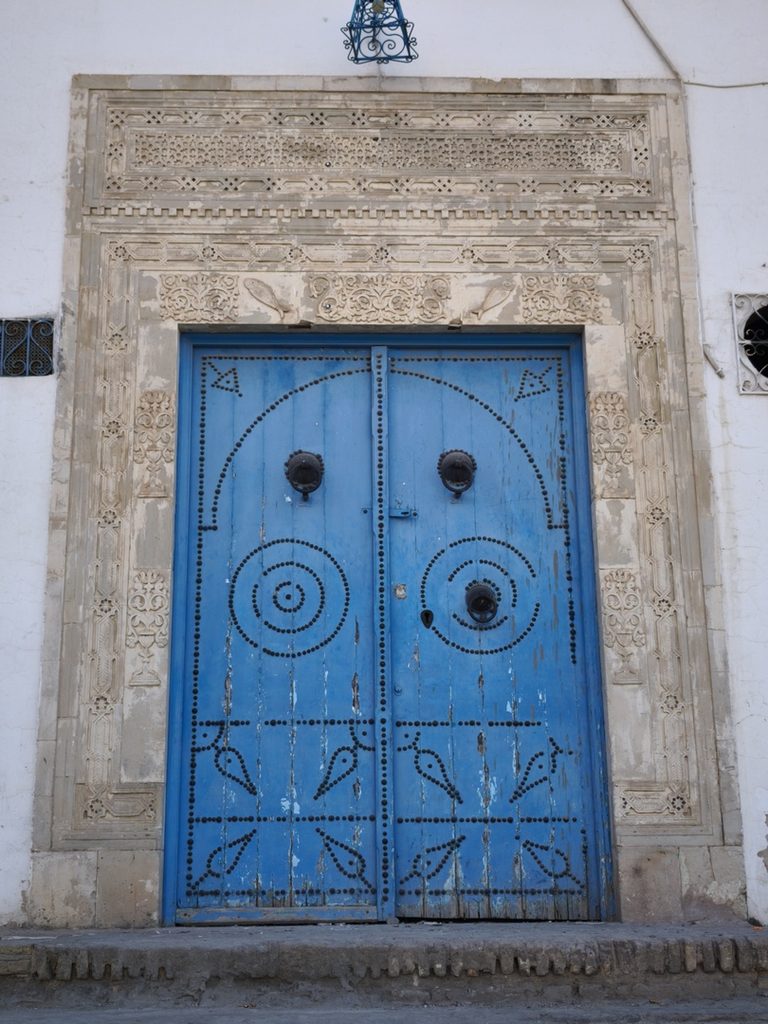
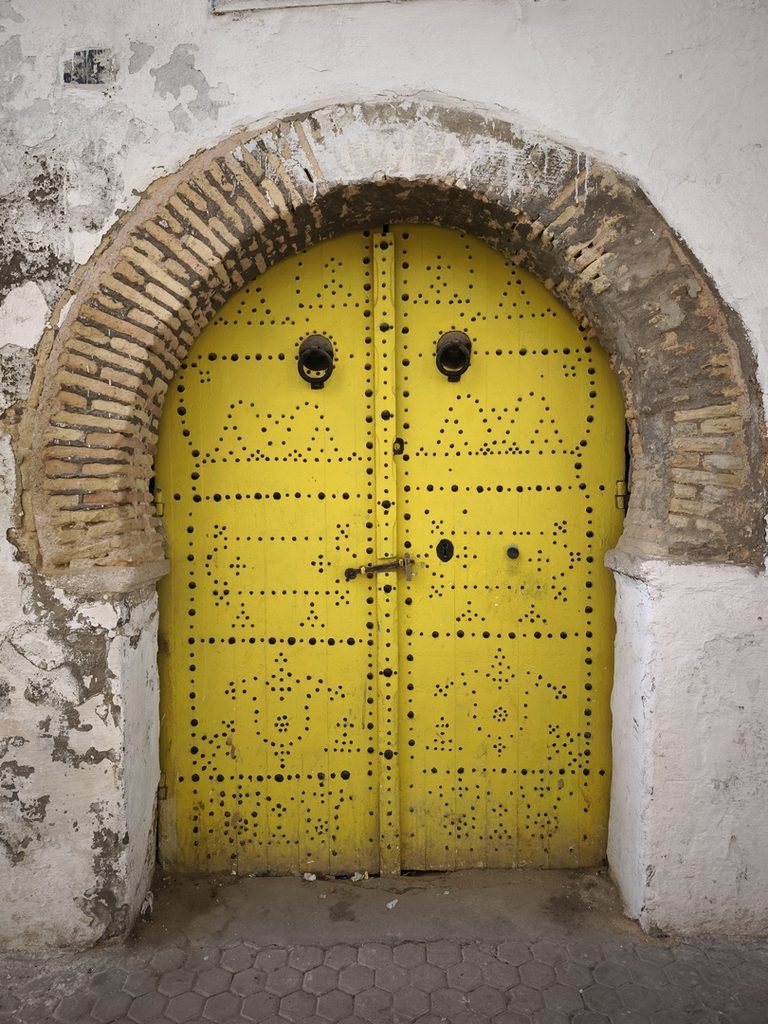
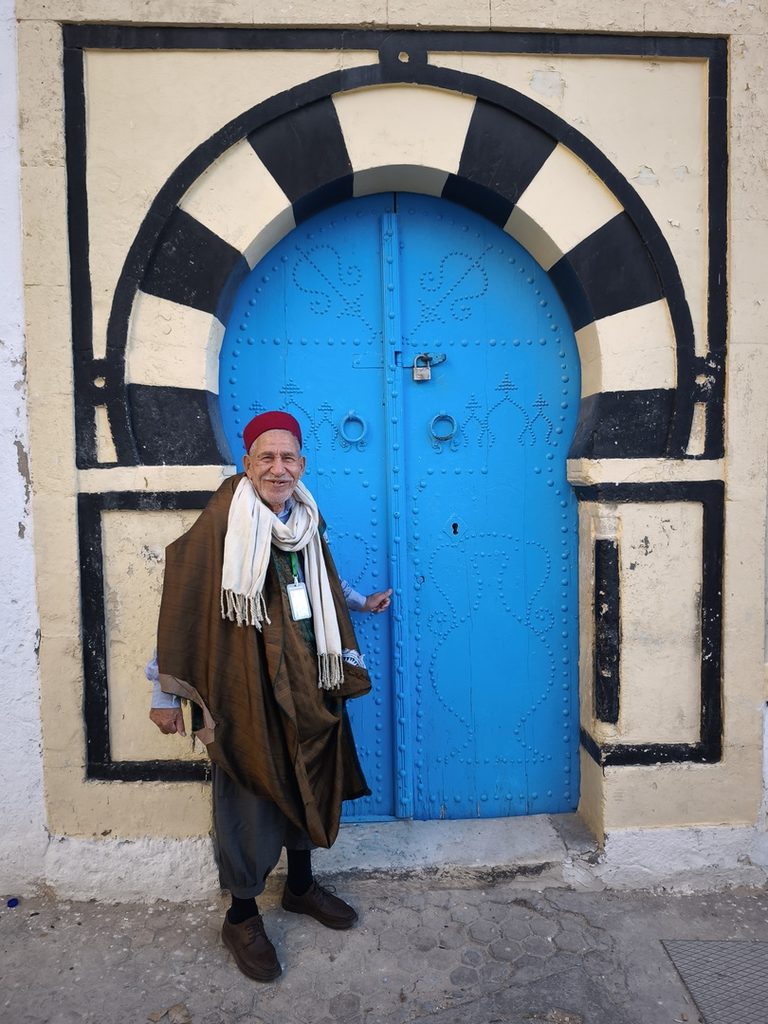
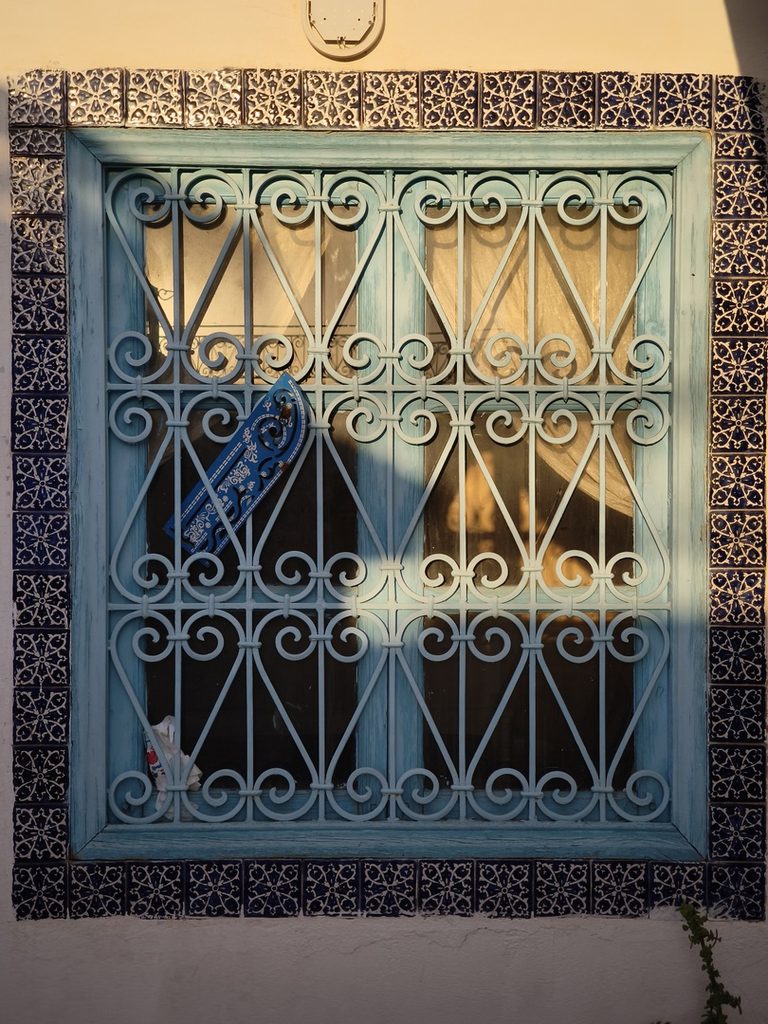
As you walk through the medina, you also discover monumental doors with ornate carvings, wrought-iron gates, arches with iron beams, and windows protected by wrought-iron grilles. Some monumental doors are set in beautiful carved stone frames; others, more modest, compete in color and fantasy. Painted in blue, green, or ochre tones, their heavy wooden lintels are often adorned with metal nails drawing stars, lozenges, or roses. Sometimes surmounted by overhanging arches, these doors open onto houses organized around patios, sheltered from prying eyes. Behind their ornate richness lies one of the fundamental principles of traditional medina architecture: preserving the privacy of family life.
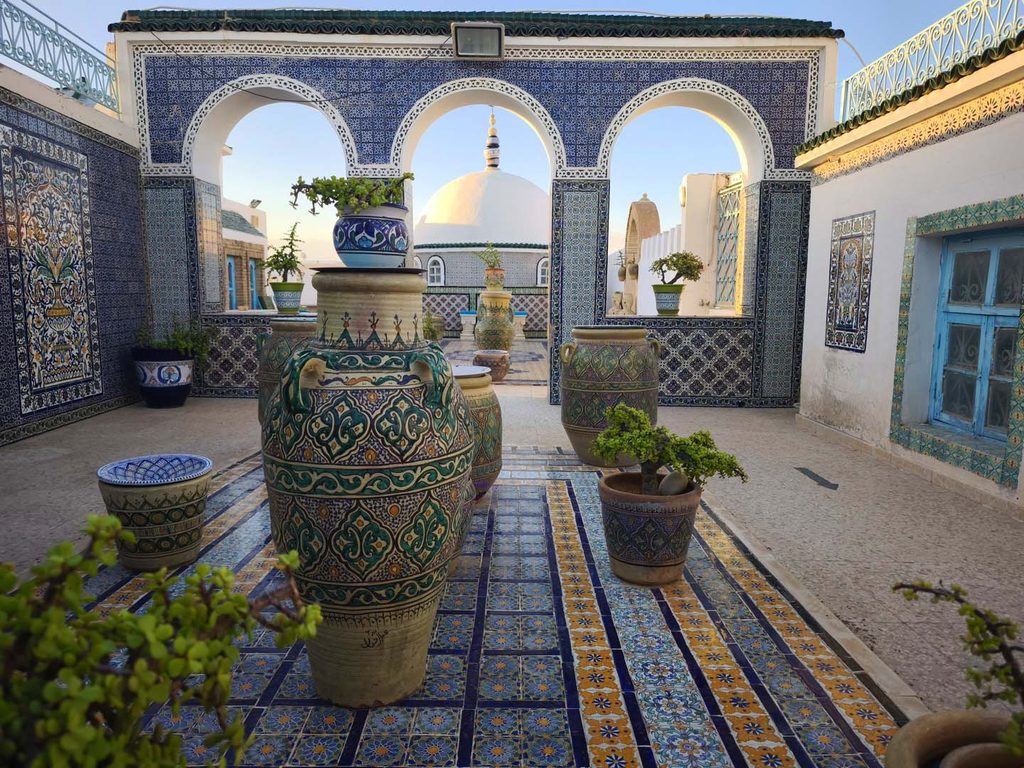
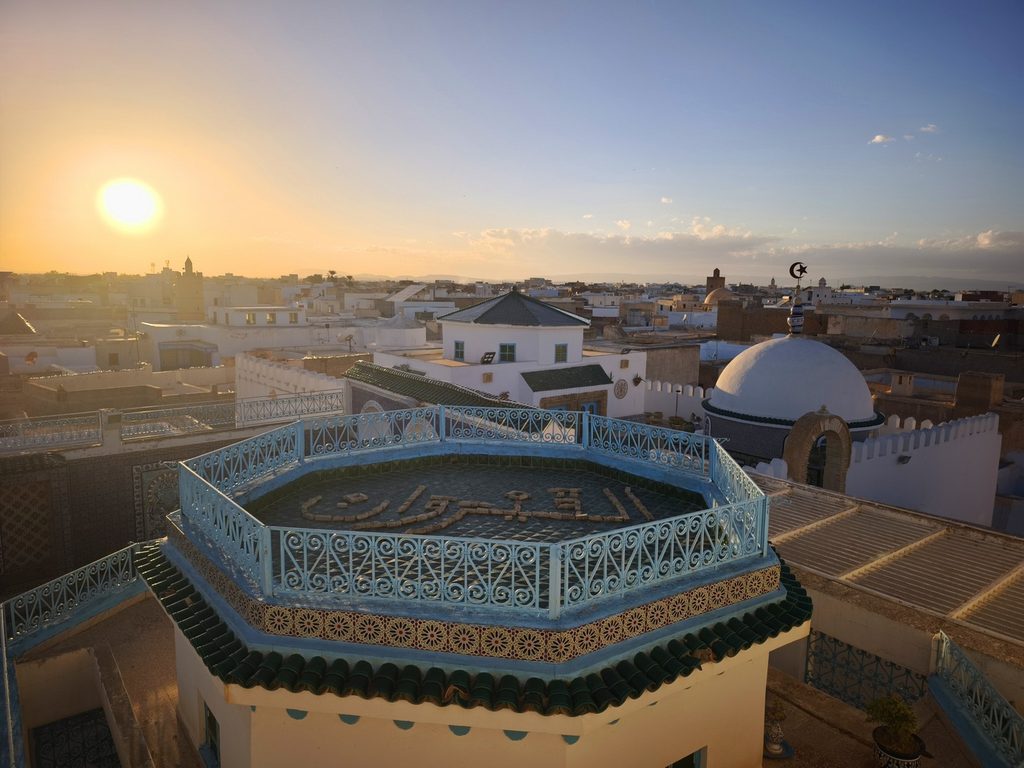
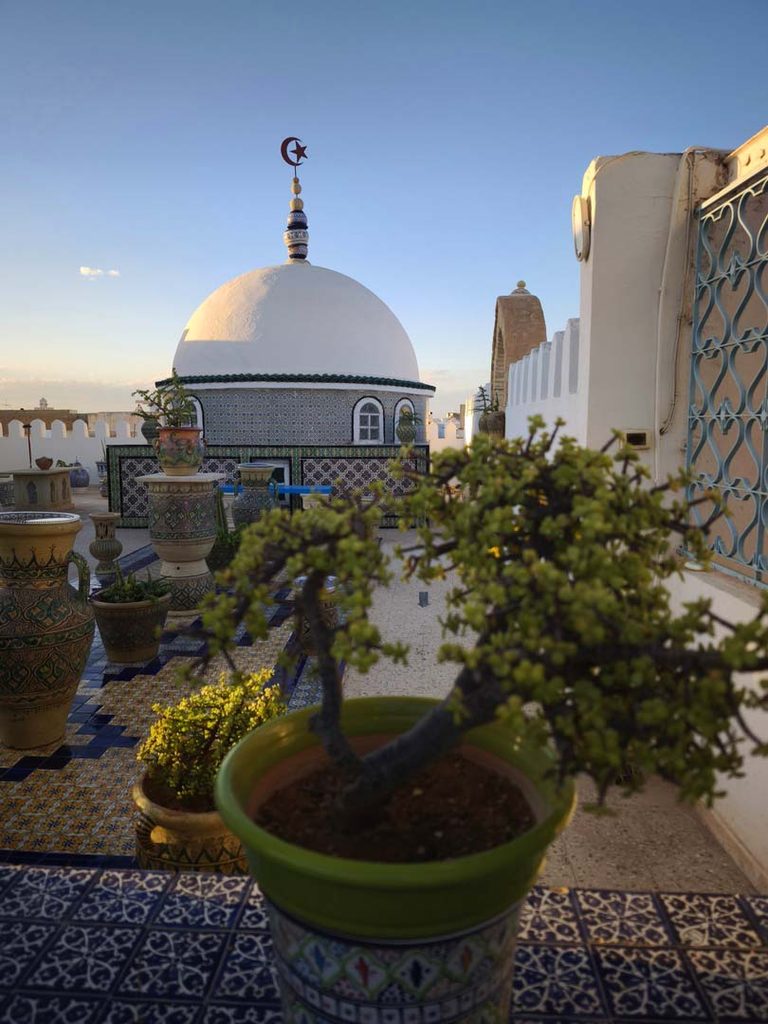
The terraces offer another perspective on the city. From the heights, the gaze sweeps over a tangle of flat roofs, whitewashed domes and minarets. Geometric volumes overlap, creating a landscape dominated by white, ochre and earth tones. In some places, glazed earthenware and ceramics add touches of color to this harmony of gentle hues.
Ceramics also play an important role in Tunisian decorative arts. The glazed tiles, with floral or geometric motifs, adorn the walls, patios, and some religious buildings. Deep blues, greens, and yellows contrast with the whiteness of the plaster. In both old houses and monuments, these decorations bear witness to multiple influences, notably Andalusian and Ottoman.
The souks, between excitement and traditions
In the souks, Kairouan regains all its liveliness. The alleys narrow, the shops overflow with merchandise, and conversations mingle with the calls of the merchants. Under the covered passageways, the light descends in beams onto the stalls. Here, there are baguettes and leather goods; further on, copper objects, pottery, traditional clothing, and colorful fabrics. The shops are also filled with brightly colored ceramics, part of which comes from Nabeul, a major center of Tunisian pottery renowned for its enamelled faience and polychrome designs.
Spices and pastry scents accompany the walk. The merchants present their products, discuss prices, and sometimes have the kindness to offer tea, as during our visit to the merchant’s shop. Allani carpet. Commerce retains this dimension of sociability that is what makes these traditional markets so charming.
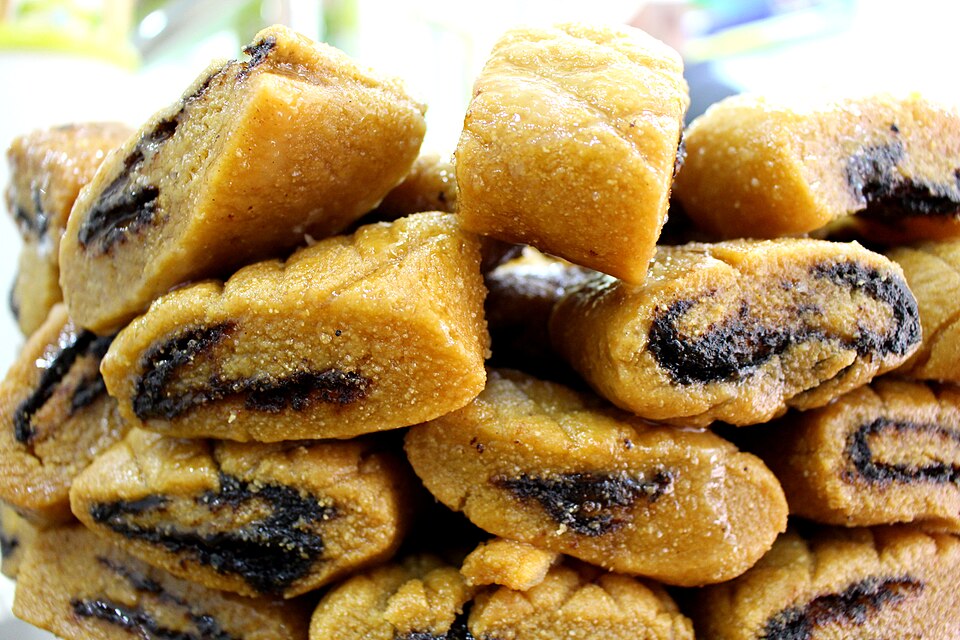
Kairouan is also renowned for its makrouds, Pastries made from semolina, usually filled with dates or almonds paste and then coated with honey or syrup. Their diamond-shaped shape and fragrant flavor have made them one of the city’s emblematic specialties. In some shops, you can observe their preparation, from shaping the dough to baking.
© ZeinebtakoutiCommons.
But it is mainly the carpets that attract attention. Hanging on the walls, stacked in stores or spread out on the floor, they are a profusion of colors and patterns. Their geometric designs, medallions and borders tell a traditional story that has greatly contributed to Kairouan’s reputation.
Kairouan, the Tunisian capital of carpets
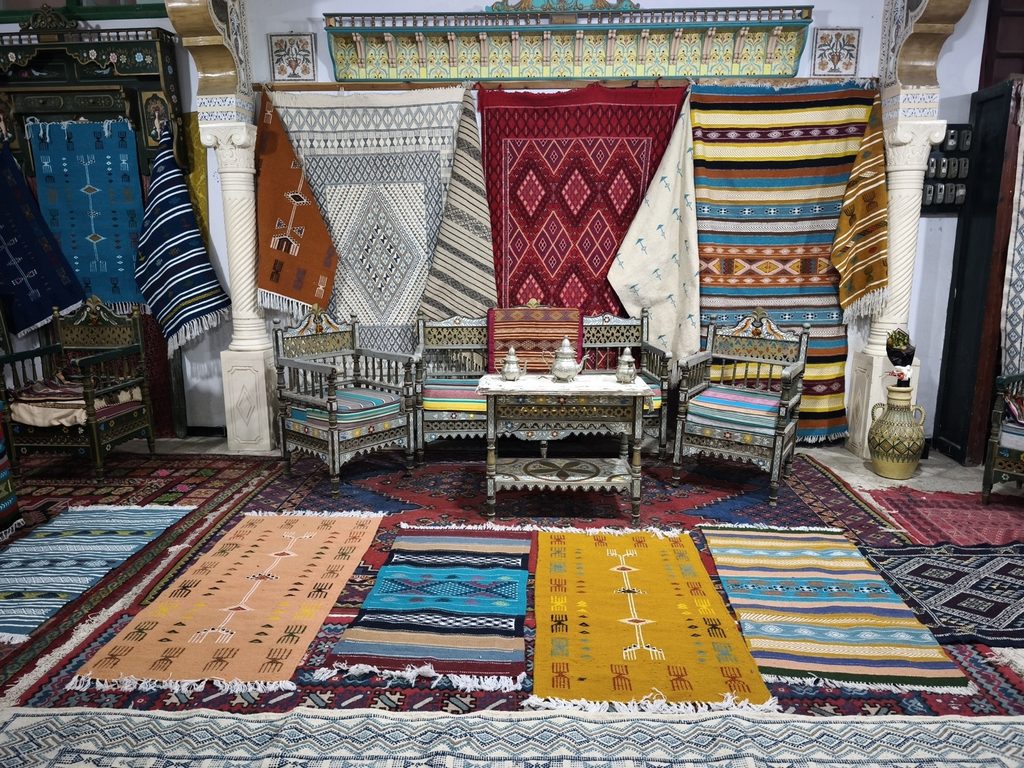
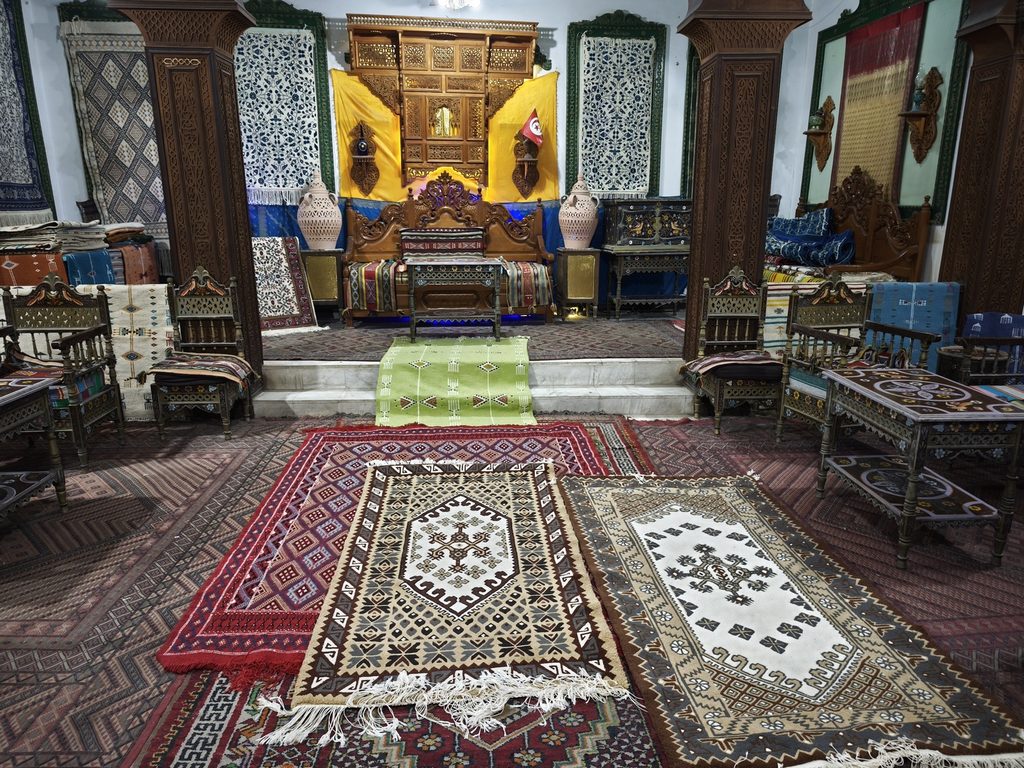
Although weaving has been practiced for centuries in different regions of Tunisia, Kairouan has established itself as the major center for the production of knotted carpets.
The classic Kairouan carpet stands out for its thickness, the quality of its wool, and the richness of its compositions. It usually features a central medallion, often hexagonal, surrounded by stylized floral motifs and several decorative borders. The traditional colors favor deep red, blue, green, and the natural colors of the wool.
Among the most popular models is the’alloucha, Recognizable by its muted tones of cream, beige, brown or grey, which echo the natural shades of the sheep’s wool. It is a knotted wool carpet (approximately 40,000 knots/m²) with harmonious patterns arranged around a central medallion, testament to a demanding craftsmanship.
The mergoum It belongs to a different family of carpets. Unlike the knotted carpet, it is woven flat, using a technique that produces a relatively fine surface. The motifs are then embroidered by hand. Its compositions make extensive use of lozenges, triangles, parallel bands and other geometric figures and symbols derived from the traditional Tunisian repertoire. The colors can be vivid, with contrasts of red, black, white and yellow. Lighter than the classic Kairouan carpet, mergoum It is also more durable and suitable for many domestic uses.
Finally, the kilims, or climbs According to Tunisian tradition, they are also flat woven carpets traditionally made in Bedouin communities. Thinner and lighter than knotted carpets, they are distinguished by their colorful bands and geometric patterns. Flexible and easy to carry, they were particularly suited to the nomadic lifestyle.
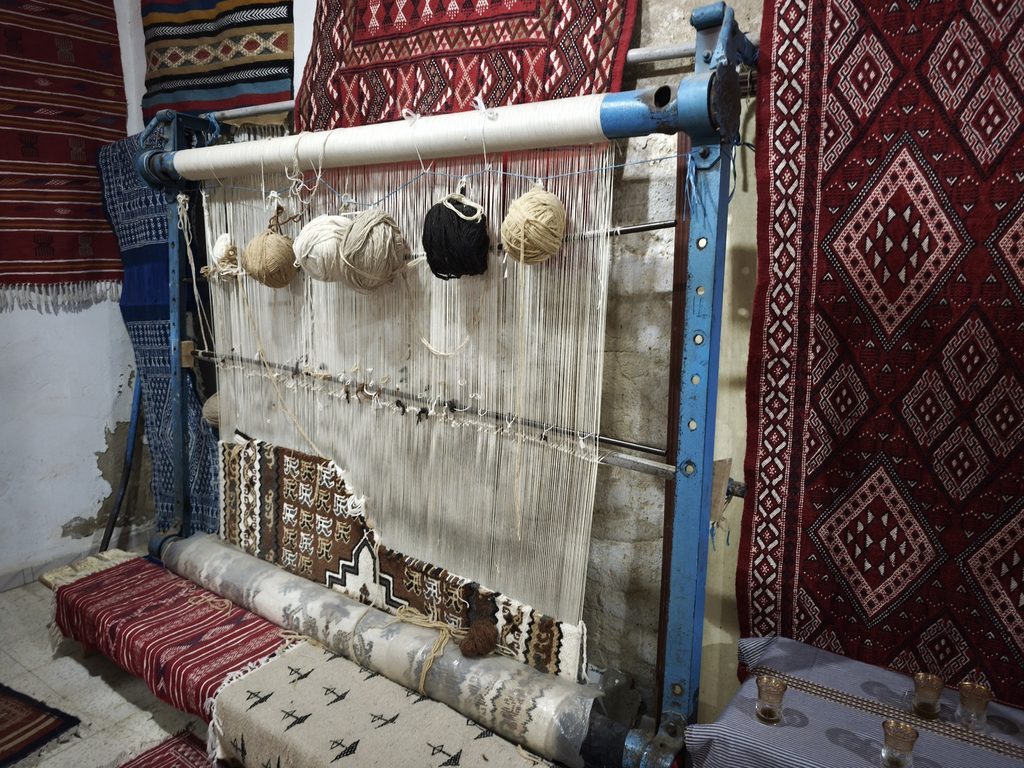
In Kairouan, the carpet once held a special place in the lives of women and family traditions. According to an ancient custom, young girls offered their first carpet to the mausoleum of Sidi Sahbi, which houses the tomb of’Abu Zamaa el-Balaoui, companion of the Prophet, in order to obtain his blessing. This practice echoes a local legend that features Kemla Chaouch, the daughter of a Turkish governor, to whom the introduction or refinement of a weaving technique inspired by the carpets of Anatolia is attributed. The young woman is said to have made a wool carpet to thank the saint for having granted one of her wishes. Although the story remains difficult to disentangle from the legend, it attests to Ottoman influences on Tunisian craftsmanship. As for the custom of offering one’s first carpet to the mausoleum, it is now in danger of disappearing.
In the workshops, the work of the weavers deserves special attention. Installed in front of their vertical looms, they weave or interweave the threads with precision acquired over the years. The design gradually emerges, row by row. For knotted carpet patterns, the density of the knots, the regularity of the work, and the quality of the wool contribute to determining the finesse and value of the piece. This activity, long practiced in a family context, played an important economic role for the women of Kairouan. It remains a major element of the city’s artisan identity, even though the competition from industrial production and the evolution of consumer habits pose new challenges for traditional workshops today.
Other treasures behind the walls
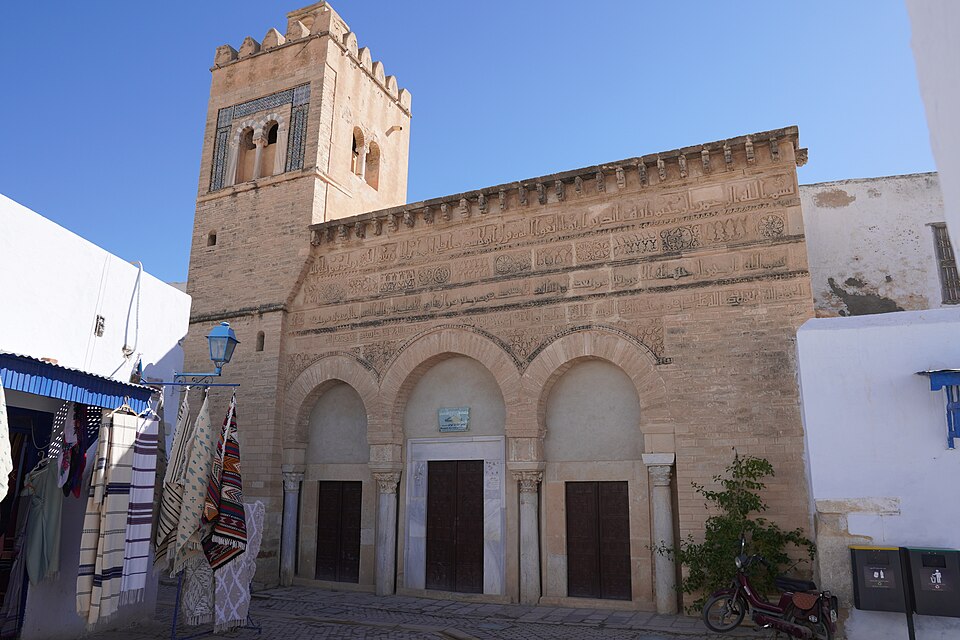
The medina has several monuments that deserve to be explored in more detail. Among them, the Three-Gate Mosque, built in 866, holds a special place in the history of Islamic art. Its façade, adorned with Kufic inscriptions and sculpted decorations, is considered the oldest known carved mosque façade. Although smaller than the Great Mosque, it nevertheless bears witness to the same artistic exuberance that characterized Kairouan in the ninth century.
© Habib M'henniCommons.
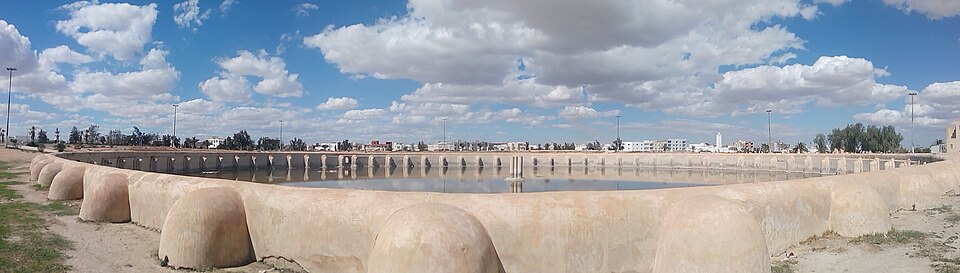
Kairouan also preserves an exceptional testimony of the ingenuity of its builders: the basins of the Aghlabides. Built in the 9th century to ensure the city’s water supply, they formed a particularly elaborate hydraulic system. In this region where water is a precious resource, their construction represented a true technical feat. The two large reservoirs still visible remind us of the importance given by the Aghlabid rulers to urban organization and infrastructure.
© Karama ben amorCommons.
We leave this city with the desire to return to enjoy all its richness. Behind its apparent discretion, it retains a strength and personality that distinguish it from other Tunisian cities. And perhaps that is where its charm lies: in the way it reveals itself without ever revealing all its secrets. From the Grand Mosque to the weaving workshops, from the patios adorned with faience to the bustling alleys of the souks, Kairouan reveals several faces. That of a religious and intellectual capital, but also that of a city of artisans, where the gestures passed down from generation to generation continue to give life to an exceptional heritage.
Text : Brigitte Postel
Photos : Brigitte Postel and according to indication
Practical information
Go there with Tunisair
With Tunisair, Tunisia is just a few hours away by plane. The national airline serves Tunis and Djerba from Paris and Marseille, but also from Lyon. Its network also connects Tunis with several French cities, including Nice, Toulouse, Bordeaux, Nantes and Strasbourg, according to the flight schedules.
On board, Tunisair prioritizes a traditional travel formula, with a catering service offering meals or snacks depending on the flights. The company has Economy and Business cabins and offers various services designed to improve passenger comfort. Depending on the chosen fare, a baggage allowance in the hold may also be included.
A privileged connection between the two shores of the Mediterranean, to reach both the cultural treasures of Tunis and the beaches of Djerba.
Information and reservations: www.tunisair.com
Tunisian Tourist Office – Paris
16, rue Friant, 75014 Paris, France
Phone : +33 (0)1 44 51 51 74
Email: ontt.france@discovertunisia.com
https://www.discovertunisia.com/
Allani Rug
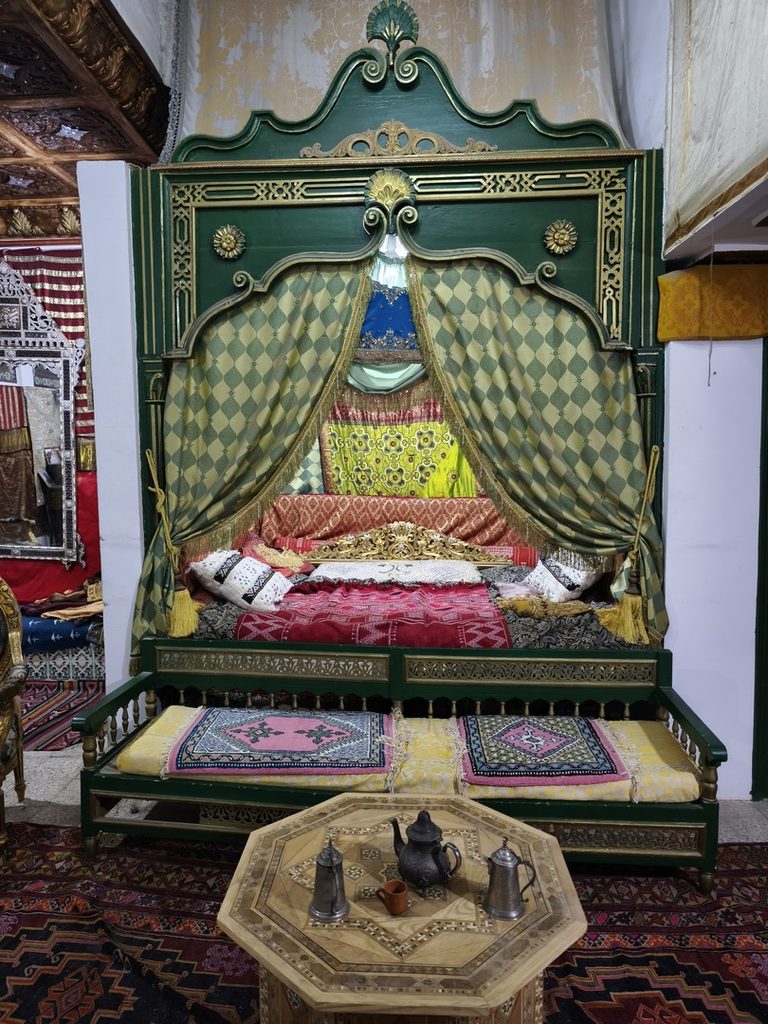
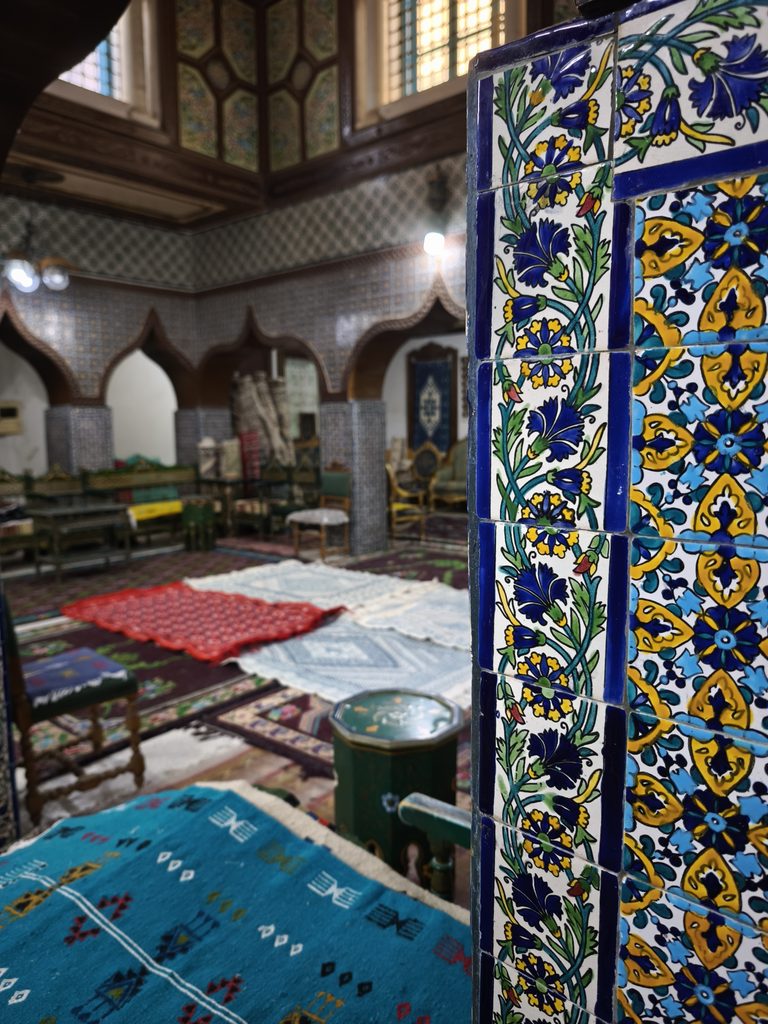
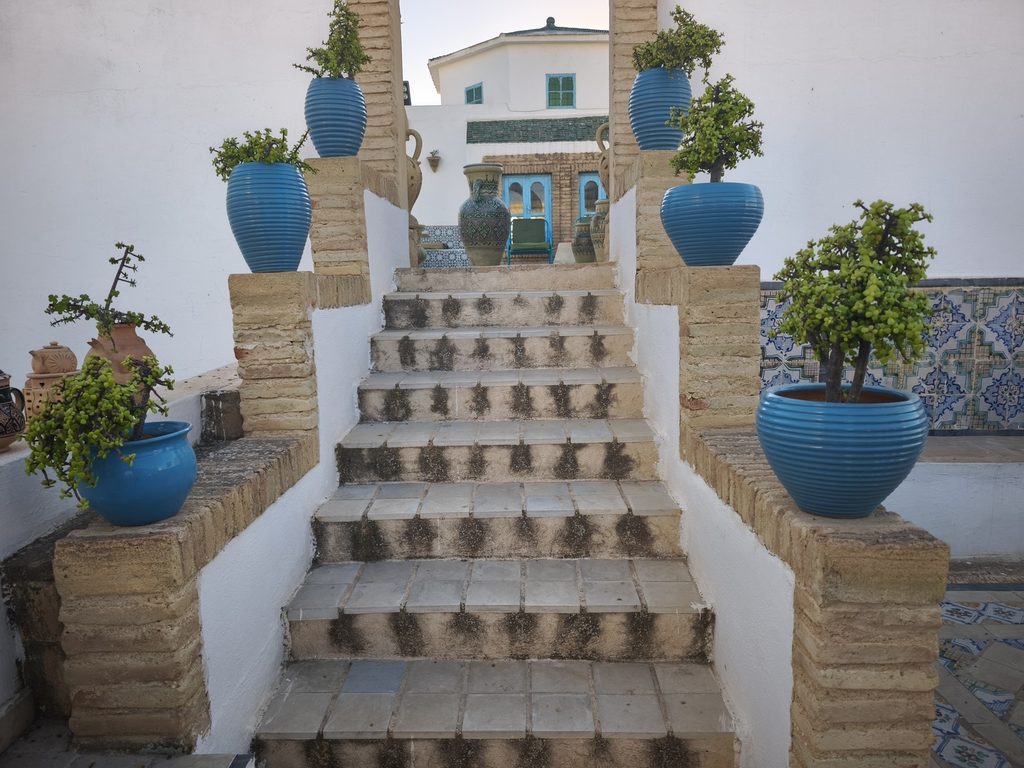
The House Allani offers the opportunity to discover one of Kairouan’s great traditional crafts: the carpet. Set in a palace-like residence, it offers an exceptional setting for showcasing its carpets, whose patterns and colors testify to the skill of the Tunisian weavers. But the charm of the place also lies in its architecture. From the terraces adorned with glazed ceramics, the gaze sweeps over the roofs and domes of the medina. A place that is worth visiting not only for its carpets but also for the beauty of its decor.
Address: Rue Sidi Abid, 3100 Kairouan. https://www.facebook.com/societe.tapis.allani.faycal/?locale=fr_FR
Where to sleep: Dar Koraich Guesthouse
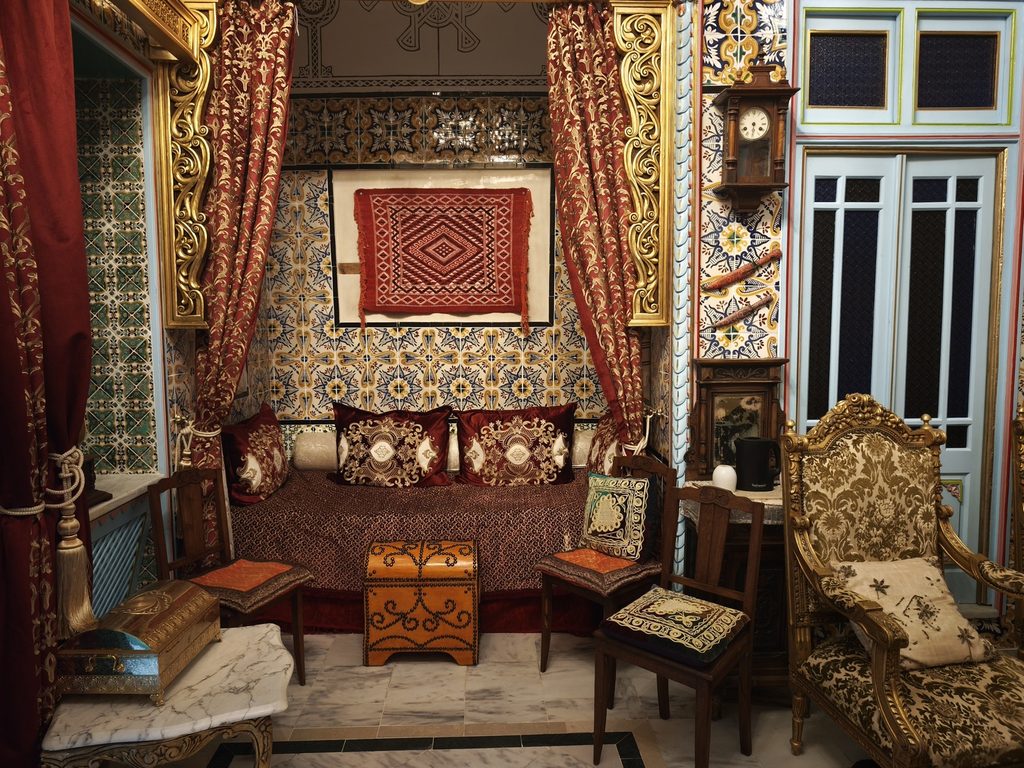
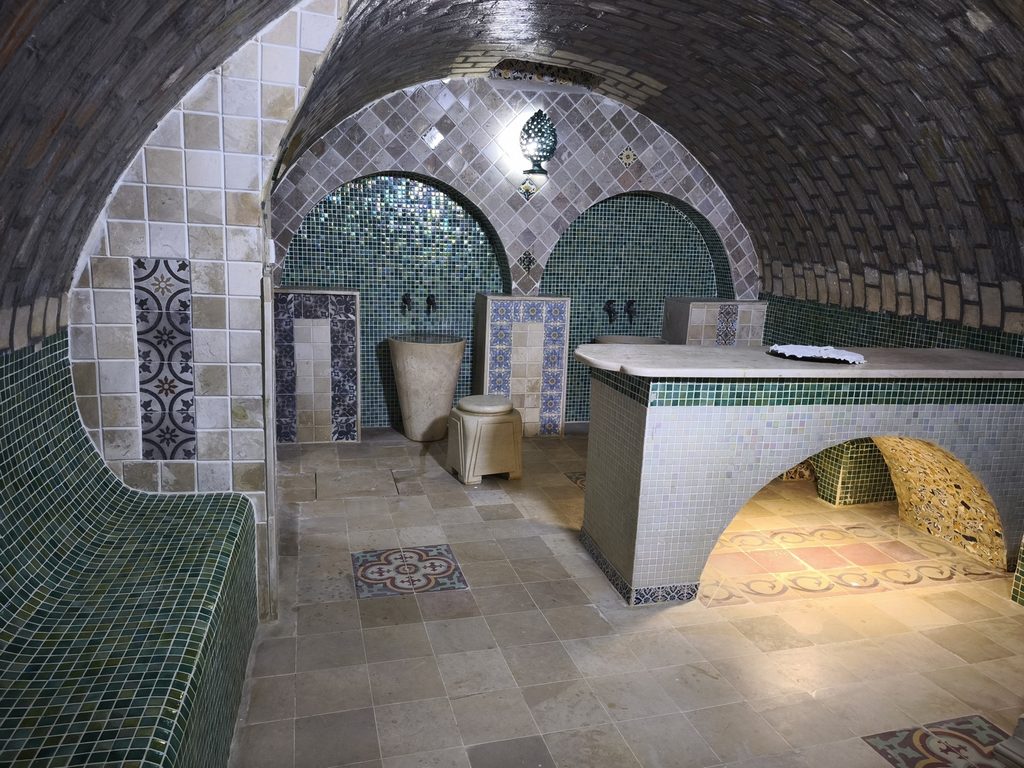
In the neighborhood of Bab El Jalladine, in the heart of the medina of Kairouan, Dar Koraich Welcomes its guests in an old house carefully restored. Arranged around a patio, the house retains the charm of traditional Tunisian architecture, with its intimate spaces and terrace overlooking the roofs of the old city. The rooms, decorated in an authentic style, invite you to enjoy the peacefulness of the place. An address full of character to prolong your discovery of Kairouan and to experience Tunisian hospitality. The best part: a magnificent, ceramic-clad hammam.
Phone: + 216 94 369 341 email: dar.koraich@gmail.com