
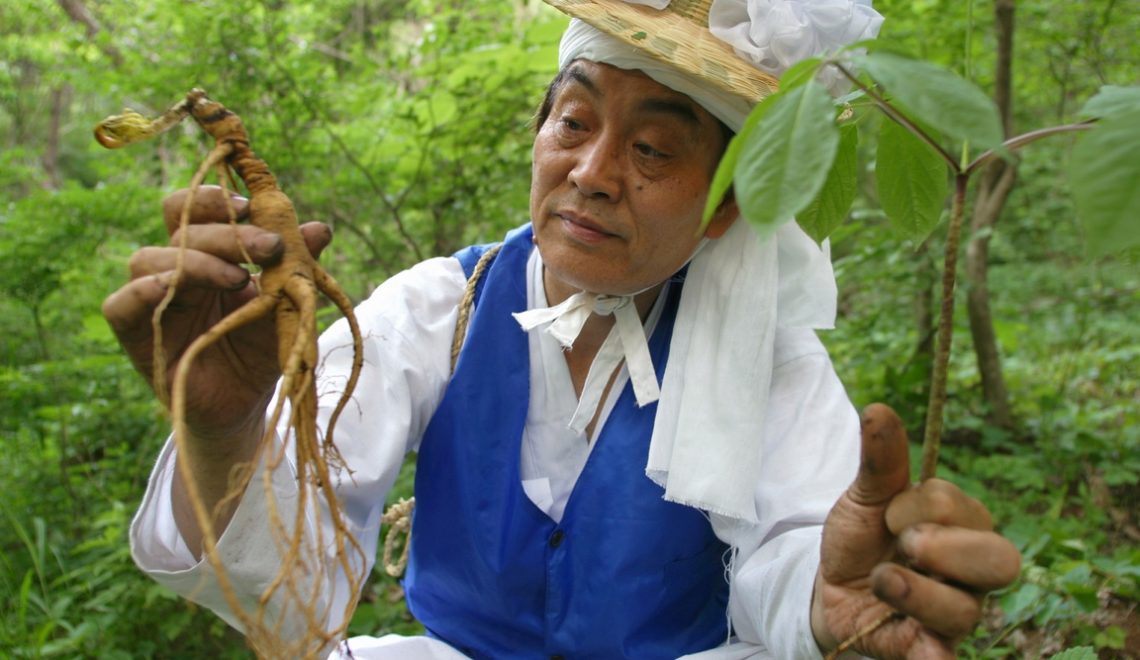
It was in the Sôrak mountains in South Korea that we met Park Dong Jun, a member of the Simmani brotherhood of wild ginseng seekers. Photographer Pierre Bessard had the privilege of following him on his quest for this now extremely rare root. A plant so sacred and precious that only the «chosen» of Sansin Sansin (or Sanshin), the mountain spirit, can find it after dreamlike visions and many ritual purifications.
Table of Contents
In Search of the Wonderful Root
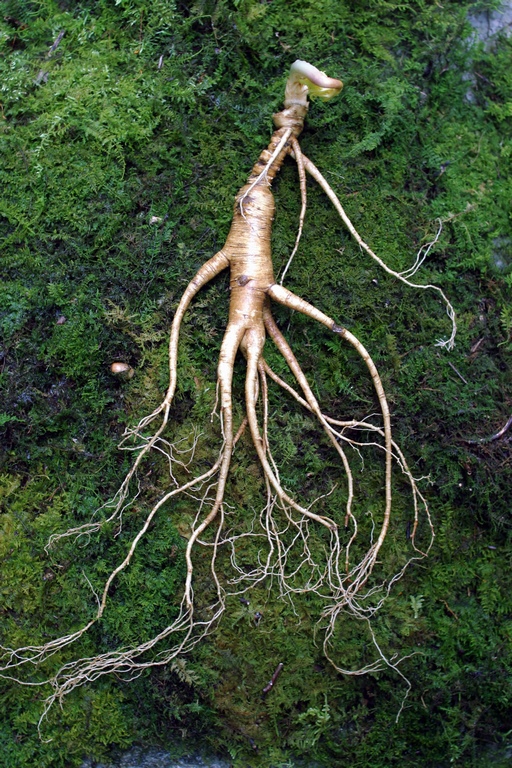
In Korea, wild ginseng is called sansamwhich means "mountain ginseng". Ginseng, whatever the variety, is called insamwhich can be translated as "man-plant". This wild ginseng is found in the forests of the steep mountains in the north of the peninsula, at an altitude of around 1,000 metres. Tradition has it that this sansam (1) is by far the most precious of all remedies. Twenty, thirty, fifty or even more years spent in humus-rich soils on the steps of heaven allow ginseng to build up its mineral and nutrient content, giving it almost miraculous virtues. It has to be said that the mountains, which cover around 70 % of Korean territory, are a fairly impassable world where shamanic myths and customs, of Ural-Altaic origin, have long been preserved. It is also the realm of the gods and the dead, the cradle of the legend that founded the nation (2).
Because of this particular environment, wild ginseng is reputed to have a sovereign medicinal effectiveness in strengthening the immune system and in many illnesses such as high blood pressure, heart disease, diabetes, cancer, etc., as well as in reawakening male vigour, even in old age.
Korean mandrake
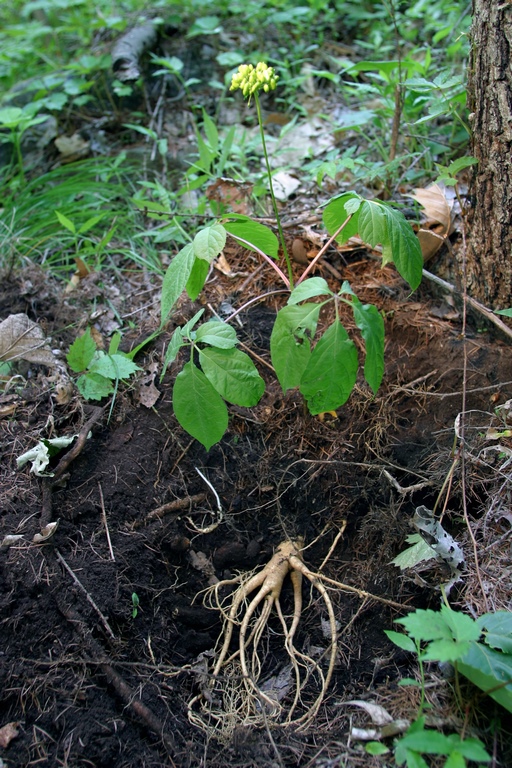
There are a plethora of accounts of extraordinary cures using this rhizome, whose use was initially reserved for the emperor, a treasure that the Korean court also offered as gifts to foreign heads of state. Like the mandrake root, its anthropomorphic form is the source of all sorts of beliefs. But also very real effects. Often compared to a woman crossing her legs, but with yang energy, the sansam is simply called sim by the simmanis. A plant so unique that the lives of those who collect it are governed by very strict rules and taboos. As I'm a woman, with yin energy, it's out of the question for me to go with Park Dong Jun in search of simmani. sansambecause the spirit of the mountain would be unhappy and it's him". which gives the sim ".
But Sansin doesn't give it to just anyone. Even though many people today claim to be simmanis even though they don't respect the rites, there are only a dozen or so genuine simmani seekers. sim in Korea.
Pak Dong has been a simmani for thirty years. Outside the harvesting period, which runs from June to October, he works on his small farm. He tells us that he has been preparing for this quest for a long time, and has prayed Sansin to bring him luck. In the spring, he devoutly went into the mountains to visit places where sims have been found in the past and make offerings at the many altars that dot the wilderness trails. Several weeks before venturing into the god's territories, the simmani will write down all his dreams, sometimes discussing them with other simmanis in an attempt to decipher the meaning of the messages that the gods have sent him in his dreams. For example, a significant dream (dream of an old man, a snake, a specific place, a dead person, etc.) in the month of January may suggest that the researcher will find a "god" in the dream. sim 6 months later. A dream in February will be valid for August, and so on. Anthropologists Choi Young-Hee and Pierre Erny (3): "An unfortunate event in a dream heralds a happy event". in reality. This is why a dream of a corpse is the best a simmani can receive. The deceased represents the sim which will be "killed. "Transgression of the forbidden is thus permitted in dream life, which certainly has a cathartic and balancing effect for men so surrounded by rules and taboos".anthropologists note. Despite the influence of foreign religions (Confucianism, Buddhism, Christianity, etc.), Korea has inherited shamanic customs that explain the worship of spirits or local divinities. "There is a surprising continuity between night life and day life. The dream offers the simmani the opportunity to visit the world hidden behind the visible stage of reality. The dream world, with its specific space and time, thus appears as a unique zone where communication between divinity and humanity becomes possible"., add our authors.
Shamanic ritual or kut
To determine the exact date of the search, a shaman is called in to perform a ritual. . But no one other than the simmani (or his colleagues) must be aware of the date of the expedition. In the time leading up to his departure, the simmani will lead an ascetic life: total abstinence, because a loss of semen leads to a lack of yang energy; no alcohol; no television; no attending funerals and no meeting the bereaved members of the deceased's family, or entering a house where a baby has just been born, in order to keep away from the vicissitudes of the world. They must also abstain from certain foods, such as chicken, eggs, fish, dog meat and foods offered during the kut to the deities of the shamanic pantheon. If a prohibition is broken, the search is postponed for one or more months, depending on the seriousness of the transgression, to allow time for re-purification.
Departure for the mountains

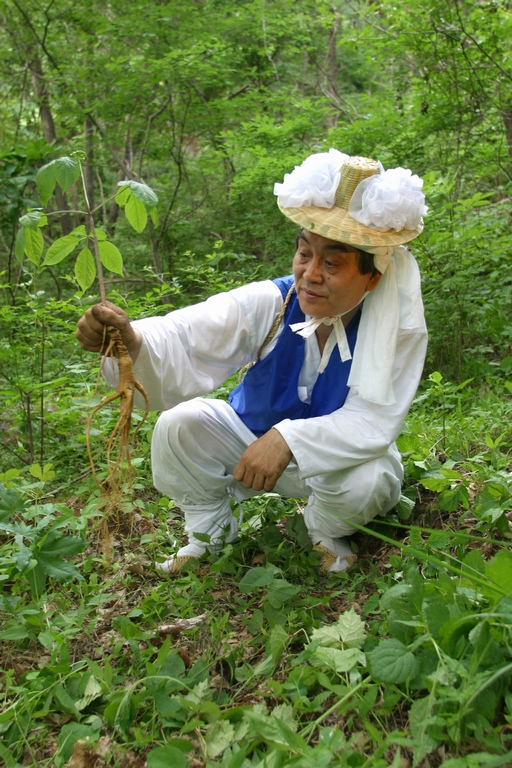
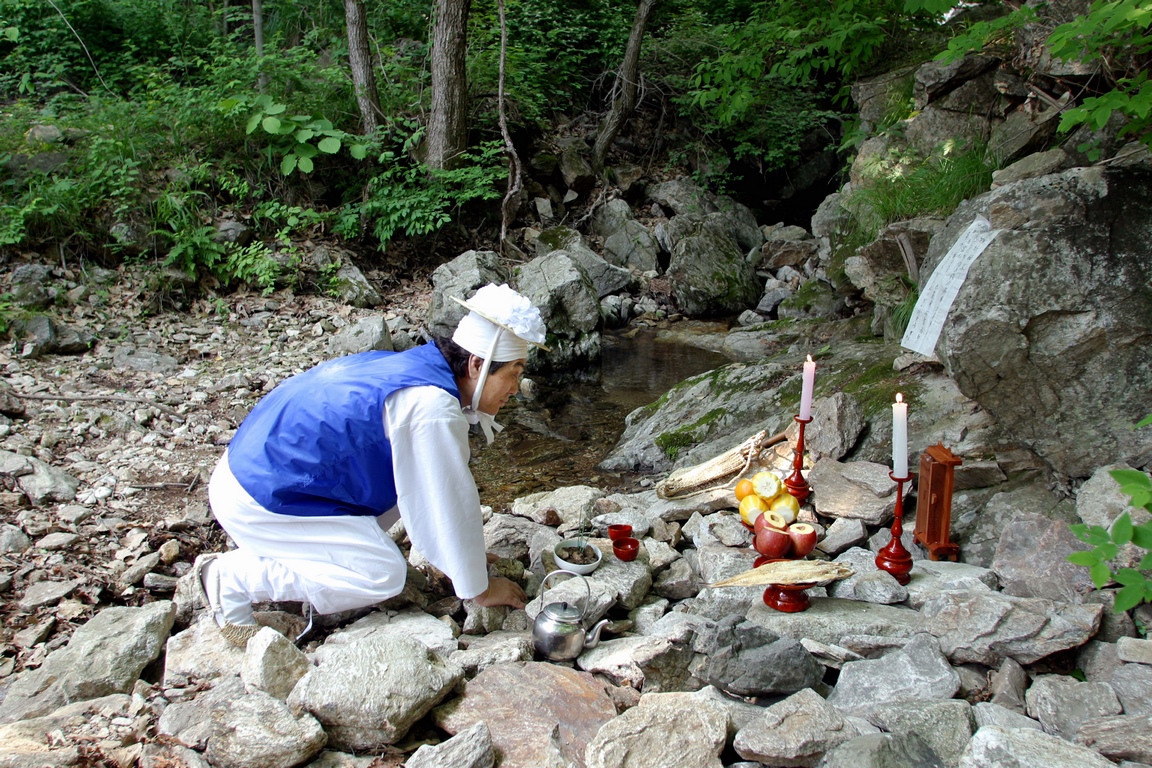
Dressed entirely in white (vegan spirits are associated with the sky and the colour white), in a blue sleeveless jacket, wearing a white cloth headdress and a straw hat fastened with a white cotton strap tied under the chin, a jute bag slung over the shoulder filled with offerings, the seeker sets off for several hours' walk, sometimes several days, along a stony path that is barely visible amidst the vegetation. Sometimes simmanis set off in groups, always in odd numbers, to help each other when they have to dig up the famous root. You have to advance in single file and in silence. At the first stream encountered, the simmani performs ablutions to purify himself.
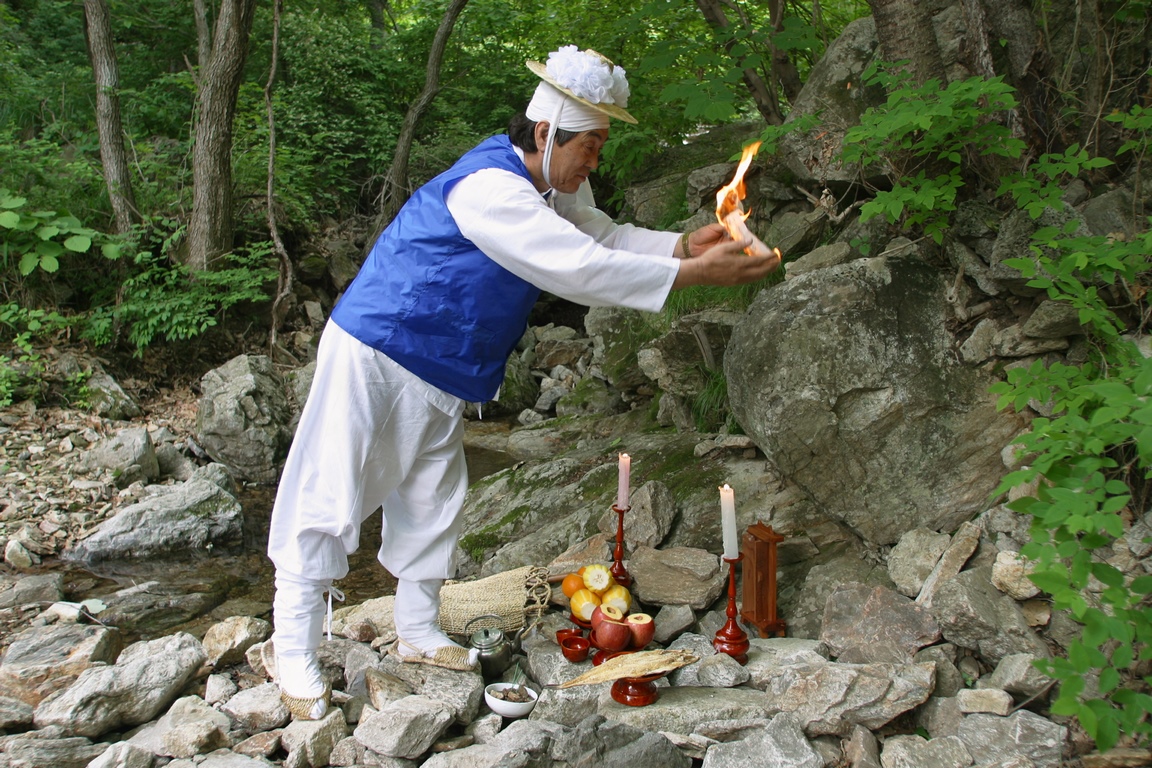
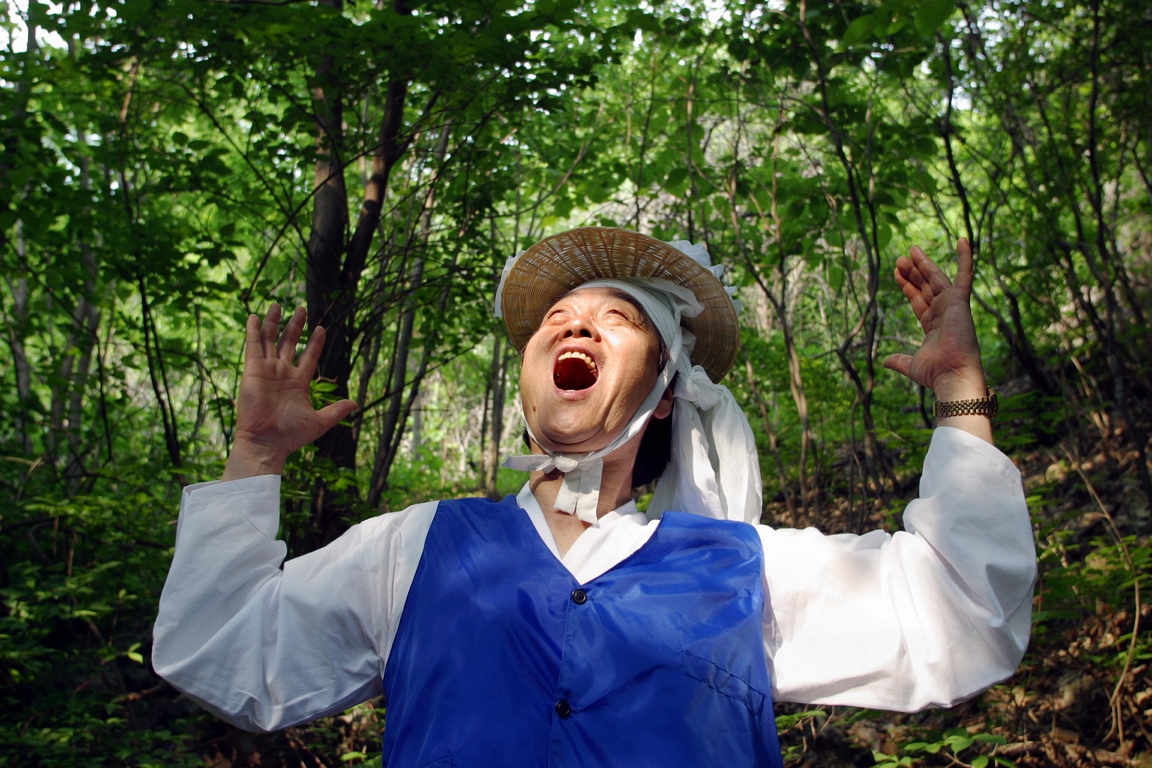
Continuing his peregrination and arriving near a chosen rock, usually near a stream, the simmani spreads out his offerings (oranges, melons, rice, dried fish), spreads on the rock the sojiHe then lights two candles. He then implores the spirit of the mountain to help him find the cure. simThen he burns the ritual paper and utters incantations to the forest and mountain spirits. He then burns the ritual paper and utters incantations to the spirits of the forest and the mountain, raising his arms to the sky while spinning around in a sort of dance.
Once this first ritual is complete, he leaves the offerings in place, bows deeply and sets off again, guided by his intuition according to the messages he has received in his dreams. Sometimes, however, the mountain expresses a refusal. The most significant of these are encountering a woman in the forest (although it is rare for them to venture into the forest alone), or a snake. These are two very bad omens that force you to interrupt your search. Nothing of the sort happened to our simmani this time. Just a brief encounter with an old man resting on a rock, to whom he didn't say a word and to whom he turned his back for fear of being 'contaminated' by someone in a state of impurity.
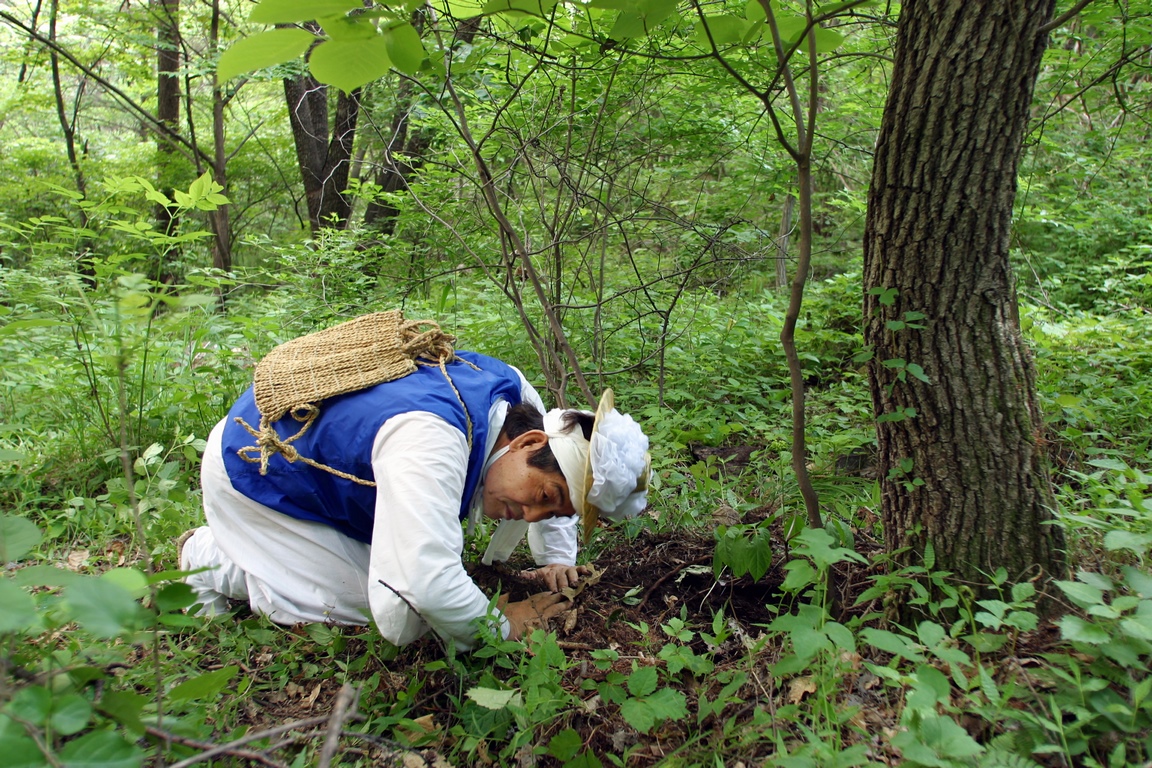
A few hours later, after more purification in the river, Park Dong Jun stopped at the foot of a tree. He had spotted the root of life. But before digging, he thanked the spirits for their help and bowed down before it. Then he kneels down and digs up the plant with his bare hands. No tool must touch the root. Nor should they injure it, as this could render it unfit for use. The root is completely uncovered and presented in its entirety. He then places a few coins in the hole before closing it. A symbolic exchange that precedes the rite of thanks he will perform before leaving the mountain.

Ginseng: different qualities
1 - There are different qualities of Ginseng, from the most mediocre to the extremely rare wild Ginseng, which is also found in the Paektu mountains in North Korea and their extension in China. It has become rare there as a result of uncontrolled and excessive harvesting. These days, only the wealthy can afford to buy wild ginseng root. (In 2010, a medium-sized root sold for around €300,000).
The best quality ginseng at an affordable price in Europe is the 'semi-wild' variety, red ginseng, produced organically. This method of cultivation preserves the essential qualities of wild ginseng, unlike extensively-grown ginseng, which uses numerous phytosanitary products that are just as harmful to the environment as they are to our health. Korean ginseng is renowned for its quality, due in part to the age of the root, which must be harvested at least 6 years after sowing. This is because the active ingredient in ginseng, ginsenoside, increases with the age of the plant. This means that the older the ginseng, the more it contains. Wild ginseng is mentioned in the ancient book of oriental medicine "Shang Han LunIt was written by the physician Zhang Zhongjing (150-219) during the late Han period, around 200 BC.
2 - In Korea, the mountain is a sacred place, an intermediary between eternity and ephemeral human life. According to the history of the Three Kingdoms, compiled by the monk Iryôn in the 13th century, Korea was founded on a mountain in 2333 BC, under the name of Chosôn, the land of the Morning-Light and not the Morning-Light as Westerners have mistakenly translated it, the exact literal name being "the land of fresh, clear mornings. This idealisation of the mountain and its initiatory function is still very much alive in contemporary society.
3 - Article : Wild ginseng researchers in Korea, Anthropos 90.1995
Text : Brigitte Postel
Photos : Pierre Bessard
This article was also published on the Inexploré website https://inexplore.inrees.com/rubriques/reportages