
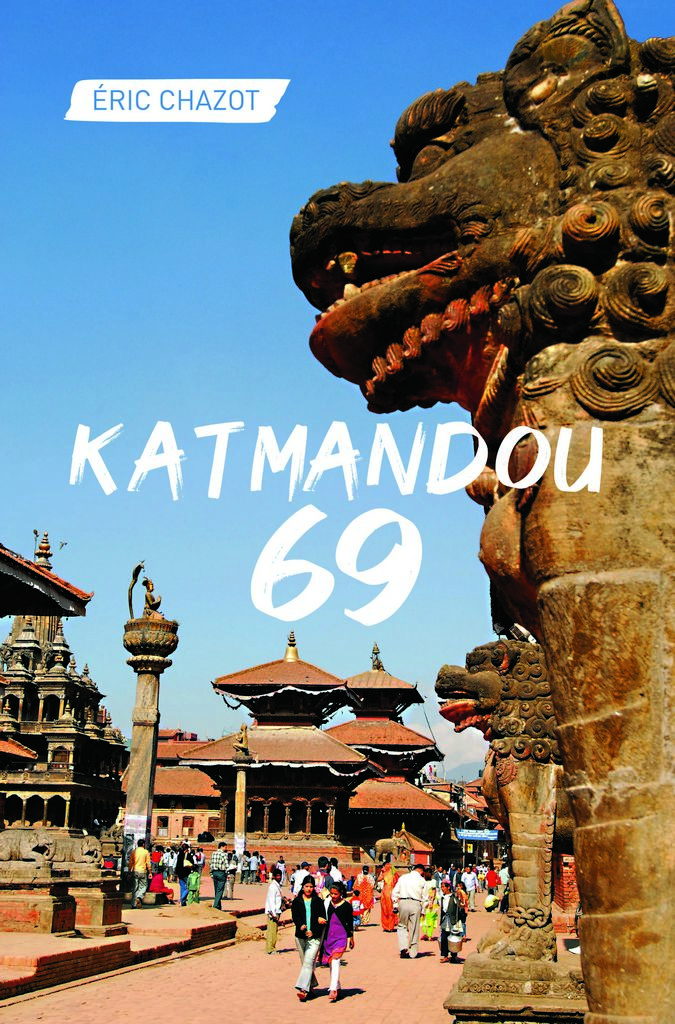
Kathmandu 69 is a story that straddles the line between autobiography and fiction, based on Éric Chazot's own experience in the late 1960s, when Kathmandu became one of the magnetic poles for young Westerners on the rebound. More than a simple travel novel, the book captures a moment of historical and inner upheaval, when geographical wandering became confused with existential flight.
Table of Contents
A start without a compass
Antoine, the narrator, is 19. He is a trainee teacher in the suburbs of Lille, already tired of the adult world before he has even entered it. Everyday life suffocates him. He sees society as a frozen set, devoid of meaning. He pretended to be learning a trade, but it was mainly boredom that he was perfecting in a disillusioned lucidity. His departure was not heroic. It was not motivated by a clear plan, but by an almost physical need to break away. To leave. To tear himself away from everyday life. Antoine starts in Paris, then moves to the margins, to experimental hostels, to alternative communities where they talk about educational non-directiveness, freedom, sexuality and self-transformation.
The road as a test
Heading for Kathmandu, he crosses Yugoslavia, Greece, Turkey, Iran, Afghanistan, Pakistan and India. The reader is quickly plunged into an adventure devoid of folklore and romance. A rickety old car, bad roads, makeshift repairs. Crossing Turkey in the snow becomes a nightmare. Danger is omnipresent and tangible. The ravine lurks, the mechanics fail, night falls. « We are approaching the ravine, slowly, as if in a dream, but disaster is close at hand. ». The fear is naked. You can feel the cold, the exhaustion, the uncertain and sometimes absent solidarity. A bus passes without stopping. A lorry tries to help, then sets off again. And suddenly, the unexpected: « In five minutes, these four colossuses had the vehicle back on the track. Football, football!" said one of them, handing me a small Turkish national team crest. »Human solidarity is welcome.
The body, psychedelia and disillusionment
The story is punctuated by a series of encounters. Some leave a lasting impression, like Jean-Loup, a disconcerting resident, a figure who is both fragile and visionary, a mirror of Antoine's flaws. Or the sadhus with their astonishing abilities, including a « capable of carrying a rock weighing fifty kilos attached to a rope at the end of his penis. His only possession is the cap of a human skull, which he uses as a begging bowl as well as a plate. He smokes quantities of hashish that no Westerner could tolerate, abstains from all sexual relations and professes total faith in Mahadeva, the god of yogis. ». Far from being idealised, hallucinogenic experiences are described in all their ambivalence. « I thought I was expanding my consciousness, but sometimes I was just losing myself in it. »writes Chazot, without complacency.
The novel stands out for this honesty. Self-exploration is never presented as a luminous path. It is made up of shame, fear, humiliating or dangerous situations, bodies put to the test as much as illusions that crack.
Father and son, at the end of the world
But the journey is not just external. It is also deeply intimate. Antoine travels with his father, a discreet, fragile, human figure. The map of the world becomes a vertigo: « He couldn't really imagine any region further from France than Palestine. ». Each stage brings them face to face with unexpected and disconcerting realities. The fear that the car might break down is mixed with vigilance: « The important thing is that it holds, and the obsession with seeing that terrible red light come back on will never fully fade until the end of the journey. ». But the journey is also a confrontation with human impulses. «Together we travel through the Middle East's version of sex hell, a collection of unhealthy prowlers checking out unappetising flesh offered up to their lust. "
India and Benares
Crossing the border into India is an experience of sensory and cultural wonder: horses, elephants, wrestlers, Sikhs in impeccable turbans, smiling women... The reality of the country soon proves more complex, with its bureaucracy, suspicious customs officers and the unforeseen problems associated with drug possession. « It's only a short step from anxiety to nightmare. We cross it when, during the body search, the customs officers discover a thumb-sized piece of hashish in Ylva's bra. "
India unfolds as a fascinating but demanding country, where crowds, poverty and religious fervour combine in a constant vertigo for the traveller. In Benares, the Ganges, cremations and devotion offer both a sacred spectacle and a confrontation with mortality and misery. In this chaos, unexpected human figures emerge, like Ulrich, an adventurer-guide and friend, who reintroduces security and human warmth. « Perhaps everywhere in the world there is a civilised man, a man who reaches out to you at the crucial moment, a man who, whatever his language, the colour of his skin or his uniform, reminds you that men are brothers. "
Kathmandu as a mirage of initiation
The road to the East, and to Kathmandu in particular, becomes a space for projection. « Arriving in the Kathmandu valley was an unforgettable moment, a vision that far exceeded my dreams. A green setting set by three jewels, three sparkling cities brimming with pagodas, monuments and sculptures in bronze, stone and wood. »Asia is not just a geographical elsewhere, but a promise of reinvention. Yet the book gradually deconstructs this expectation. The Orient was not a refuge. It merely revealed what they had come to escape.
In Nepal, the author discovers that « the inner journey, even if it's a psychedelic one, will open the doors to [his] unconscious more surely and more quickly than an analytical treatment »and that every daily gesture carries meaning: « Every step I take in the city is like reading a line from a sacred book that I decipher stone by stone. »
The journey becomes an inner initiation where « poverty is freedom, you have to know how to strip off, how to lighten up »It's a lesson that contrasts with the tumult of the freaks and the over-consumption of drugs around him. Each encounter becomes a lesson in life, detachment and the search for oneself. Between psychedelic vertigo and contemplative wonder, he learns that « when you think you've lost the treasure and give up looking for it, only then will you find it ». A call to let go while pursuing the essential. Kathmandu then appears as a paradoxical place: both a fantasised spiritual matrix and a harsh space, where poverty, drug addiction and psychic disorientation are reminiscent of the limits of the hippie utopia.
An era without blind nostalgia
Kathmandu 69 anchors the story in a pivotal period: the end of the 60s, hippy routes, the explosion of norms, the quest for sexual, political and spiritual freedom. Chazot captures the energy of that era, but also its flip side. The novel avoids any easy nostalgia. « We wanted to change the world, but we didn't even know what to do with our own lives ".
Today, Kathmandu 69 resonates differently. It speaks both to the generation of the Sixties and to a contemporary generation in search of meaning, but deprived of the illusion of a salvific elsewhere. The book becomes a precious testimony to the promises and impasses of escape.
About Éric Chazot
Éric Chazot is a writer specialising in Himalayan cultures. He spent several years living in Nepal, an experience that informs all his work. Part fiction, part autobiography, part anthropology, his books explore the encounter between the West and the East, the spiritual lived versus the spiritual fantasised.
With Katmandou 69, Chazot delivers a sober, sometimes rough, but profoundly human text that continues to shed light on our own contemporary wanderings.
Text : Brigitte Postel