



It was in Borneo, in Sarawak, that we met an Iban tribe and spent a few days in an Iban house. a longhouseA traditional "longhouse", sometimes described as a "village under one roof". A habitat perfectly adapted to the equatorial environment, but threatened by modernity.
Table of Contents
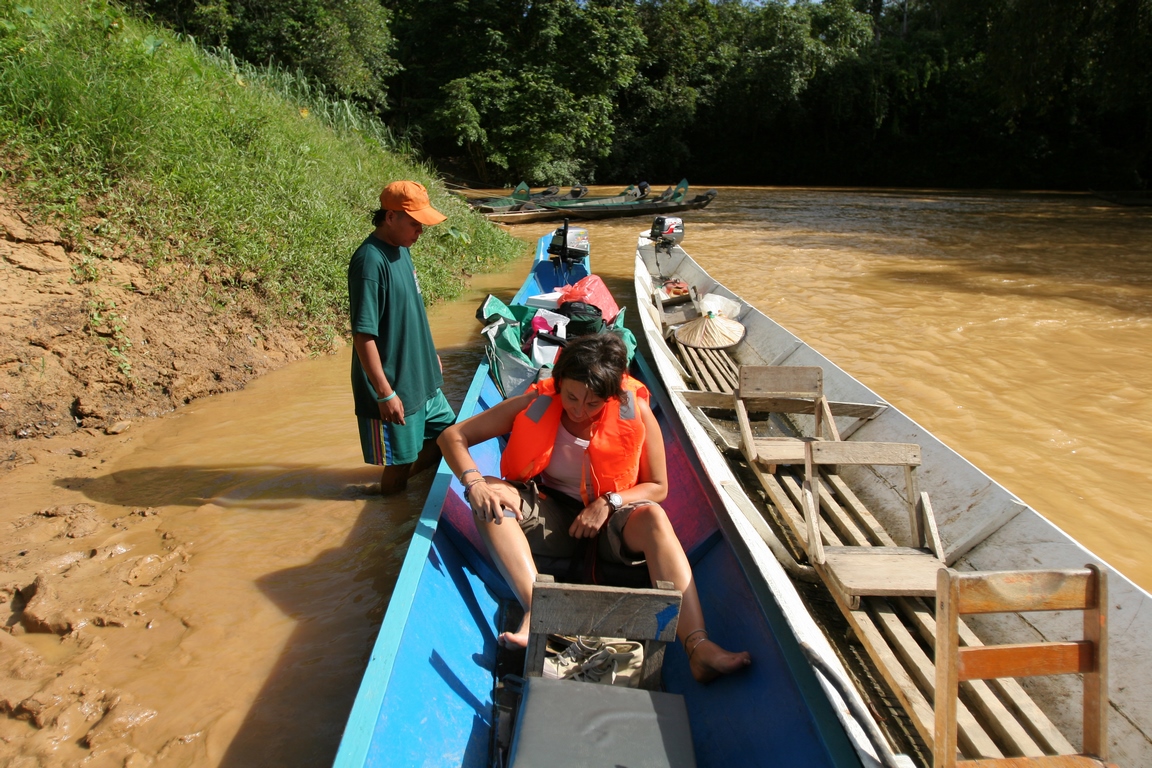
Kuching, the capital of the state of Sarawak, is some 280 km from our embarkation point, Lubok Antu, on the shores of Lake Batang Ai. The pier is non-existent. So it was with our feet in the water that we joined the traditional motorised pirogues that would take us to the longhouse of Ngemah Ili, on the banks of the Lemanak river. There are four of us in this boat, or praoA rather unstable group, including the security guard and the pilot.

We are at the end of the monsoon season and the current is fairly swift. To be on the safe side, we had to sail close to the banks, which were calmer. Two hours later, after passing a few houses on stilts and watching the rainforest go by, we arrived at our drop-off point. We disembarked to the sound of the gong and drums of the Ibans who had come to welcome us. The longhouse is set up in an elevated position, parallel to the river. The river is the only means of transport.
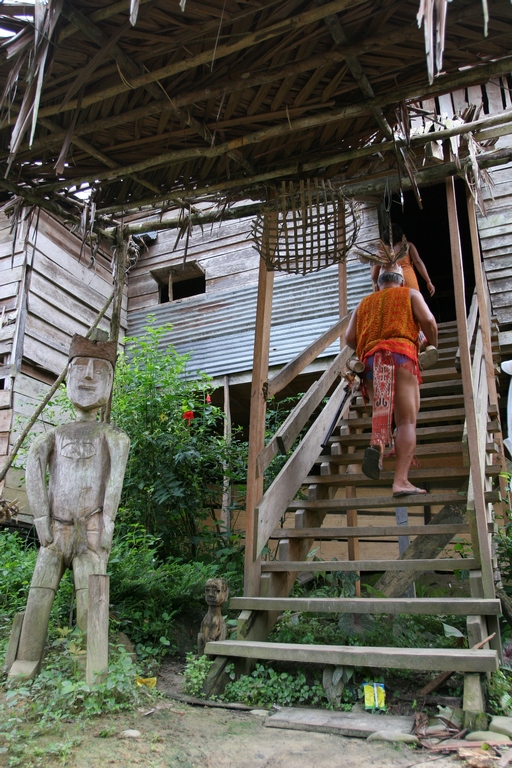
One of Sarawak's oldest architectural styles
The umah hai (umah means house and hai means long in the Iban language) are found throughout Sarawak. They are found among the Ibans, the Dayaks of the island's interior, the Bidayuh and the Orang Ulu. The use of local materials and their layout are in harmony with the environment and climatic conditions. The importance of these "residences" can be gauged from the fact that all Ibans are tied to a longhouse, to the extent that, until recently, living in an individual dwelling was considered abnormal. The Ibans said of these solitary individuals that they were under the influence of the "spirit of evil". When Ibans meet, they introduce themselves by referring to the community they come from. "I come from the house of Tuai (chief) XX". Even Ibans who have left to work in the cities and live there return at least once a year to the longhouse where their family lives to celebrate their ancestors.
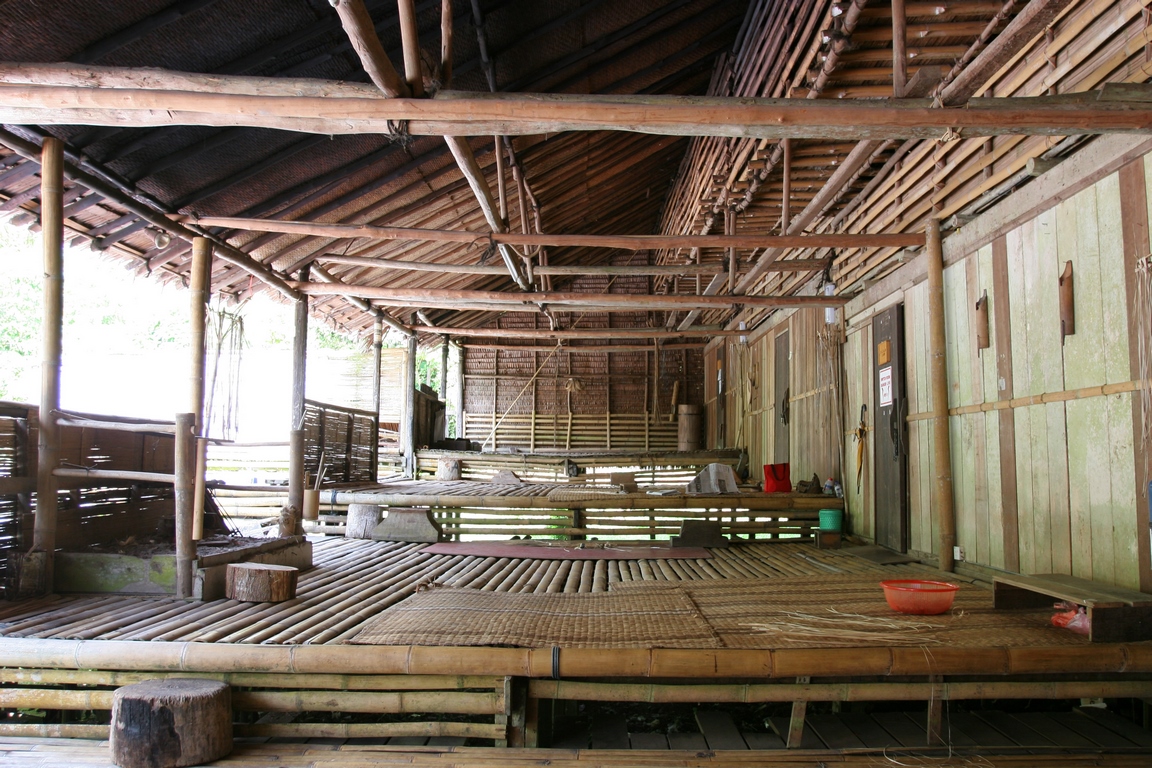
These houses are raised communal dwellings built on pillars planted in tight rows. They are made of ironwood, as softwood would not withstand the constant humidity of the soil and air, or the tropical rains that can flood the ground. They vary in height from three to ten metres and in length up to fifty metres, sometimes more. They comprise a series of flats or bilekThese are arranged in a linear fashion, separated by bamboo partitions. Each bilek is home to a family with children and grandparents. Each flat is linked by a solid door to the communal gallery on one side.

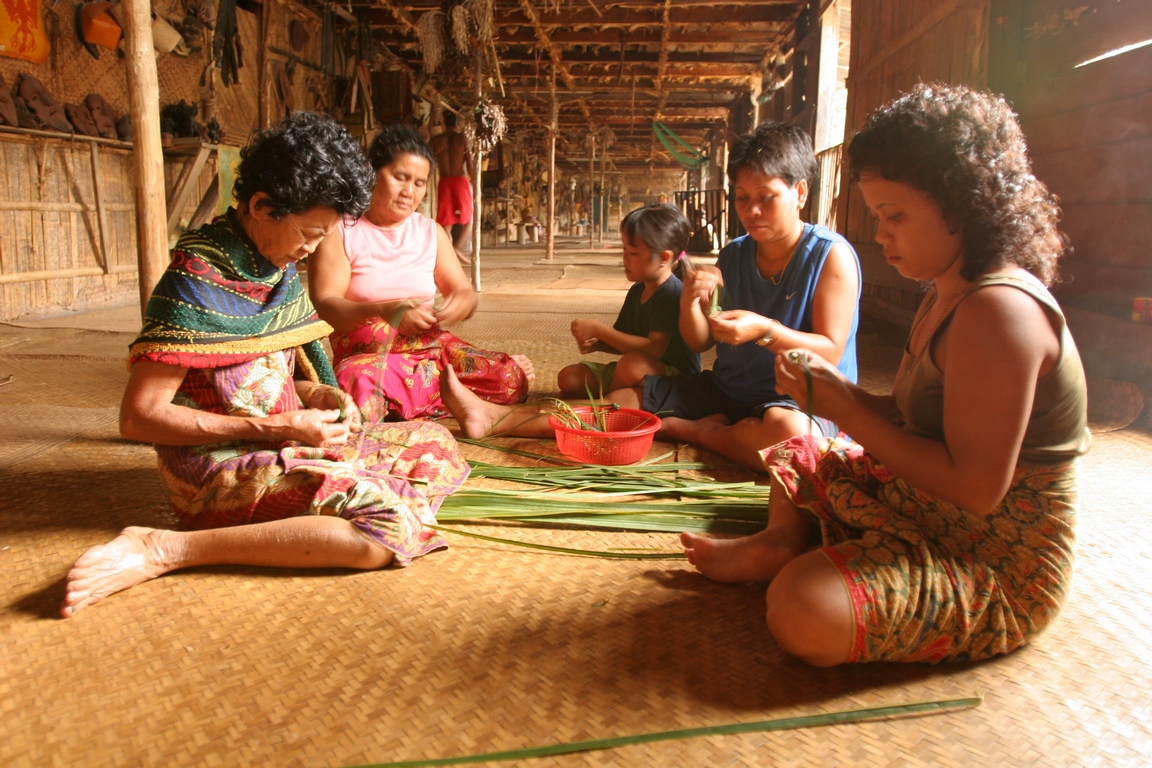
Here, the Ibans go about their daily chores; mothers cradle their babies in small bamboo cradles while chatting with their neighbours. Others weave rattan baskets. Visit ruai is the place for social interaction par excellence. It is adorned with colourful woven panels, various rattan mats, posters, colourful shields, quivers full of arrows, etc., not to mention a few dried heads in nets hanging from a beam.
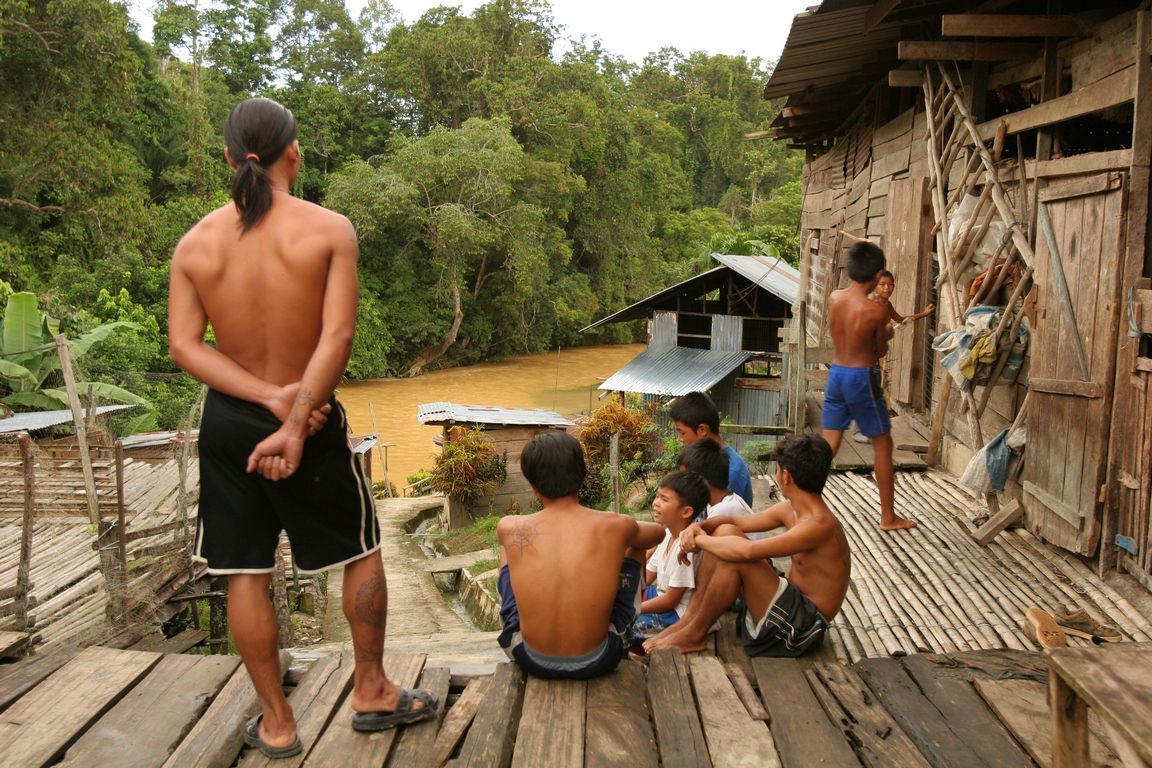
On the other side of the private spaces are the kitchen and the toilet area, sometimes with a shower. Longhouses have a sloping roof. This shape is adapted to Borneo's tropical climate, with heavy rainfall throughout the year. It is covered with sago or palm leaves, but more recently many have adopted zinc sheet roofs over the leaf thatch, which are simpler to install but so much less aesthetically pleasing... Under the sago or bamboo slatted floor, chickens, pigs, dogs and the inevitable rooster wake us up at dawn.
Building techniques
Two types of structure are used in the construction of traditional longhouses. The first is made of hardwood posts and beams, while the other combines hardwood pillars with light-frame bamboo cladding. The hardwood post-and-beam structure is common in Iban and Orang Ulu longhouses, while bamboo is more commonly used in Bidayuh longhouses. Pillars and beams are joined using a traditional mortise and tenon joint. This technique makes it easier to dismantle and extend the building. When the family grows, the residents can add another living space. bilek to the main house or, if this is not possible, to build close to the individual houses. They are connected to the longhouse by elevated walkways made of planks on stilts.
However, these traditional buildings are gradually being abandoned by the inhabitants in favour of small detached houses. Customary materials and building methods are being replaced by modern materials and construction techniques. The traditional longhouse is now an endangered habitat, although some are being rebuilt with greater comfort to accommodate tourists or maintained as cultural artefacts with historical value, rather than as living spaces.
Fortunately, some Iban groups remain attached to their way of life. The longhouse where we stayed is home to around fifteen families. It is run by a chief called " Tuai rumah "He was chosen for his charisma and sense of responsibility. He is chosen for his charisma and sense of responsibility, and leads the group with a gentle hand, according to the oral law. He must arbitrate conflicts between the bilek of a longhouse according to adatcustom; enforcing what is forbidden - pamali -In the past, before the Brooke rajah and the Dutch eradicated headhunting, it was he who decided on these disastrous expeditions. In the old days, before rajah Brooke and the Dutch eradicated headhunting, it was he who decided on these disastrous expeditions. All the residents are joint owners of the common property: the house, the banana fields, the rattan coppice, the virgin forest and the rice fields. The values of mutual aid and sharing are alive and well, whether in hunting or rice-growing, as are honesty and the taboo against lying. "The Dayak is the most honest man under the sun., wrote Eric Mjöberg, former director of the Sarawak Museum in Kuching and a great explorer of the island. During the harvest, the houses are left unguarded while the inhabitants live night and day in the rice fields; nothing ever disappears. "[1]. Moreover, the Iban language has no word for theft.
Iban hospitality
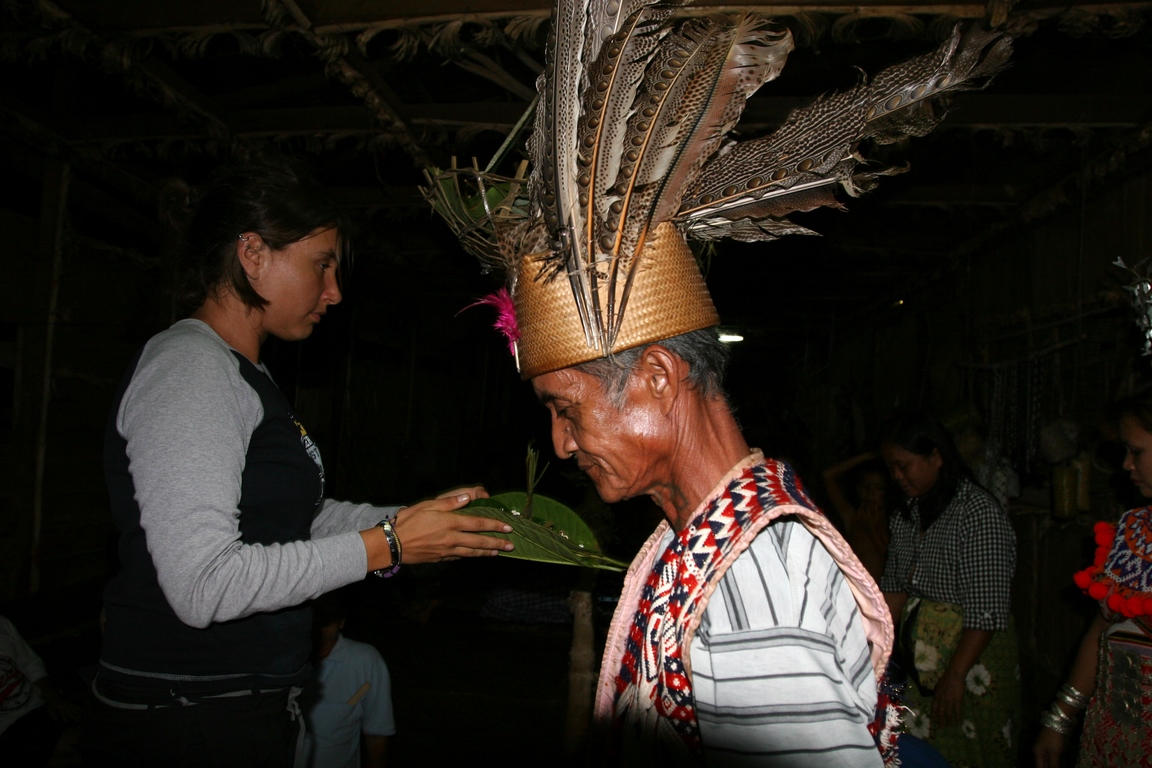
Known for their hospitality, today's Ibans are as friendly and welcoming as their ancestors were fierce and cruel. According to Peter M. Kedit, ethnologist and deputy director of the Sarawak Museum (Kuching): "When visitors come to the longhouse, they are like gods who have come to bring good fortune and blessings to the community. So the Ibans welcome all visitors with the same kindness and hospitality as the gods. suit their celestial visitors".[2]. The Ibans are constantly concerned to live in harmony with the spirit world. If visitors are important, they don't hesitate to celebrate a special occasion. miring. " These ceremonies are generally organised to honour the petara (gods), spirits and ancestors. In other cases, they may be performed to make a wish or to succeed in future endeavours, in business or travel, or to appease the spirits and gods of the natural world. If the ceremony is not done properly, it could lead to bad luck or bad dreams. "explains a young Iban in broken English.
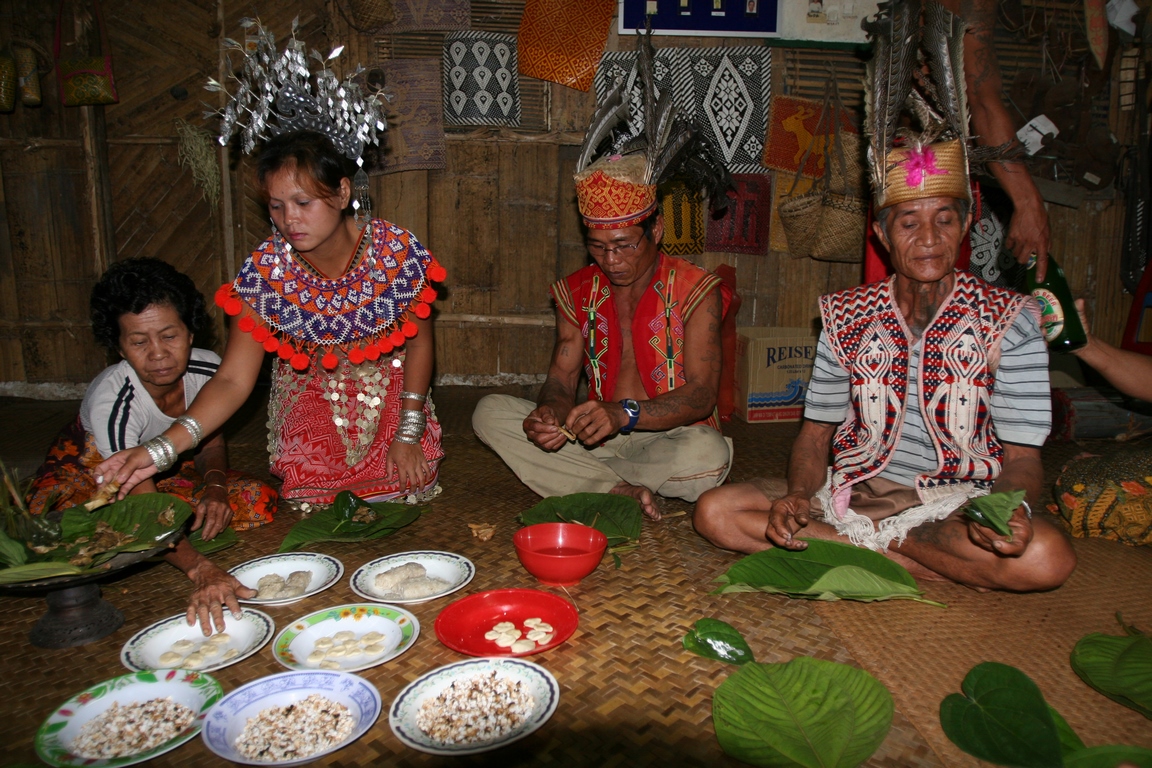
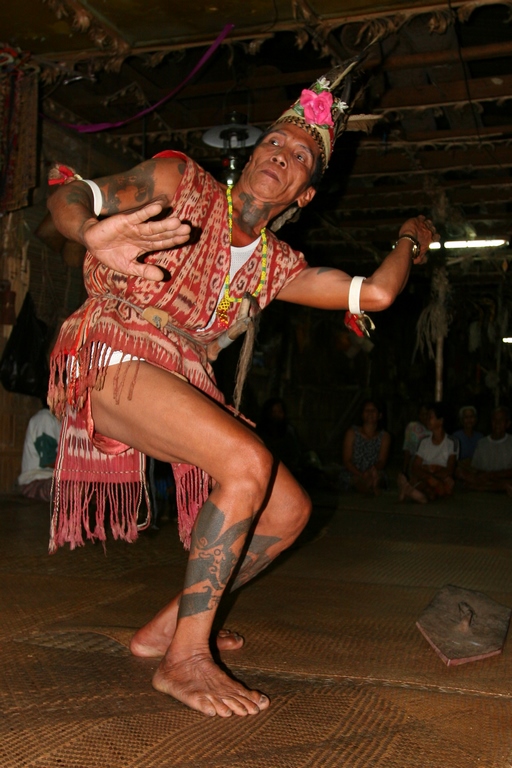
For that miringour guests donned their ceremonial robes and everyone gathered in the gallery to watch the show. "the spirits of the forest protect us and keep the bad ones away from the house".. After the offerings (rice and betel leaves, chicken), the Iban offered us a concert and a demonstration of traditional dances, including the famous war dance. ngajat.

Meals are served in the gallery by people appointed by the chief to look after the guests. We are seated on mats on the ground, and the women have prepared a simple meal based on rice, which is present at every meal, fish and vegetables grown around the village. The side dishes vary according to the fishing, hunting and harvests of the day. And for those who like it, a small glass of rice alcohol (tuak) as a toast.
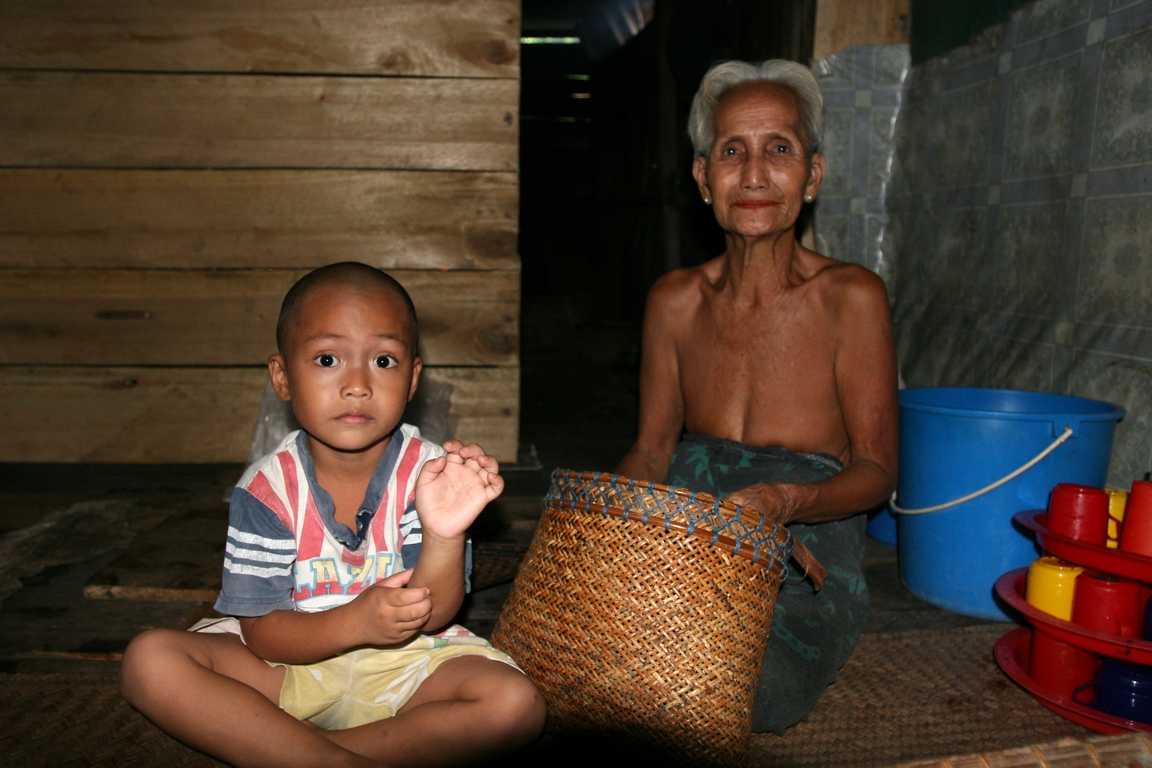
Families return to their ibek for meals. Before returning to spend the afternoon or evening in the gallery, lit by simple electric bulbs. Our sleeping arrangements are set up each evening: a simple foam mattress on the floor, with a sheet and a piece of cloth as a blanket, all under the essential mosquito net. The nights are short. The evening gatherings, card games and discussions can keep us up late into the night. We sleep in the communal area, which is partly open to the forest, and hear all sorts of noises unusual to our Western ears. The household is up very early. The roosters and birds start first. We yawn from a too-short night while our hosts are already fishing or gutting fish. Others go off to work in the rice fields, or the pepper and rubber plantations close to the houses. While the younger children go to the village primary school, the women go to the river to wash their clothes. The teenagers are mostly absent. They attend boarding schools in the towns, which is the only way they can continue their secondary education. Today, many young men leave for urban centres or Brunei to support their families. This brings in more money but poses problems for farming activities in the village communities.
That leaves tourism development to generate revenue. Tourists now pay a small fee for their accommodation. The money is pooled and used to meet the needs of the community, in the event of illness or to organise festivities. Travel agencies have understood this and are keen to protect this fragile socio-cultural ecosystem, one of Sarawak's assets. This is undoubtedly the price to pay for the survival of authentic longhouses.
Who are the ibans
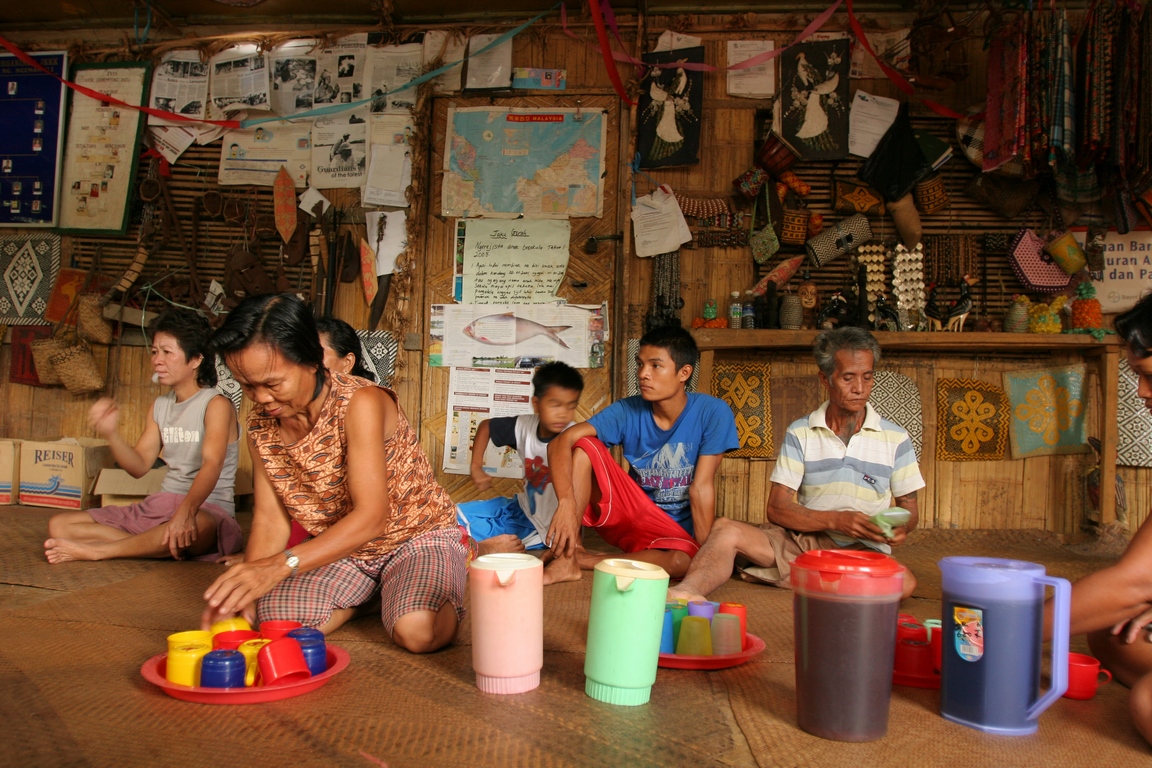
The Ibans, also called Sea Dayak by the first English settlers because they appeared to be particularly adept at navigation, are today the largest Dayak group (around 700,000 people). Of Malay origin (probably from Sumatra, from where they emigrated in search of arable land), they came to Borneo late in life. Their language indicates that they arrived before the conversion of the Malays to Islam (15th century), however, as it contains no Arabic words. They settled on the banks of the rivers they crossed in dug-out canoes and gradually became sedentary. Living in a territory distinct from that of the Dayaks of the interior and separated from them by the Sadong river, the Ibans are made up of sub-groups: Saribag, Skrang, Undup, Ulu Ai, Lemanak, Balau and Sebuyan. Once concentrated in the region around Sarawak, on the border with the present-day Sultanate of Brunei, the Ibans have spread throughout the island of Borneo. As for the word Iban, it comes from the word kayan Ivan which means 'traveller' and characterises the incoercible tendency of marine Dayaks to explore unknown places.
The latest headhunters
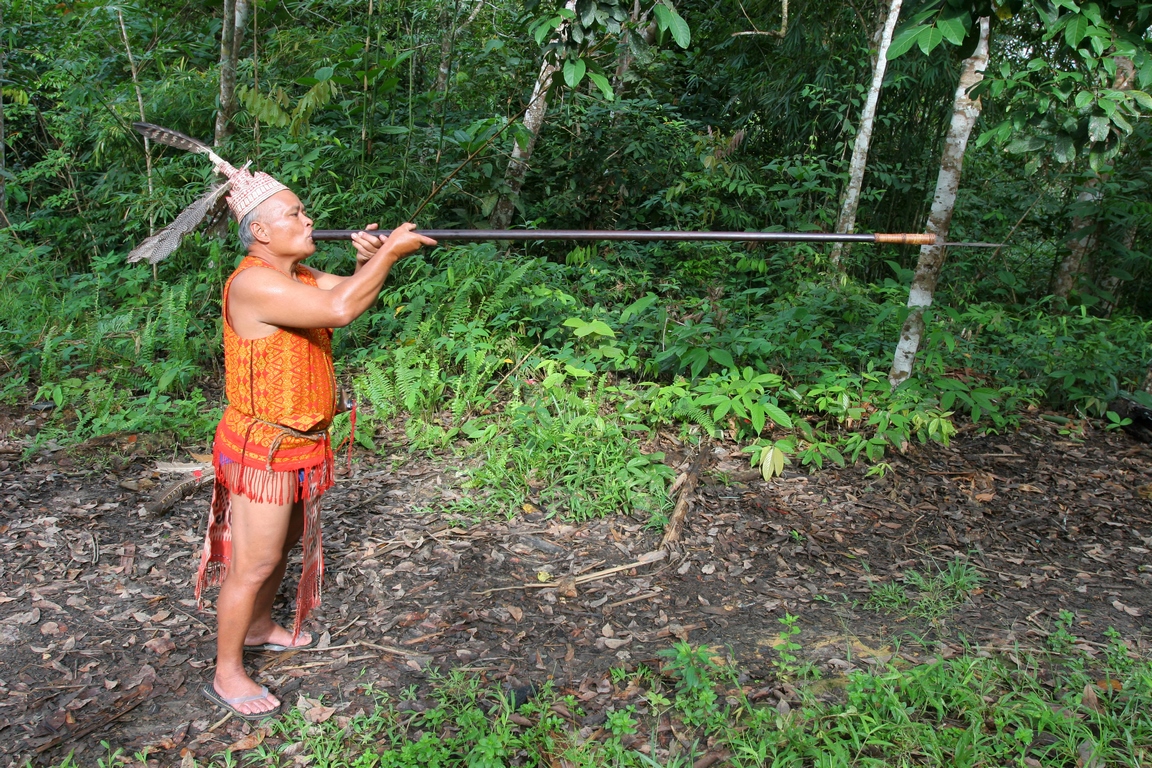
Despite the efforts of the white rajahs[3] to eradicate this practice, headhunting continued until the early 1930s. Associated with notions of vitality and fertility, headhunting was an integral part of customs. It was practised to ensure a good harvest, to bring in game or to celebrate a special event in life. "There can be no births, weddings or funerals without the passive collaboration of enemy skulls, intended to enhance the solemnity of the ceremony".revealed Norwegian explorer Carl Alfred Bock in his writings of 1887[4]. A man is never held in complete esteem until he has brought back at least one head and thus proved his valour. And anyone who has not cut off a head does not count in the eyes of women and cannot marry. "The last incidents of headhunting were recorded in 1975 and those of which I have personal knowledge date back to 1959".reveals Vinson Sutlive, who has studied the Iban tribes of Sarawak.[5]. Today, the skulls displayed in the longhouse galleries are still venerated and believed to ward off evil spirits.
in Borneo
Borneo, the third largest island in the world (one and a half times the size of France), lies at the centre of the Malay Archipelago. Most of it, in the south (Kalimantan), belongs to the Republic of Indonesia. The north includes the Sultanate of Brunei and two member states of the Malay Federation: Sabah and Sarawak.
Text and Photos: Brigitte Postel
This article appeared in Natives n°8 https://www.revue-natives.com/editions/natives-n08/
[1] Eric Mjöberg. Borneo, the island of headhunters. Librairie Plon, 1934.
[2] Peter M. Kedit, Modernization among the Iban of SarawakKuala Lumpur, 1980.
[3] "Rajahs" refers to the British James Brooke, his nephew and his grand-nephew. The first, known as the "White Rajah", was an Indian-born adventurer who helped the lieutenant of the Sultan of Brunei to subdue the rebellious natives in 1839-1840. In 1842, Brooke obtained ownership of Sarawak from the Sultan, which became his rightful property.
[4] Carl Alfred Bock. Among the cannibals of Borneo. Karyair Voyage. Reissued 2019.
[5] Encyclopaedia of Iban Studies, Vinson and Joanne Sutlive. Kuching: The Tun Jugah FoundationBorneo Classics Series, 2001, published in https://journals.openedition.org/moussons/2751

Hello, I've just read about your very interesting recent stay in a longhouse in Serawak. Could you give me the name of this one as there are lots of offers on the net but I wouldn't necessarily like to go through a big agency. Thank you in advance and have a good trip
Hello,
Sorry for the late reply. You need to go through a Sarawak tour operator like Seek Sophie. https://www.seeksophie.com/collections/kuching-things-to-do-in-sarawak-longhouses-c14jndee5q
You can find the longhouse where I stayed on their homepage. Have a nice trip