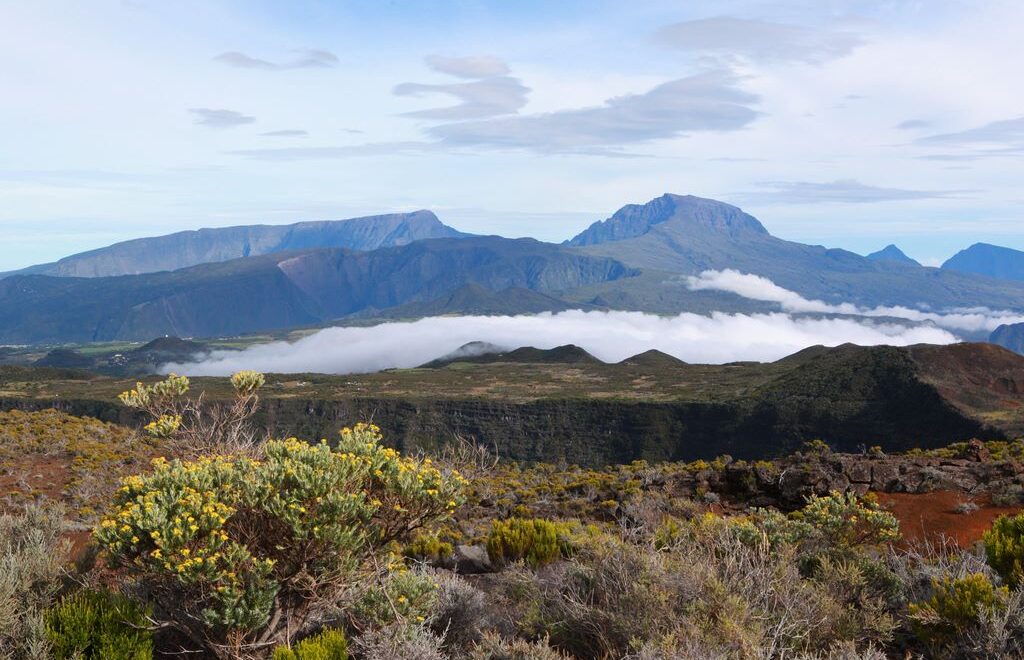
A volcanic island rising out of the Indian Ocean, Réunion is a sanctuary of biodiversity. Primary forests, humid ravines, Creole gardens and mountain paths are home to an extraordinary flora, with endemic species and plants from elsewhere that have found a home here.
In the mists of the Hauts, along volcanic paths or at the turn of a Creole garden, the flora of this intense island tells a vibrant, ancient story. Here, botany is more than just a descriptive science. It is memory, cuisine, migration and resistance. From the fanjans of the primary forests to the brèdes of the fairground markets, from protected endemic plants to species from other continents, the island has a complex plant story to tell. An immersive encounter with some of its emblematic botanical figures.
Table of Contents
Acmella oleracea or brède mafane, the plant that sparkles
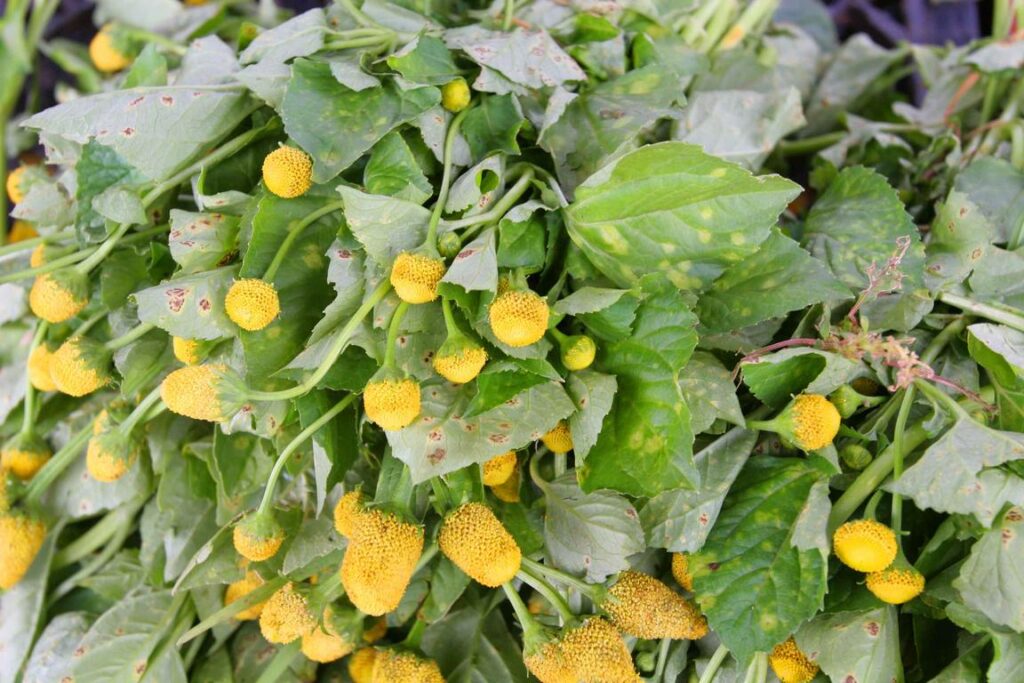
At a market in Saint-Paul, among the fresh bream lined up in green bunches, the mafane bream (Acmella oleracea). It is as surprising as it is tasty. Its small yellow flowers with red centres look like miniature buds.
The ancients and sailors used it to relieve toothache. In Creole cuisine, it is used to flavour rougails and salads. « It's a plant that plays with the mouth »explains a producer at the market. Thanks to its natural anaesthetic properties, its flower buds were chewed to numb a toothache or treat a mouth ulcer during long crossings. This is why it is known as the «dental plant» in some parts of the world. The Reunionese writer Jean-Louis Robert, in his book Le Fond des Choses, With a touch of poetry and a sense of humour, he evokes the very special sensation that defines the culinary identity of the Indian Ocean: « Brède mafane is the herb that makes your mouth water and your tongue go on holiday. It doesn't just nourish, it electrifies. "
Allamanda blanchetii, the splendour of the coastline
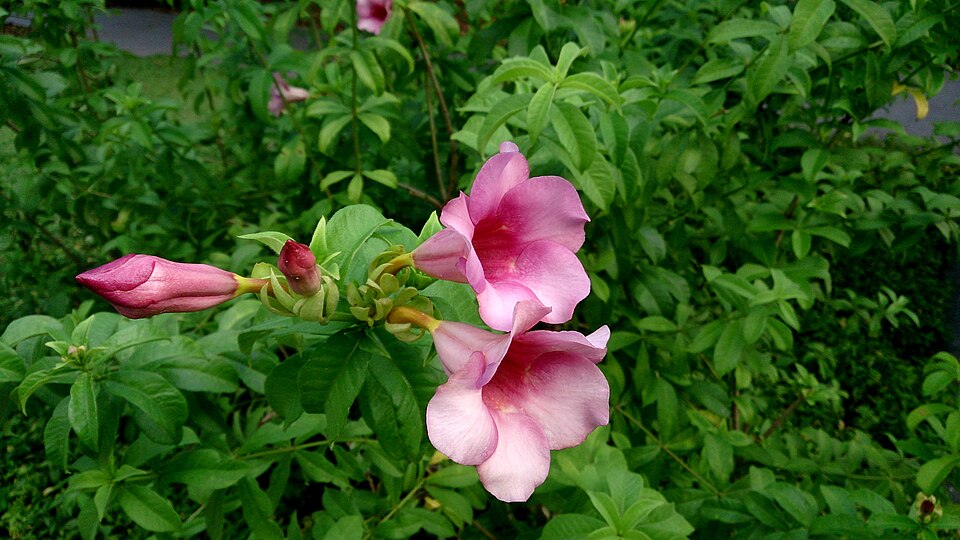
In the sunny coastal gardens, from the heat of Saint-Gilles to the sea breezes of Saint-Pierre, Allamanda blanchetii bursts into wide, violet trumpets and displays an insolent vitality. Originally from the arid lands of Brazil, this shrubby liana has found a home in the Reunionese sun, mirroring its native climate and becoming one of the island's most spectacular flowering plants.
Unlike its yellow cousin (the Allamanda cathartica), the blanchetii is distinguished by its large, trumpet-shaped corollas of deep violet, sometimes tending towards wine-red. Their texture, surprisingly soft to the touch, is reminiscent of velvet. In Réunion, it is affectionately known as the «Violet Trumpet», a name that sings as much as its colour bursts against the blue of the sky.
But don't be fooled by this apparent sweetness. Under the bark and in the stems circulates a white, sticky and highly toxic latex. This sap is a formidable defence mechanism against herbivores. The old-timers say that you should never put your hand to your eyes after pruning the shrub, or you will suffer severe burns. This is the paradox of tropical flora: a magnetic beauty that demands respect, even a certain distance.
Alsophila borbonica, tree fern
In the wet forests of Bélouve or Bébour, as the altitude brings coolness and mist, a majestic silhouette emerges from the chaos of the vegetation: the Alsophila. borbonica. Better known as the female Fanjan, the large tree fern, endemic to the Mascarene Islands, is one of the most emblematic silhouettes of Réunion's forests.
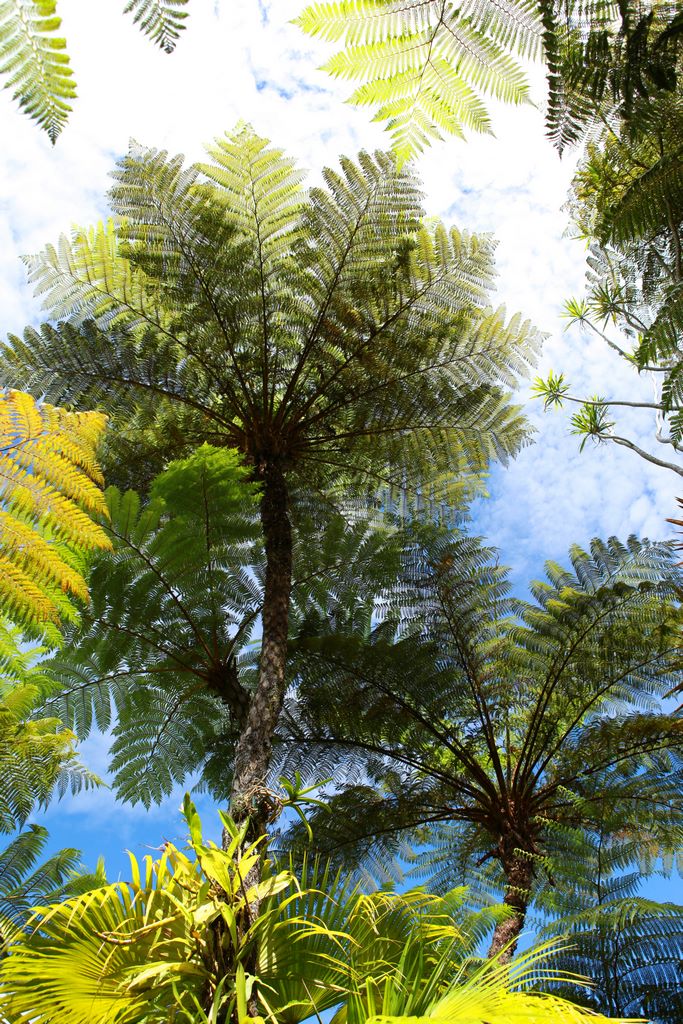
Its dark, fibrous stipe (trunk), which can grow up to 10 metres high, carries an umbrella of delicately cut, soft green fronds at arm's length. Under this crown of fronds, the light filters through, subdued, almost liquid, creating shadows that move across the soggy ground. Mosses, orchids and young shoots flourish here: an ecosystem in miniature. The trunk isn't just a support, it's a host. A veritable miniature ecosystem, its fibres harbour a teeming life: sponge mosses, epiphytic orchids and young shoots cling to it in search of light. As the Reunionese poet wrote Jean Albany (1917-1984) : « The fanjan is a large wooden bird that never flies away, but which shelters the secret of the springs under its lacy wings.. »
The omnipresence of these giants gives the forest an almost prehistoric atmosphere, a journey back in time to the secondary era. It's easy to see why botanists refer to this as a «primary forest». The Reunionese botanist Thérésien Cadet (1937-1987) saw them as « evidence of an ancient world, predating mankind ». Imperturbable sentinels watching over the fragile balance of the mountain ecosystem.
Cordyline mauritiana or Canne Marronne, the discreet sentinel of the Hauts
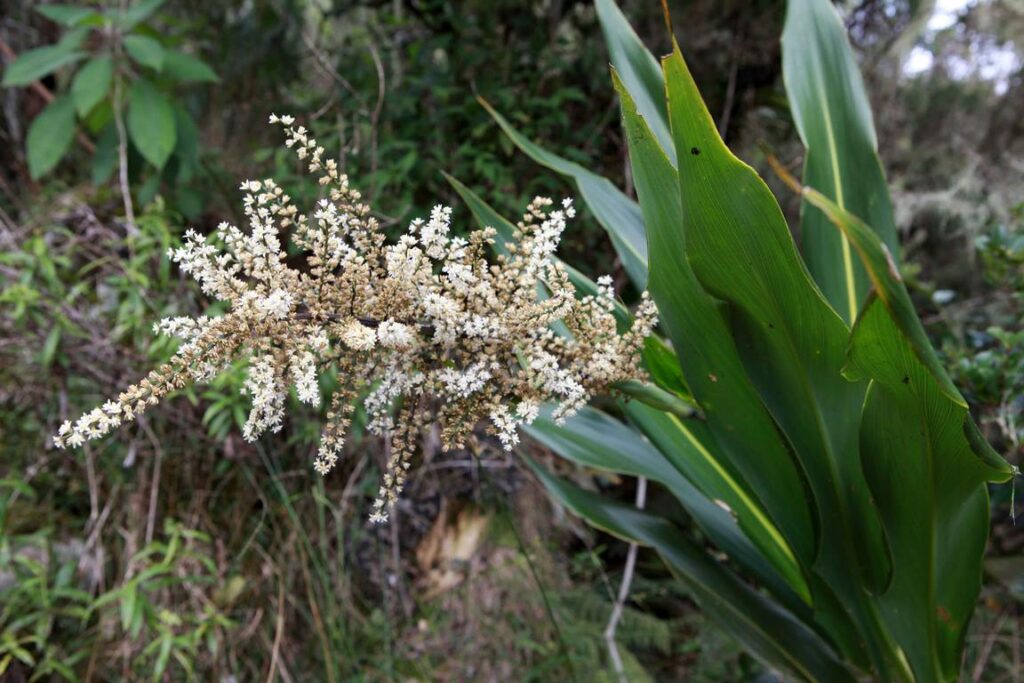
In the forests of Les Hauts, at the bend of a path on the Réunion National Park, The maroon cane stands with vertical elegance. Endemic to Réunion and Mauritius, it is one of those plants that silently structure the landscape. Long, lanceolate green leaves, discreet whitish inflorescences: nothing ostentatious, but a constant presence.
Its leaves unfurl in spirals or graphic tufts along sturdy stems. Its inflorescences, small clusters of whitish or pinkish flowers, don't try to dazzle: they whisper their presence. In Réunion, it is often said that the cane marronne is the «most beautiful cane in the world".« mountain reed ".
For National Park staff and botanists, its presence is a barometer of the primary forest. It is an indicator plant: where maroon cane flourishes in large colonies, the forest is still breathing its original air. Its disappearance is often the first sign of invasion by exotic species such as maroon vine or guava. Old-time hikers say that the presence of chestnut cane is a sign that you are entering the »real» forest, where the humidity is so high that moss grows right on the ground.
Although less famous than »Bois de Rempart» or »Petit Natte«, it was once used for its medicinal properties (often as a depurative in »la kour« herbal teas). Today, it is no longer picked, but admired as a witness to the biodiversity that has taken thousands of years to forge between the peaks and ramparts.
Medinilla speciosa, suspended elegance
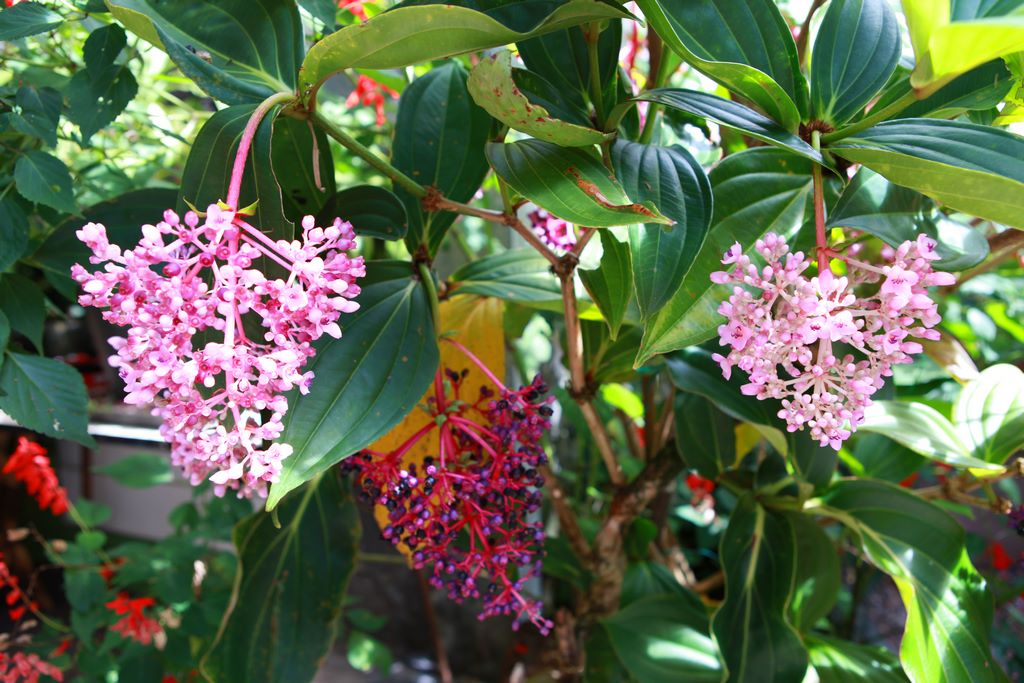
In the refreshing shade of a Creole garden, in the shelter of a pergola or under the protective canopy of tall trees, Medinilla speciosa Its pink bunches hang like plant jewels. Native to South-East Asia, this epiphytic plant (which can grow on other plants without parasitising them) has found a suitable setting of humidity and subdued light in Réunion.
Nicknamed the «Pink Grape» or the «Royal Chandelier», it is a permanent spectacle. Its broad, deep-green evergreen leaves are marked by very graphic longitudinal veins. But it's the flowering that really catches the eye: long, drooping clusters of bright pink flowers, borne on fleshy stems of the same shade.
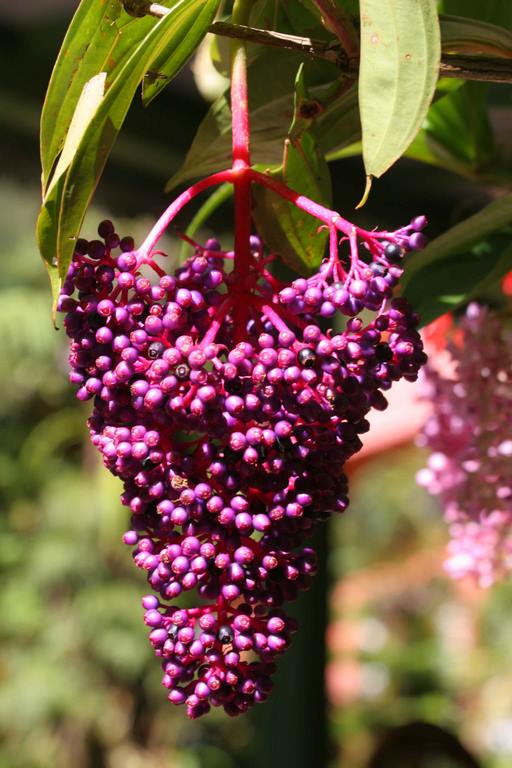
As the flowers fade, they give way to small, purple berries resembling glass beads, prolonging the plant's decorative appeal for months. Visit Jardin des Mascarins in Saint-Leu or Jardin de l'État in Saint-Denis, it is the darling of photographers. Guides often explain that its beauty comes from its bracts (modified leaves), which protect the real flowers, creating this colourful cascade effect. It embodies plant luxury, that exotic touch that transforms a simple corner into a natural reception room.
Polygonum capitatum, small-headed knotweed
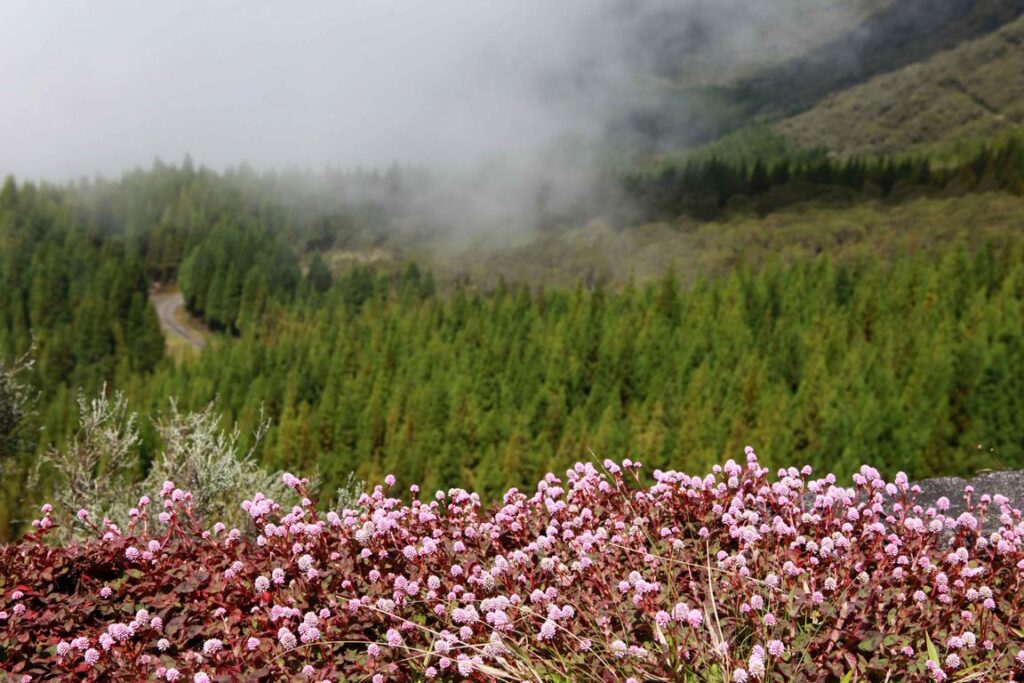
Creeping and carpeting, Polygonum capitatum (also known as Persicaria capitata) forms pretty green cushions punctuated by small spherical pink inflorescences. Native to the foothills of the Himalayas, it has found a second home in Réunion, spreading from the coastal gardens to the damp ramparts of the cirques.
Used in horticulture as ground cover for its ability to mask bare earth, it adds a touch of softness to low volcanic stone walls. Introduced for its ornamental qualities, Purple Loosestrife has acclimatised with a vigour that borders on insolence. Capable of taking root at the slightest contact of its stems with the ground by natural layering, it colonises degraded areas, roadsides and even intrudes into cliff breaches. Its invasive nature is a reminder of the fragility of island balances: by forming an impenetrable carpet, it can prevent the seeds of native species from germinating, becoming what botanists call a potential »plant plague». It therefore requires constant monitoring to ensure that the undergrowth is not transformed into pinkish monocultures.
Scaevola taccada or Brown manioc: the sentinel of Réunion's coasts
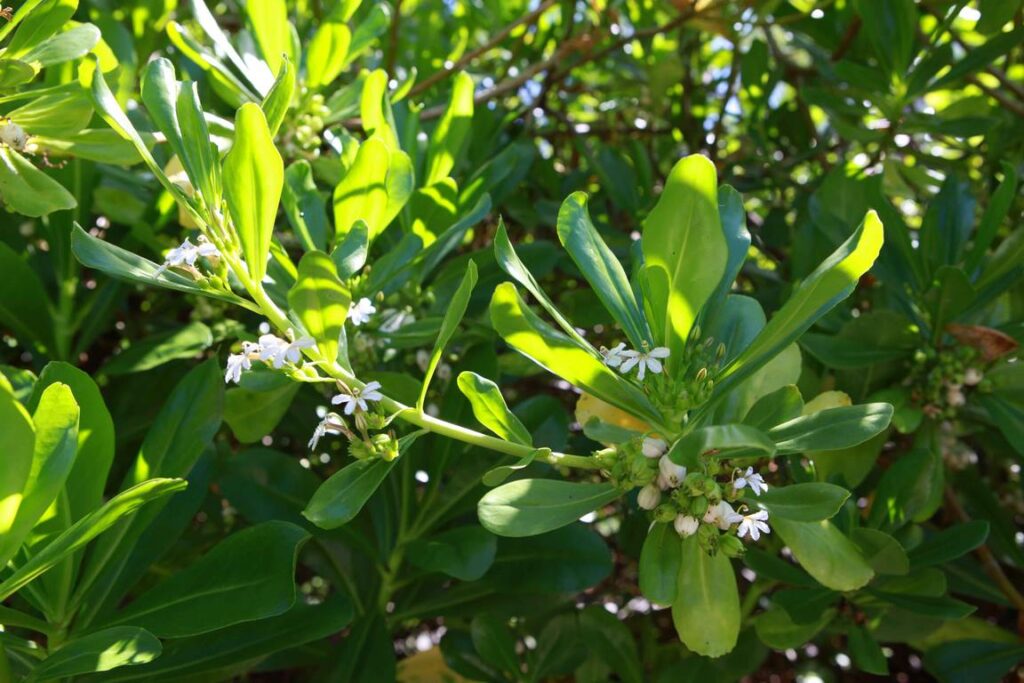
From the Pointe des Galets to the black sandy beaches of the Sud Sauvage, a green, fleshy silhouette dominates the seafront: brown cassava. Although often confused with its nourishing cousin by neophytes, there is nothing esculent about it.
Brown cassava doesn't take the easy option. Where salt scorches the earth and trade winds dry out vegetation, it thrives. This plant, native to Réunion, is a veritable coastal «engineer». With its dense root system and succulent leaves capable of storing water, it stabilises the dunes and slows the advance of the sea. « On the coral sands, the Scaevola forms a line of defence of exemplary robustness, offering its strange, unfinished corollas to the foam. « writes Thérésien Cadet in his book Flowers and plants of Réunion.
For local ecologists, it is a precious ally: it is the first line of defence against coastal erosion, a major issue on an island that is increasingly vulnerable to cyclonic swells.
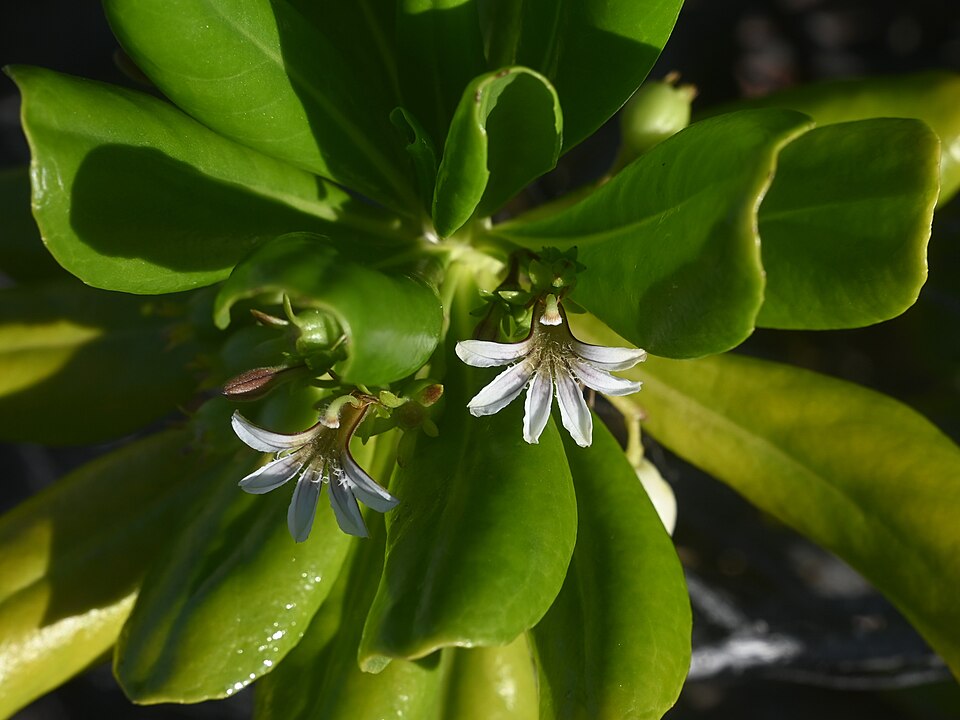
But what strikes the attentive observer is its singular flowering. The flowers of the Scaevola appear to have been cut off neatly in half, fanning their white petals downwards.
Cette curiosité biologique a donné naissance à un riche folklore. À La Réunion, on évoque souvent l’histoire de deux amants maudits, séparés par la force des choses, dont le sacrifice se reflète dans cette corolle incomplète. Une dimension poétique qui contraste avec la rusticité de la plante, faisant du manioc marron un sujet d’étude autant pour les botanistes que pour les conteurs. © Krzysztof Ziarnek, Kenraiz/Wiki Commons.
Its small white fruits, similar to polystyrene pearls, are disconcertingly light. Able to float for months without altering, they drift with the ocean currents to colonise new shores. « It's a plant that has travel in its blood, or rather in its seed. »The guides from the Conservatoire Botanique National de Mascarin are often amused.
But don't be fooled by appearances. Although its name «manioc» comes from the resemblance of its foliage to the tuberous shrub, the comparison stops there. There are no roots here to be turned into cake or flour: brown cassava is an ornamental and protective plant, but absolutely not edible.
Tacca chantrieri or the bat flower, a Gothic beauty
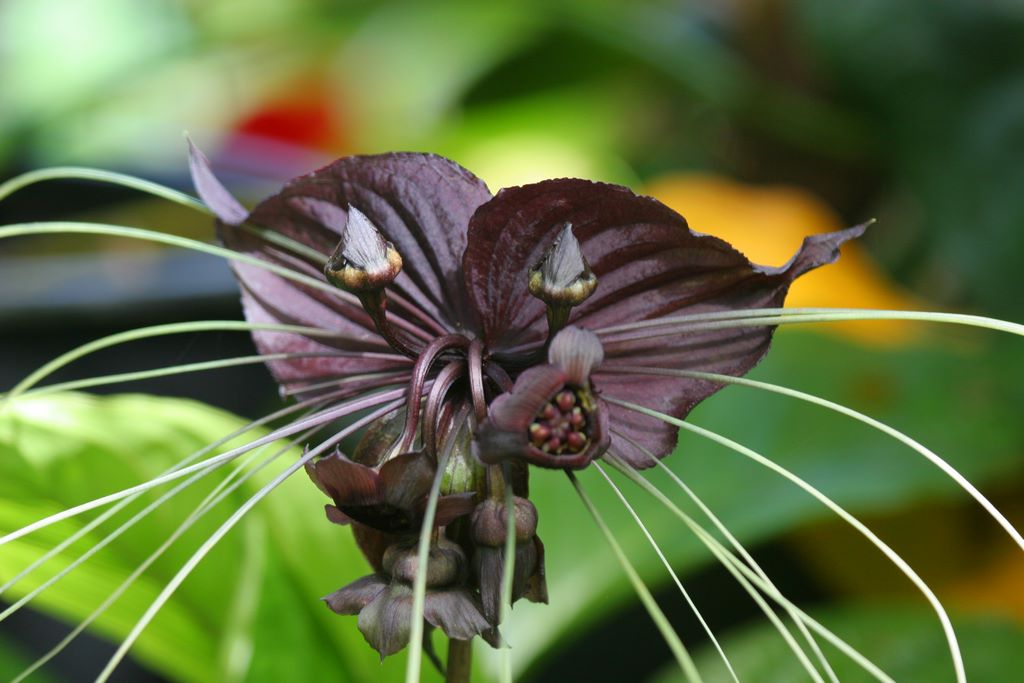
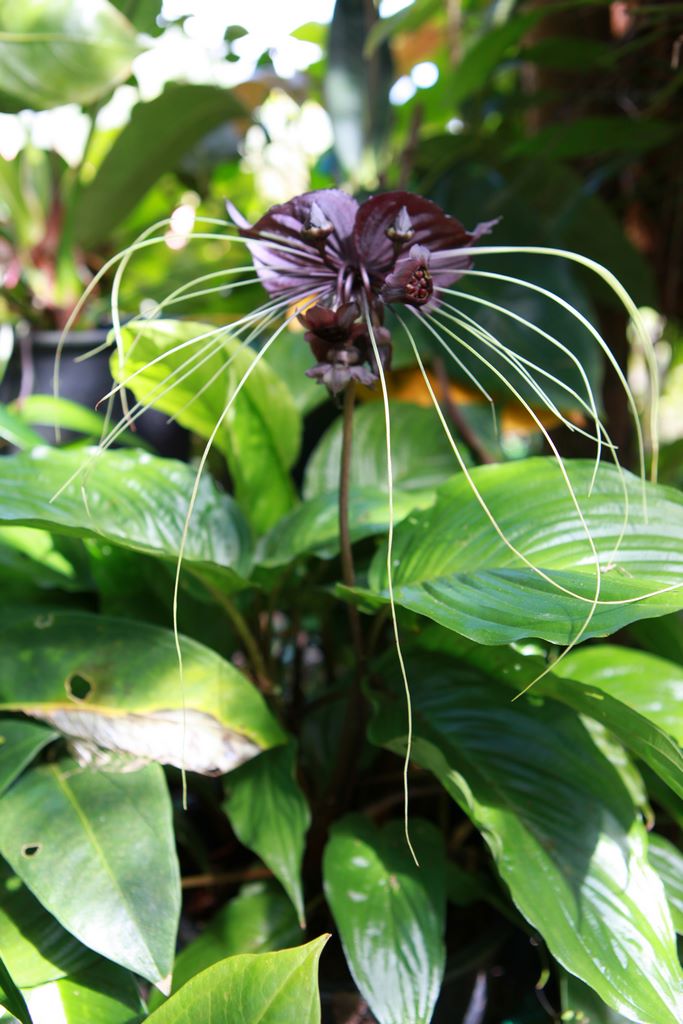
This plant is a real botanical curiosity, a sight to behold in the tropical gardens of Réunion Island. It seems to have come straight out of a cabinet of curiosities or a fantastic tale.
Its silhouette is unique in the world: bracts of a purple so dark that they appear black, spread out like the wings of a chiropteran in full flight. But it is its long »whiskers«, drooping filaments that can grow to 20 centimetres, that give it that strange, majestic air, like a creature from the abyss.
Native to South-East Asia but perfectly acclimatised to the humidity of Reunion Island, it is the very symbol of radical exoticism. For travellers, spotting it at the bend in a path in Saint-Philippe, in the Jardin de l'État in Saint-Denis or in the Folio house in Salazie is a suspended moment. It's a reminder that tropical nature isn't just about colour: it also excels in the theatrical and the mysterious.
The challenges of biodiversity with two faces
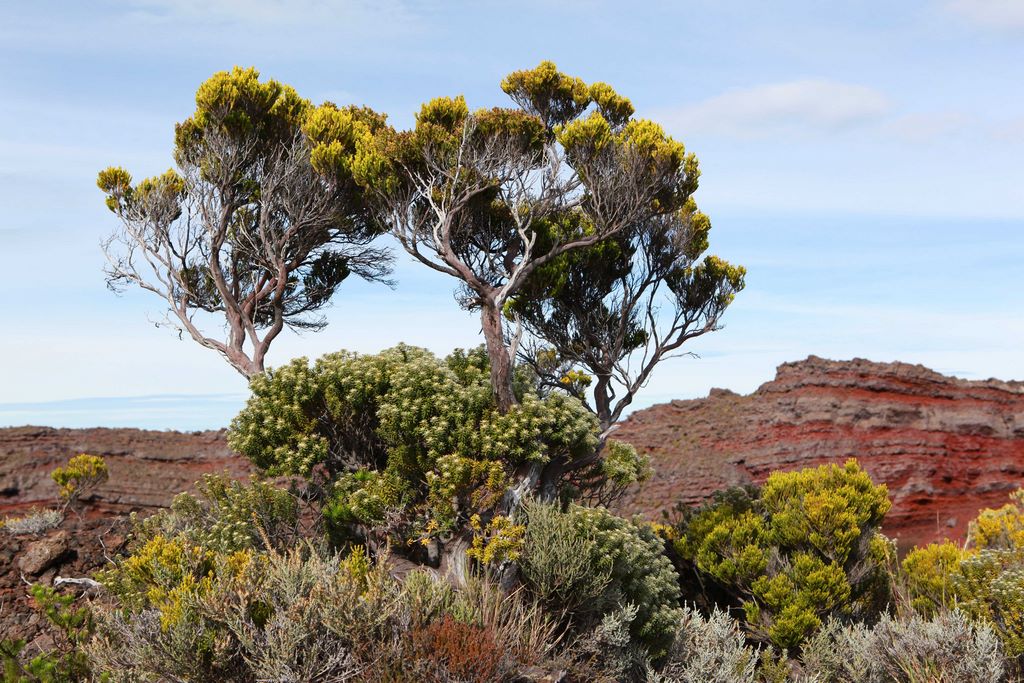
At the end of this brief inventory, one thing is clear: Réunion's flora not only decorates our landscapes, it is a living record of them. From the windswept coastline where the brown cassava erects its leathery ramparts, to the misty sanctuaries where the fanjans unfurl their age-old lacework, each species is a page in Réunion's history.
This plant journey reveals a biodiversity with two faces. On the one hand, the silent resilience of native species, such as the maroon cane, a sentinel of the shadows that testifies to the original purity of the forests. On the other, the sometimes invasive brilliance of the travellers: while the Allamanda and Medinilla offer the eye the luxury of crimson trumpets and clusters of jewels, the pink carpet of Polygonum reminds us, with an almost disturbing vigour, that the balance of an island is an architecture of crystal.
Tomorrow's Réunion depends on this cohabitation. Between the legends of »half-flowers» and the scientific realities of the fight against invasive species, botany is becoming a civic discipline. Protecting these plants means preserving much more than a genetic heritage: it means safeguarding the poetry of the Hauts, the effectiveness of natural ramparts and the memory of the ancients who knew how to read in each stem a promise of care or a warning.
In this garden of the Mascarenes, the journey never really stops. For as long as the primary forest murmurs under the feet of the Bélouve walkers, and as long as the velvet flowers adorn our varangues, the soul of Bourbon will continue to blossom, between deep roots and seeds carried by the wind.
Text : Brigitte Postel
Photos : Florian Ferry and Brigitte Postel
Find out more : https://universvoyage.com/la-reunion-un-monde-vegetal-enchanteur/
Office de tourisme de La Réunion : https://www.reunion.fr/