
Beneath its apparent postcard perfection, Florence distils a rare, almost intimidating density. Yet some places impose themselves as essential stops, because they tell, each in their own way, the DNA of the Tuscan city.
Table of Contents
Six centuries after its apogee, Florence refuses to be just a museum city. If the city of the Medici remains the sanctuary of the Renaissance, it now faces a major challenge: protecting a unique world heritage while remaining a living city. To grasp how this identity is embedded in stone, one must explore its urban fabric, where each monument becomes an essential stop revealing Florentine genius.
Ponte Vecchio, Pitti and Boboli
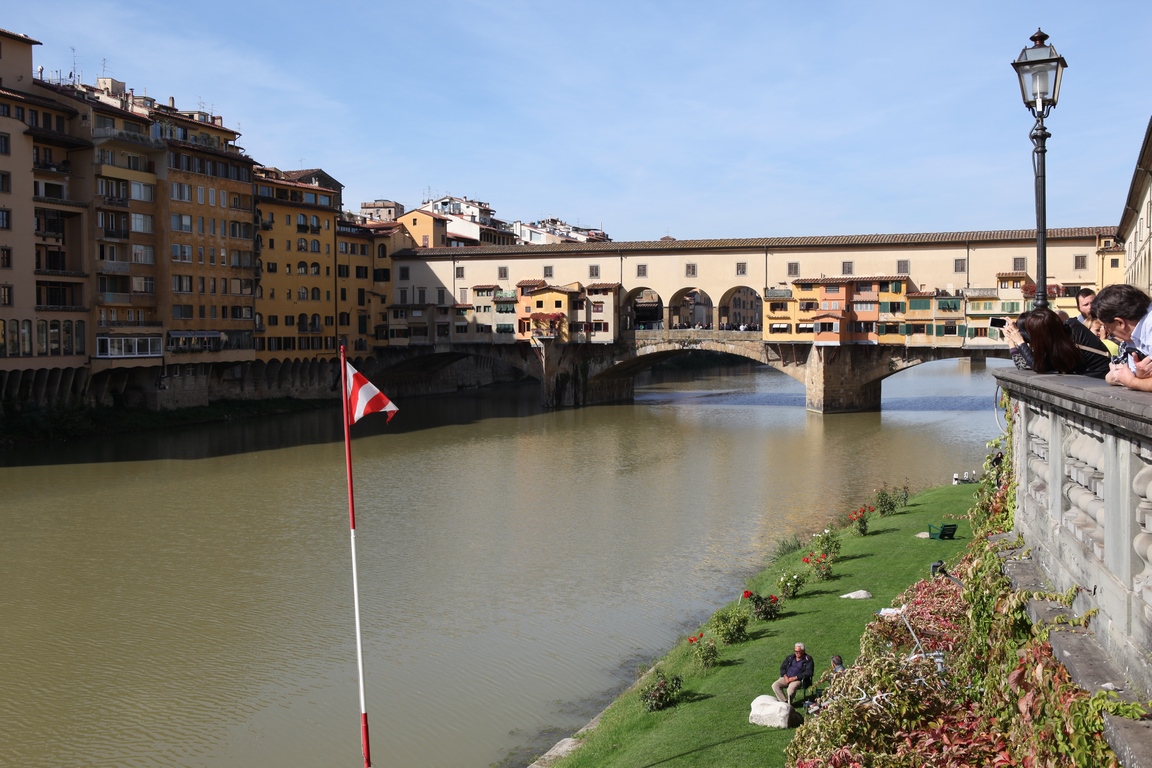
First, there is the mythical Ponte Vecchio. Perched above the Arno like a bridge between two eras, the sole survivor of the 1944 bombings, it intrigues with its hanging houses and sparkling shop windows. Once occupied by butchers, now by jewellers, they give the place an almost unreal allure. One passes through, of course, but one also returns, for the morning light and the evening gold.
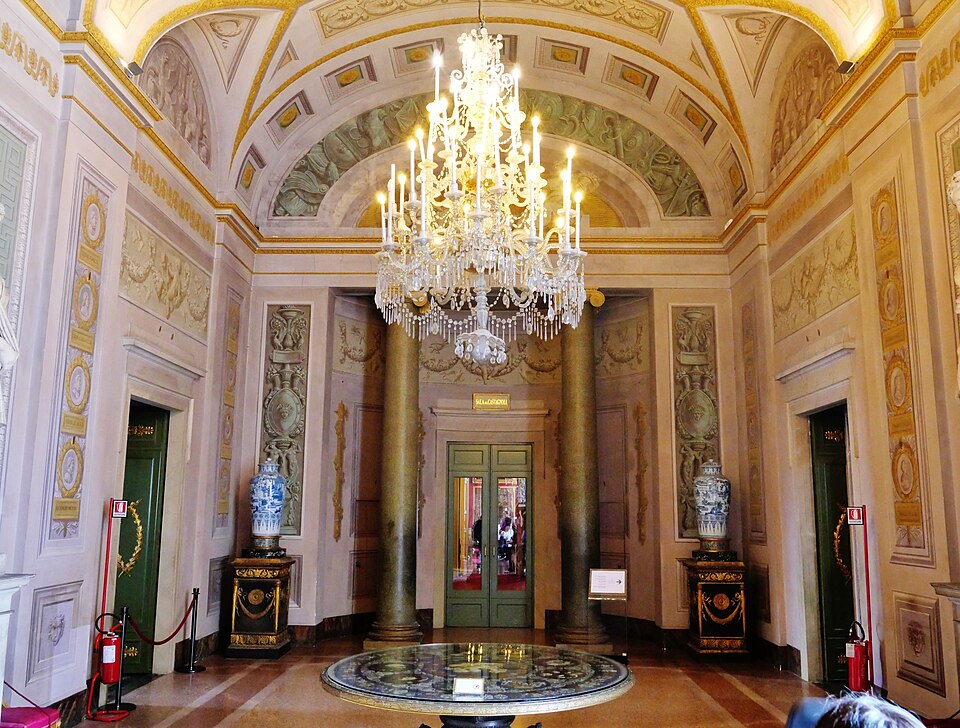
On the other side of the river lies a more subdued world, that of Pitti Palace. Formerly the residence of the Medici family, the palace is imposing in its mass and sobriety. Inside, rooms follow one another, rich with collections where art dialogues with power.
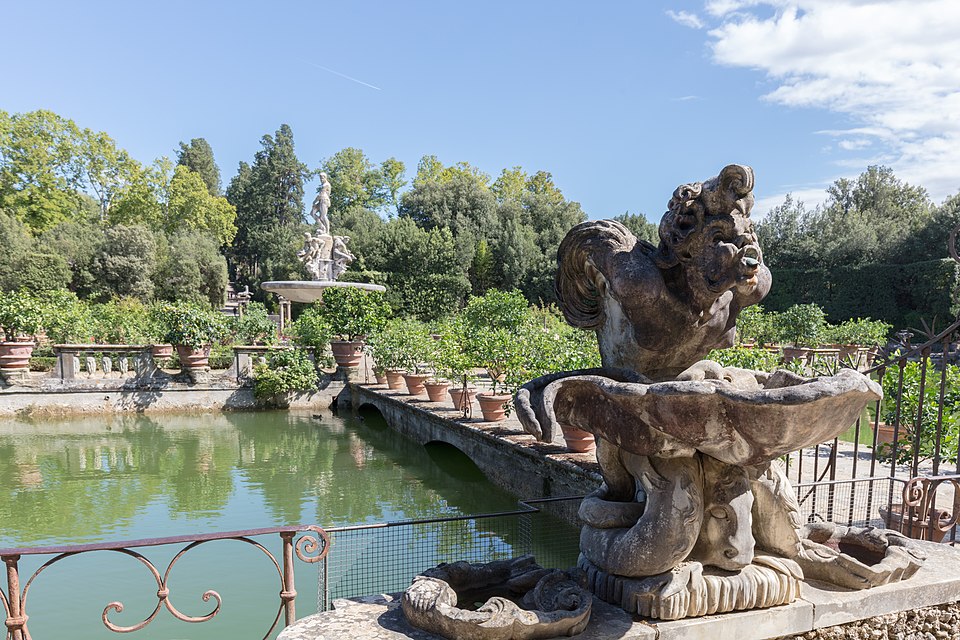
Italy. Florence. Behind the Pitti Palace, the Boboli Gardens offer an almost philosophical breath. © Diego Delso/Commons.
Galleria dell’Accademia and Palazzo Vecchio: Two Florence icons
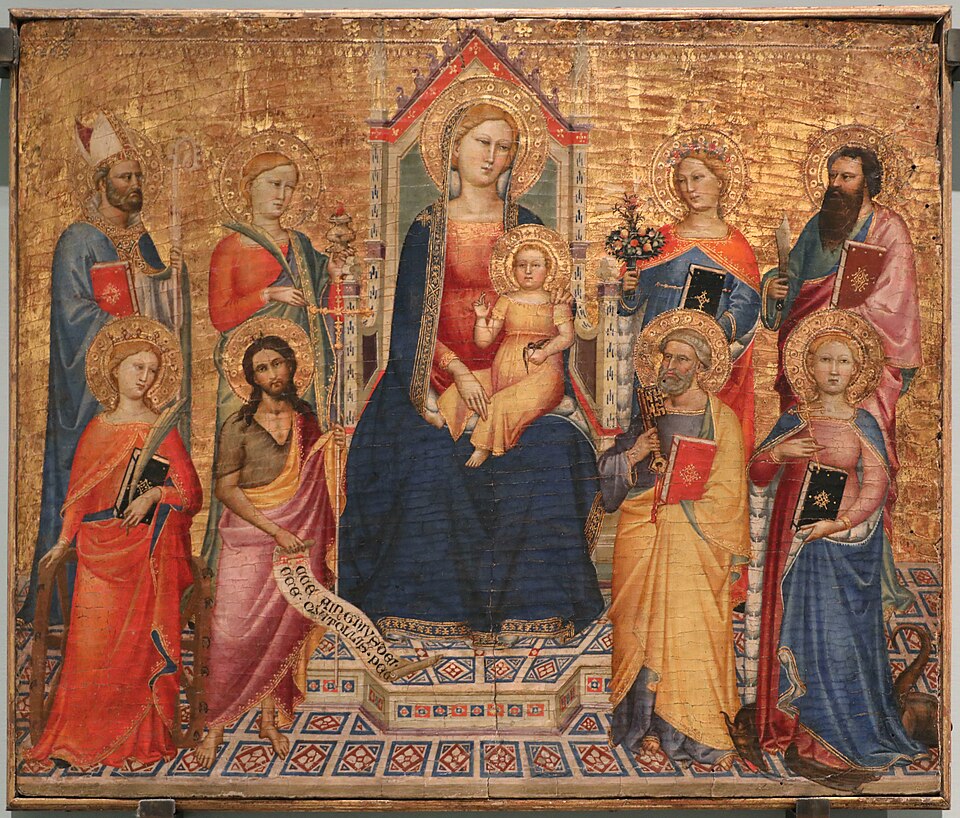
Then comes one of the most anticipated moments, and, despite the crowds, one of the most striking: the visit to the Accademia Gallery. The gallery is most famous for Michelangelo's «Prisoners» cycle, four unfinished sculptures that illustrate the concept of unfinished. These bodies striving to break free from the raw stone offer a masterful lesson in direct carving. The musical instrument department is also admired: a rare Medici collection including exceptional signed pieces Antonio Stradivari (1644-1737). Finally, the medieval painting section offers a selection of gold-ground altarpieces and works by artists like Sandro Botticelli (1445-1510). It illustrates the evolution of Florentine painting before its full bloom in the Renaissance.
Only one work naturally stands out as the highlight of the tour: the David of Michelangelo (1475-1564). Nothing truly prepares you for encountering it. The sculpture catches the eye, and then holds it. David's concentrated gaze, the tension in his muscles, the anatomical precision, all combine to make this work an aesthetic shock, even beyond its fame. Originally, the statue was displayed in front of the Palazzo Vecchio, in Piazza della Signoria. However, to protect it from the elements and damage, it was moved to the museum in 1873. © Francesco Bini/Commons.
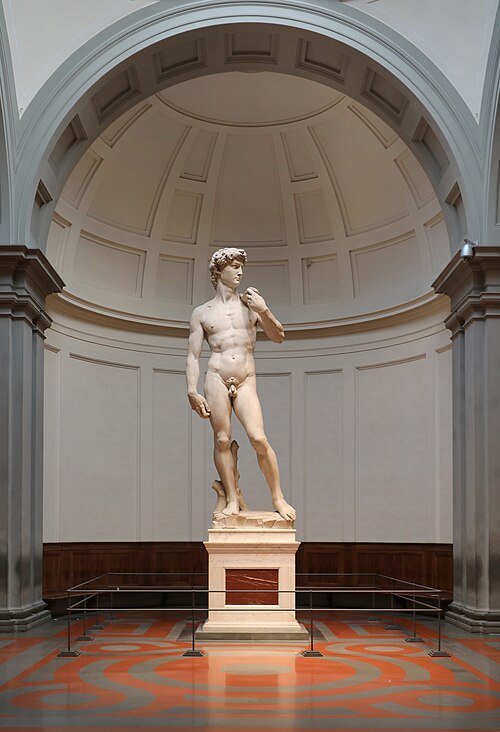
The rest of the museum remains exceptional, but inevitably revolves around this presence.
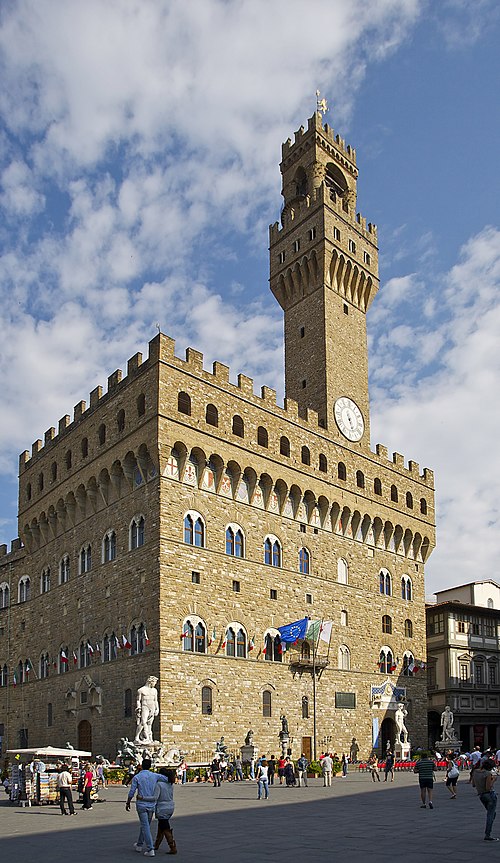
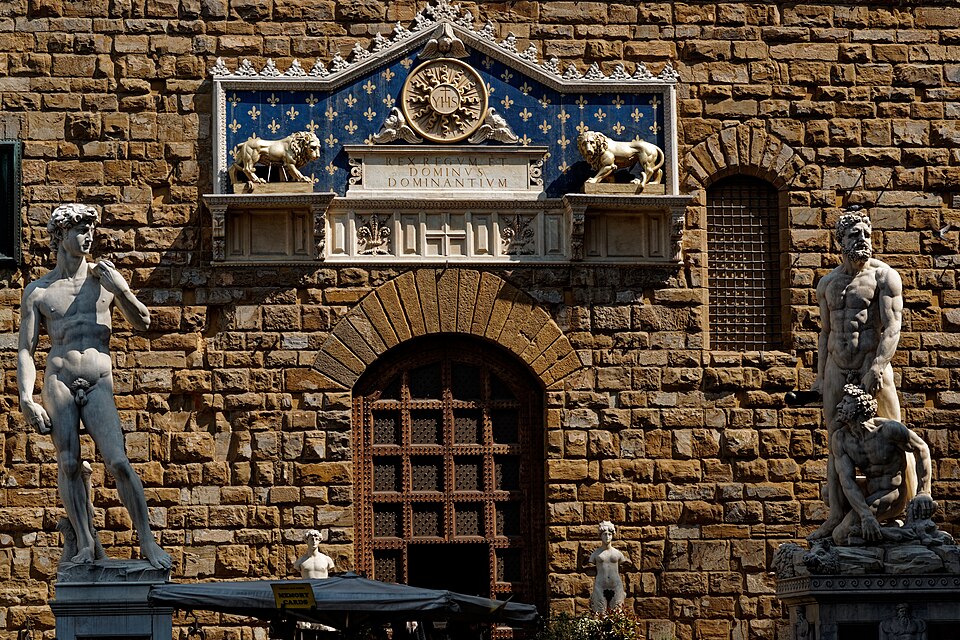
Back to the political heart of the city with the Palazzo Vecchio. On Piazza della Signoria, it recalls that Florence was also a city of decisions and conflicts. Its austere silhouette contrasts with the vitality of the square, where the statues seem to carry on the debates of the past. Inside, the frescoes and reception rooms tell a dense political history, where art is never far from power. © Jebulon/Commons.
Florence's spiritual heart: the Duomo
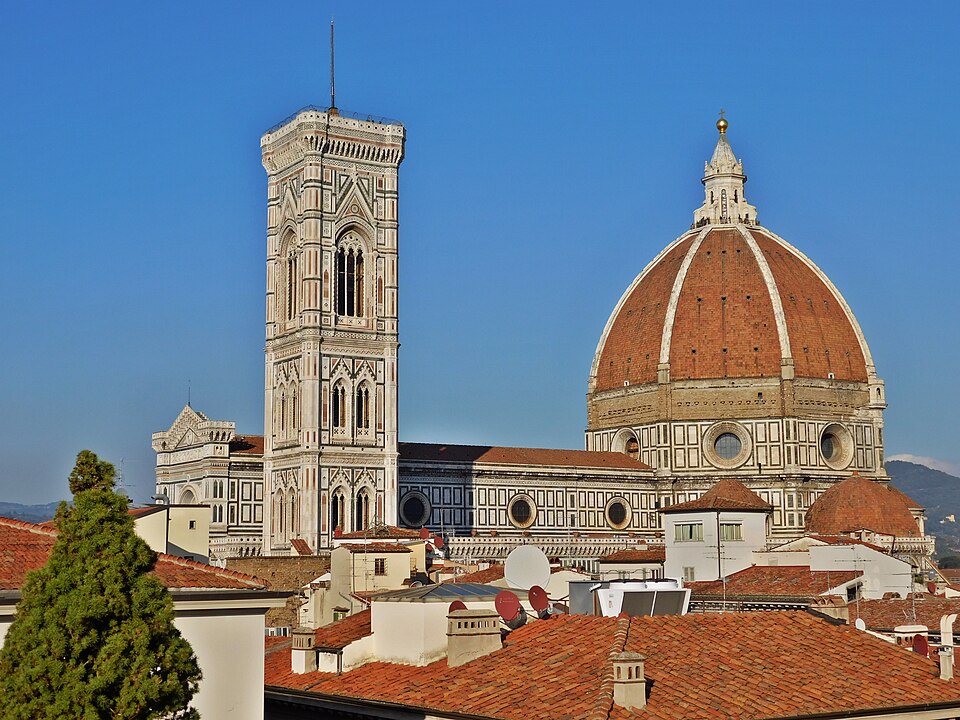
The cathedral spire was begun in 1334 by Giotto di Bondone, major artist of the Trecento, then finished after his death by other artists. © Fczarnowski/Commons.
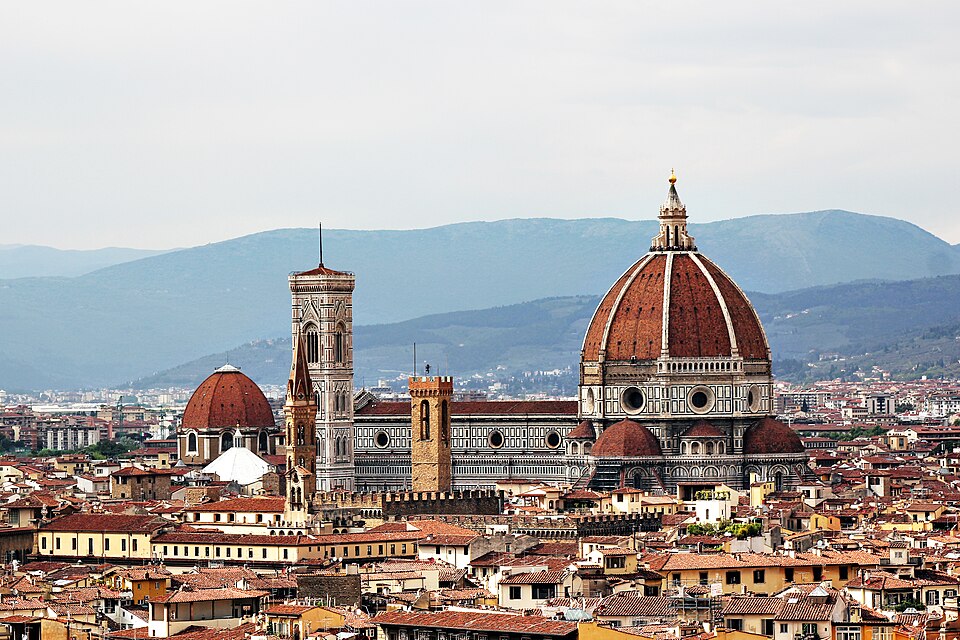
Impossible, of course, to mention Florence without looking up at its emblem: the Cathedral. The Cathedral of Santa Maria del Fiore, more commonly known as the Duomo, dominates the historic centre of Florence with its dome, a feat of architecture by Filippo Brunelleschi (1377-1446). At a time when no one knew how to cover such a vast space, he invented a bold solution: a self-supporting double dome, without wooden centering. Its polychrome marble facade, – white, green, pink, – is of an almost theatrical elegance, while the interior, more sober, leaves all the power to the structure and the monumental fresco of the Last Judgement.
The angel of sodomites
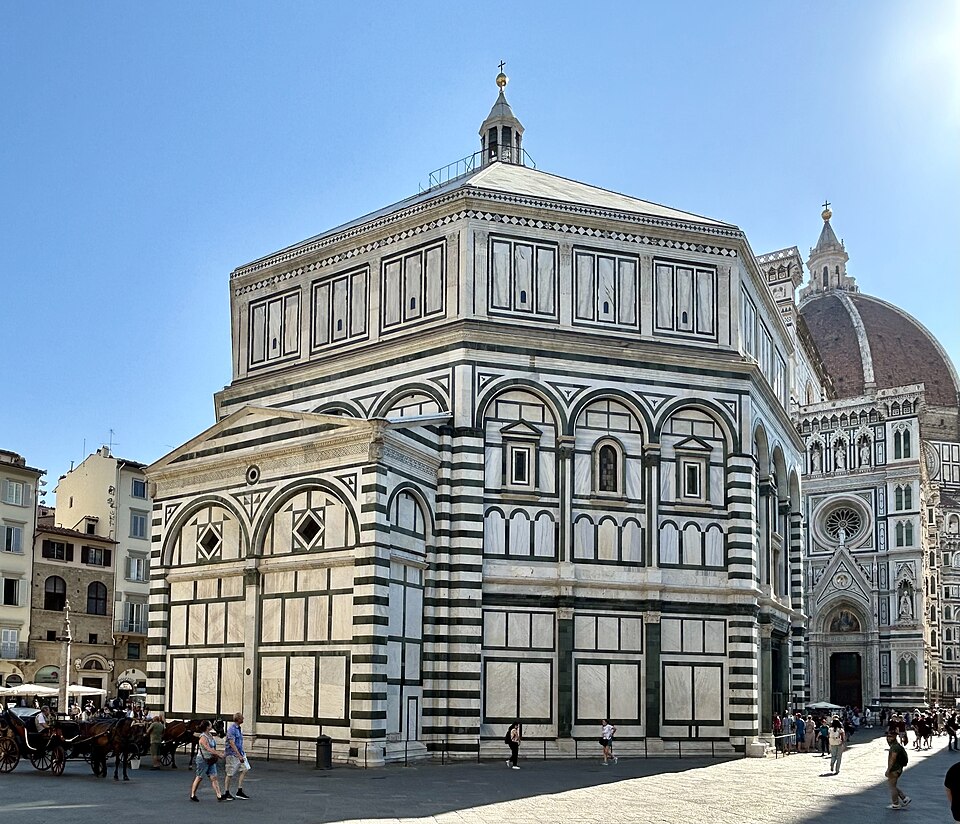
Among the many small heads and statuettes adorning the door of the Baptistery of Saint John, one of the angels appears to be making a very equivocal gesture: it is the sign of «the fig»(fare le fiche): a rude gesture.
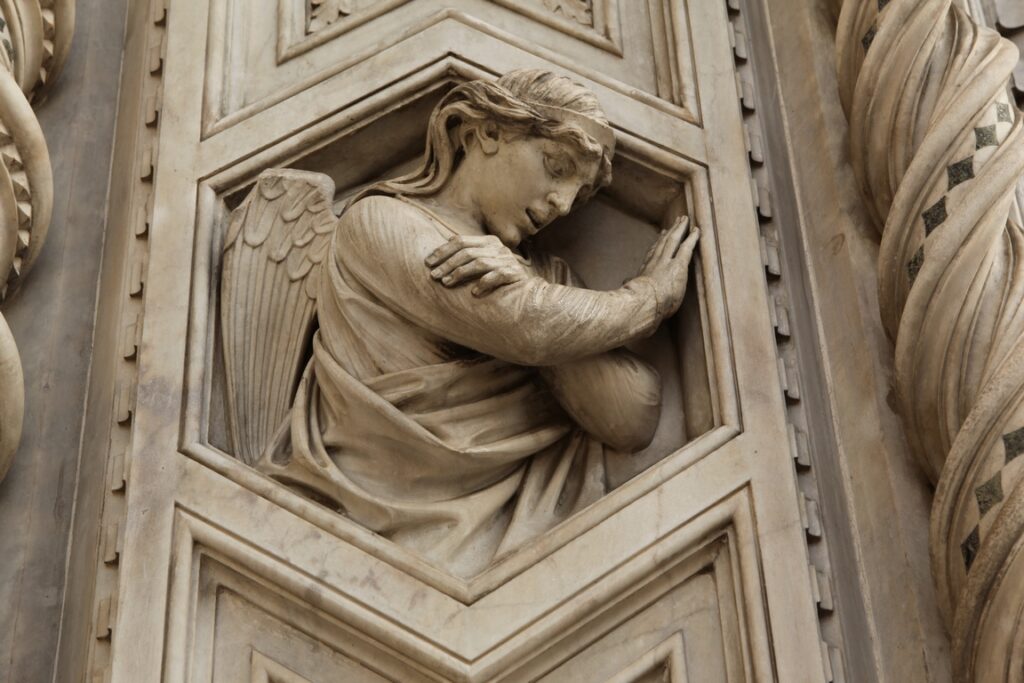
Why is he called «the angel of sodomites»? In the Florentine slang and popular culture of the time, this gesture was sometimes associated with an insult towards the morals of the inhabitants, Florence being known for its homosexual practices in the 15th century. © B. Postel.
Why would Ghiberti have depicted this gesture? Several theories exist. Either an artist's revenge: Ghiberti may have included this gesture to mock his patrons or his rivals (like Brunelleschi) with whom he was in constant conflict. Or protection against the evil eye: ironically, the fig sign was also sometimes used as an apotropaic amulet (to ward off evil), although its insulting meaning was predominant. Finally, Florentine humour: Renaissance artists loved to slip bawdy or rebellious details into sacred works.
Two basilicas: San Lorenzo and Santa Maria Novella
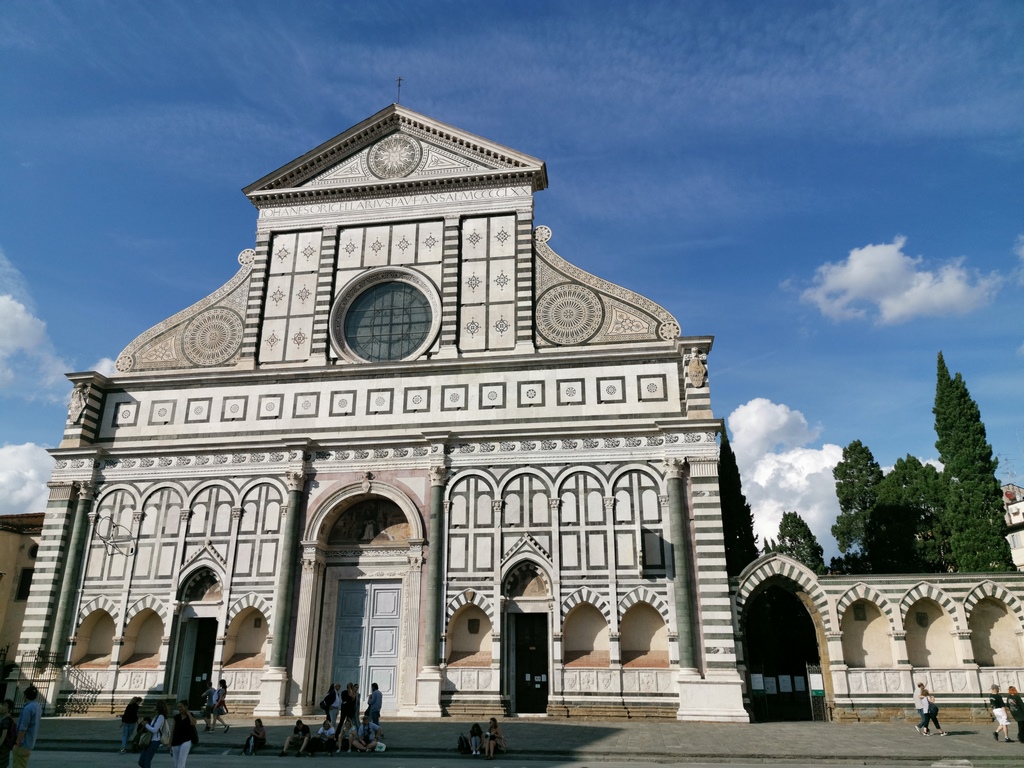
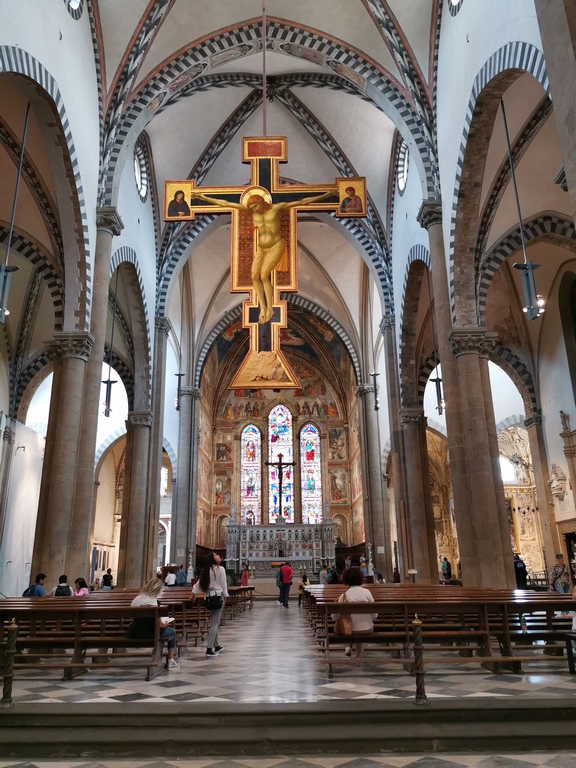
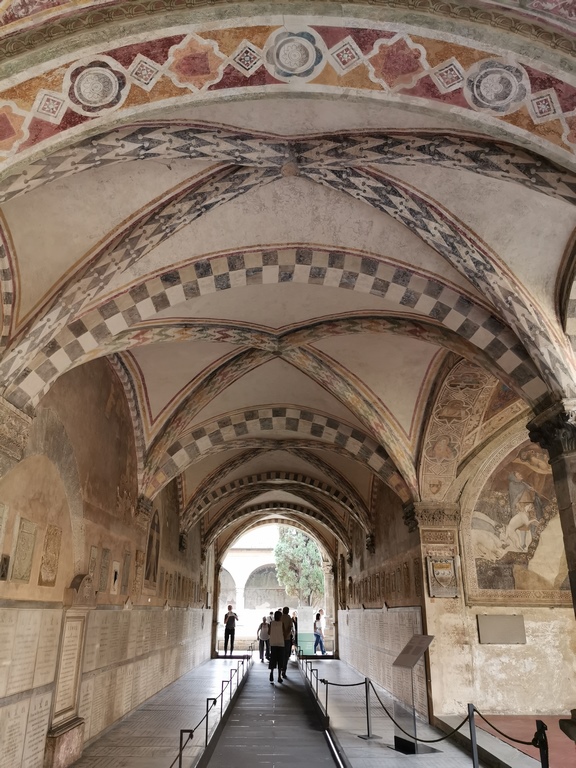
The Basilica of Santa Maria Novella surprised by the harmony of its facade and the richness of its frescoes. Less crowded with visitors, it invites more silent contemplation. In addition to Paolo Uccello's frescoes, which can also be found in the cloister, you can admire Giotto's crucifix. Suspended in the central nave, this monumental crucifix (late 13th century) revolutionized sacred art. In it, Giotto abandons the rigid Byzantine style to paint a human Christ, whose body genuinely weighs down, marking the beginning of humanism in painting.
The Uffizi Gallery, or the vertigo of masterpieces
There are places that transcend their function to become essential passages in art history. The Uffizi Gallery belongs to that rare category, housed in a building originally conceived to accommodate the administrations of the Medici.
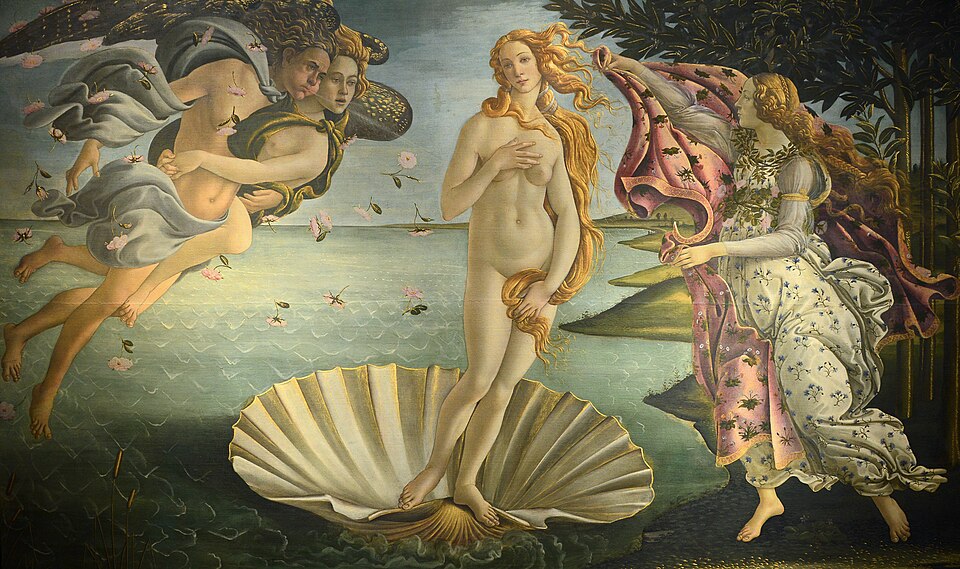
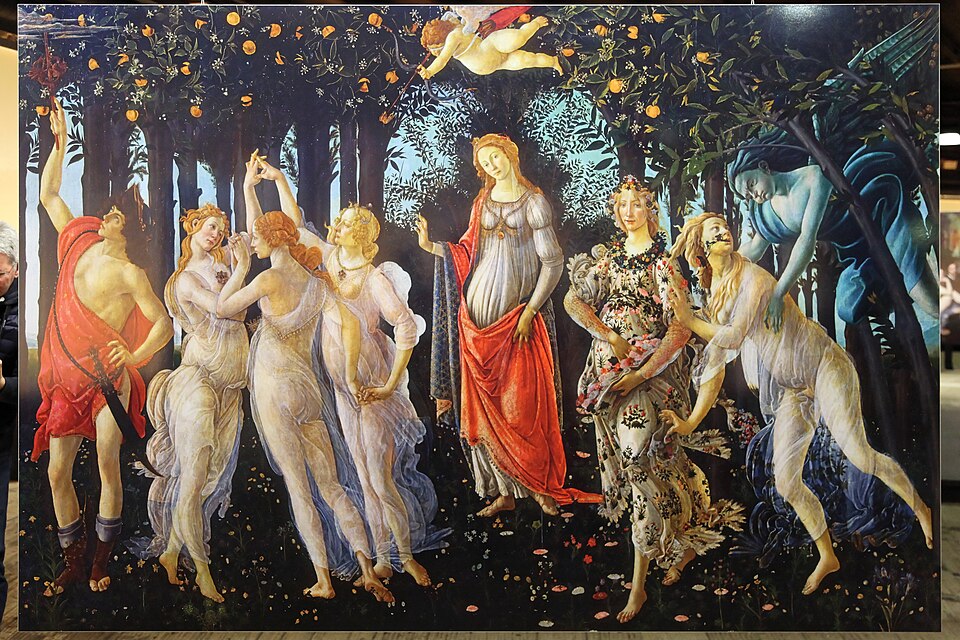
We quickly admire all these masterpieces, those we think we know even before seeing them. Before The Birth of Venus of Sandro Botticelli (1445-1510), time seems to slow down. The lightness of the lines, the softness of the colours, the almost unreal grace of the central figure compose an image that has become universal. Not far away, Spring from the same artist invites contemplation.
The visit continues as a journey through geniuses: Leonardo da Vinci, Michelangelo, Raphael. Each marks a stage, an evolution. But beyond the works, there is also the place itself. The long, bright corridors, opening onto the Arno, offer welcome moments of respite. The Uffizi Gallery obviously requires time, and perhaps even multiple visits.
Florence, at its core, is not just a list of monuments. But these unmissable stages form a solid framework for anyone who wishes to understand the city.
At Au Profumoir: create your perfume like an intimate work of art
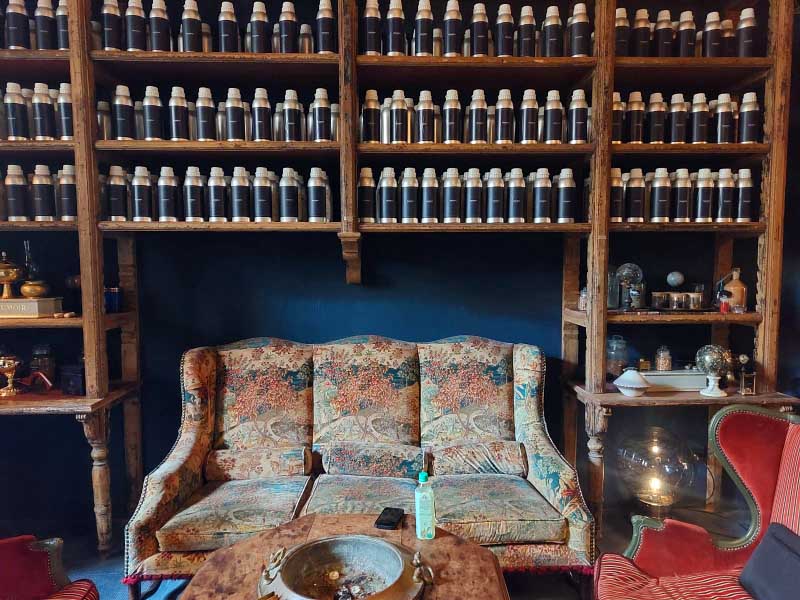
In Florence, art isn't confined to museums. It sometimes slips into more discreet places. This is the case with Profumoir, a unique workshop nestled in the San Niccolò district, where perfume becomes a medium for experimentation.
Inside, the atmosphere evokes an alchemist's laboratory. Dim lighting, wood panelling, precisely aligned vials… The establishment's ambition is to restore perfume to its artisanal dimension.
The extraction room, with its alembics, serves as a reminder that behind every fragrance lies a long process of transformation.
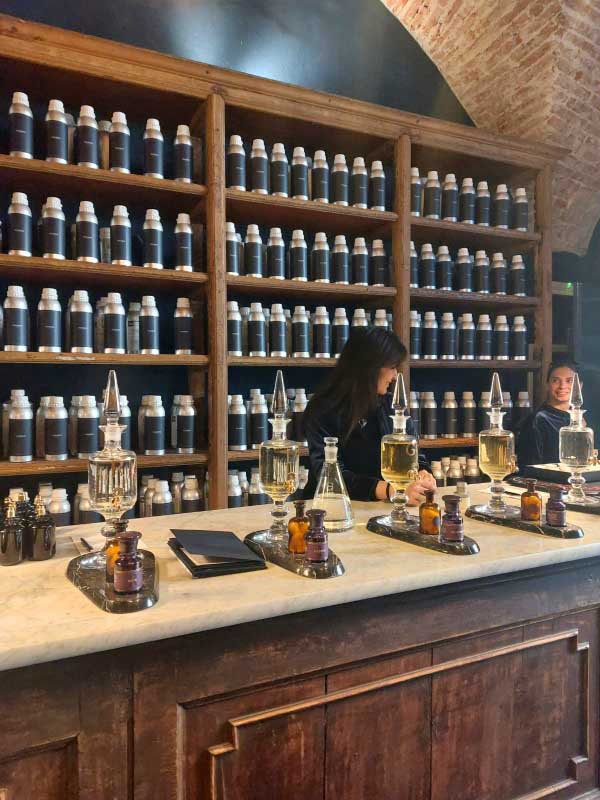
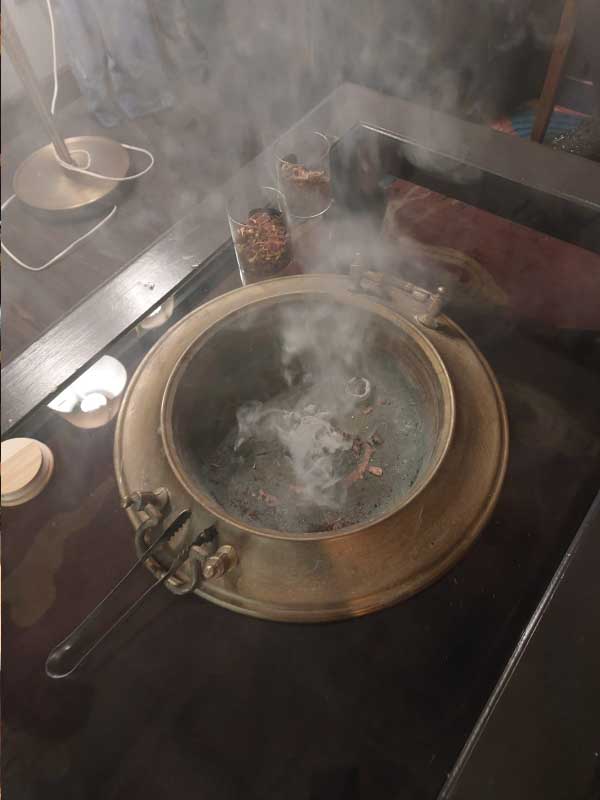
Here, you learn to create your own perfume. The experience begins in front of what is known as an «olfactory organ» – an impressive table made up of nearly two hundred essences. Floral, woody, spicy, resinous notes: each bottle corresponds to an emotion, a potential memory.
Guided by an expert, the visitor is invited to smell, compare, hesitate, and go back. Little by little, a composition takes shape. And finally, it appears. You leave with your bottle, of course, and the feeling of having created something unique.
www.profumoir.com
A food tour at Sant'Ambrogio Market
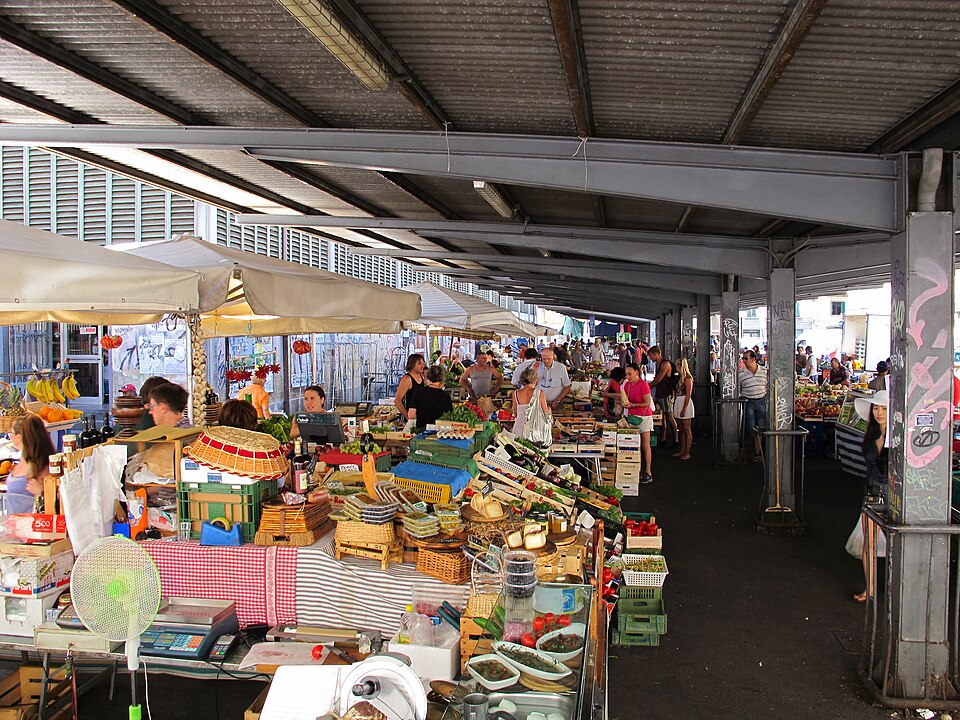
Far from the disciplined crowds around the Duomo and the compact queues on the Ponte Vecchio, Florence reveals another truth about itself to those who are willing to wander east of the historic centre. It is there that the Sant'Ambrogio market sets out its stalls. Less photographed than its cousin in San Lorenzo, it is no less lively and arguably more genuine.
It's barely ten o'clock when the guided tour begins. Our small group forms around a guide with a friendly smile who gets straight to the point: « Here, we try everything »The first stop: a cheese counter where line up Pecorino fresh, matured, with pepper or truffle. The tasting begins without ceremony. We are explained about the terroirs, the seasons, the variations in milk… Then come the cured meats. Thin slices of Finocchiona, perfumed with fennel, Tuscan ham with a subtle saltiness, crostini topped with liver pâté. Outside, the route continues between stalls of fruit and vegetables.
This Food tour is nothing like a gastronomic performance. It is more akin to an extended conversation with the city, a gentle immersion into its daily life. One learns from it that Florentine cuisine does not seek to seduce, but to endure. It is based on simple, repeated, transmitted gestures.
The visit concludes with a Florentine dessert. Everyone naturally leaves with some fresh pasta, with pear and pecorino, or spinach and ricotta. Florence that morning was an open table.
Italian Tourist Office
https://www.italia.it/fr
Accommodation
Hotel Della Calza
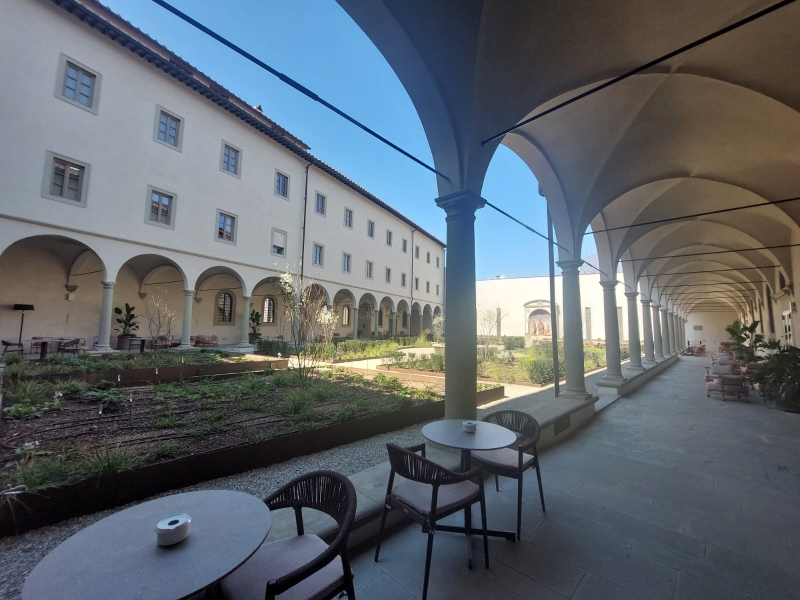
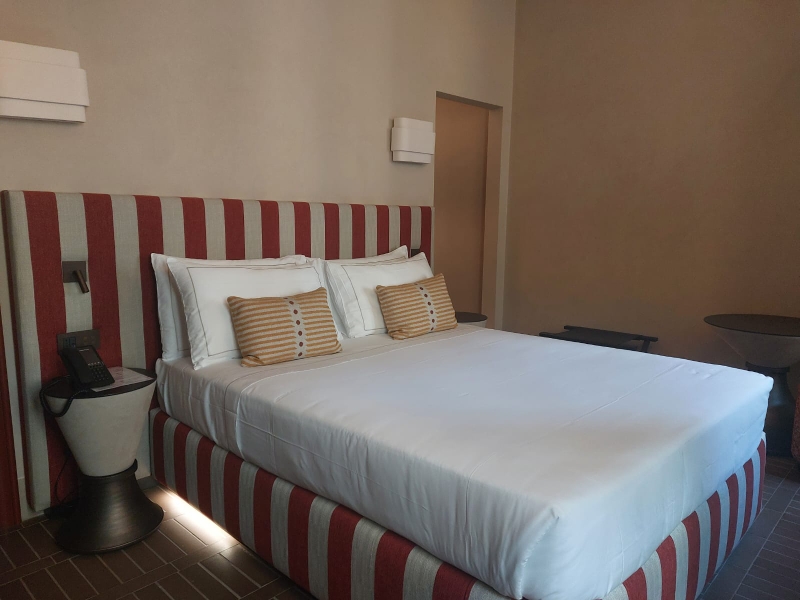
In the heart of Oltrarno, a few steps from the Duomo Square, theHotel Della Calza is reborn with a dual identity: a place of memory and a centre for well-being. Founded in the 14th century as a monastery, then transformed into a hospice, the site underwent a decisive transformation in 1859 with the creation of the Convitto della Calza, which strengthened its educational and cultural vocation. Among its treasures are the refectory with its frescoes and the Last Supper signed Franciabigio recall the artistic richness of the place.
Today, Della Calza SPA & Foresteria presents itself as «an open-air museum»: fresco restoration, conservation of memory-laden objects, and redesigning ancient spaces into rooms, lounges, and wellness facilities. The spa claims to be the most expansive in the historic centre. Housed within vaulted ceilings, it transforms the wellness ritual into a ceremony with its delicate massages using local essences.
The rooms, with their soft fabrics and muted colours, invite long hours of rest after exploring the historic heart of Florence.
www.dellacalza.com
Hôtel La Gemma
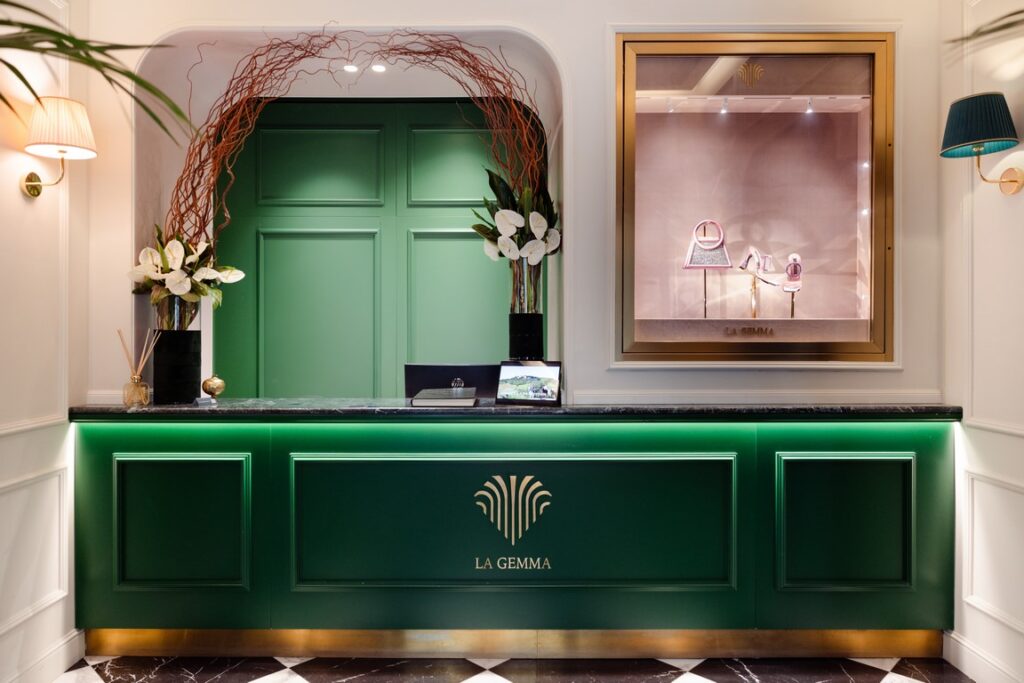
In the heart of Florence, on the discreet Via Calimala, La Gemma hotel stands out as one of the most sought-after addresses of the moment. A few steps from the Ponte Vecchio and the Duomo, this boutique hotel cultivates a hushed luxury. The interiors blend Art Deco inspirations with a subtle palette of greens. At the table, Tuscan gastronomy is contemporary, without ever denying its roots.
The venue also cultivates the art of slowing down, with an elegant café and a discreet spa nestled in the basement.
More than a hotel, La Gemma embodies a new vision of Italian luxury: intimate, sensitive, and resolutely contemporary.
To read: Full article at this link https://universvoyage.com/la-gemma-nouveau-joyau-5-de-florence/
Where to eat
Porta Romana: One of the best trattorias in Florence
www.portaromanapizzagrill.com
Go with Air Corsica
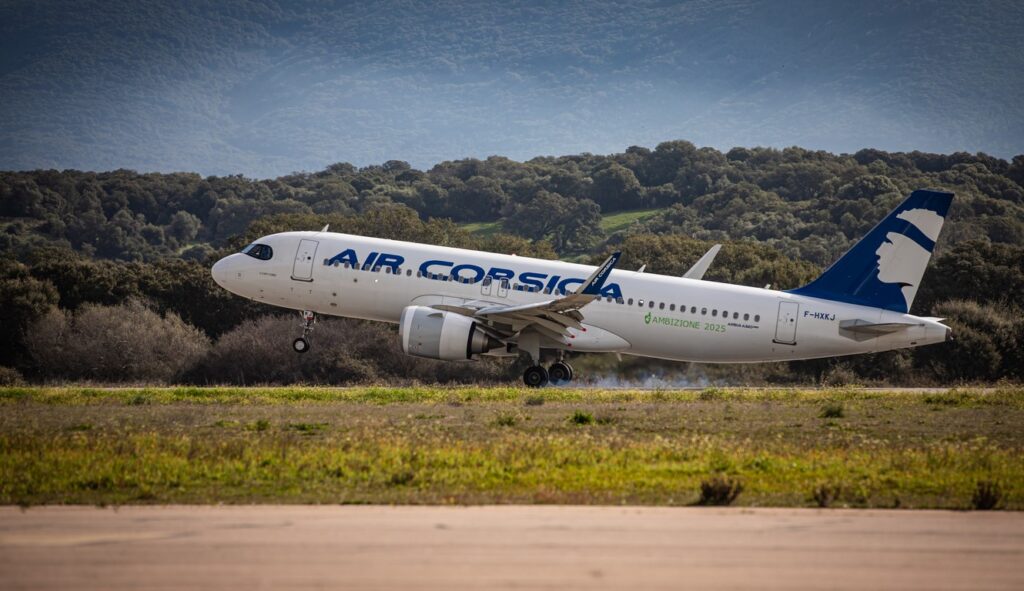
Air Corsica launched a direct route between Nice and Florence in 2025, operating three times a week, on Mondays, Wednesdays and Fridays, aboard the latest generation ATR72 600. A new milestone in its strategic development!
Beyond simply adding a destination, this is the desire of a regional airline to extend its reach beyond Corsica and build lasting bridges between the Côte d'Azur, Corsica, and Tuscany. This route, never before operated from Nice, addresses a real demand on the Côte d’Azur side and opens up new tourism and business prospects.
Air Corsica is thus continuing its expansion into Italy, offering additional travel options to and from Corsica.
Let us recall that the company established itself on the Italian peninsula in 2022, launching flights from Corsica to Rome and Milan.
The Nice-Florence (and return) schedules have been arranged to allow for full connectivity with the island's four airports (Ajaccio, Bastia, Figari, Calvi). Thus, Italian travellers have the opportunity to reach Corsica by easily obtaining their connecting flight from Nice. In the opposite direction, Islanders can travel to Florence from Corsica, via Nice.
Price: One-way from €99, including 1 checked bag weighing 23kg and 1 cabin bag weighing 8kg.
www.aircorsica.com
Text : Laurence Gremy-Flamand
Opening photo : Jonathan Körner jonko/Commons
Other photos : as indicated
Italian Tourist Office www.italia.it