
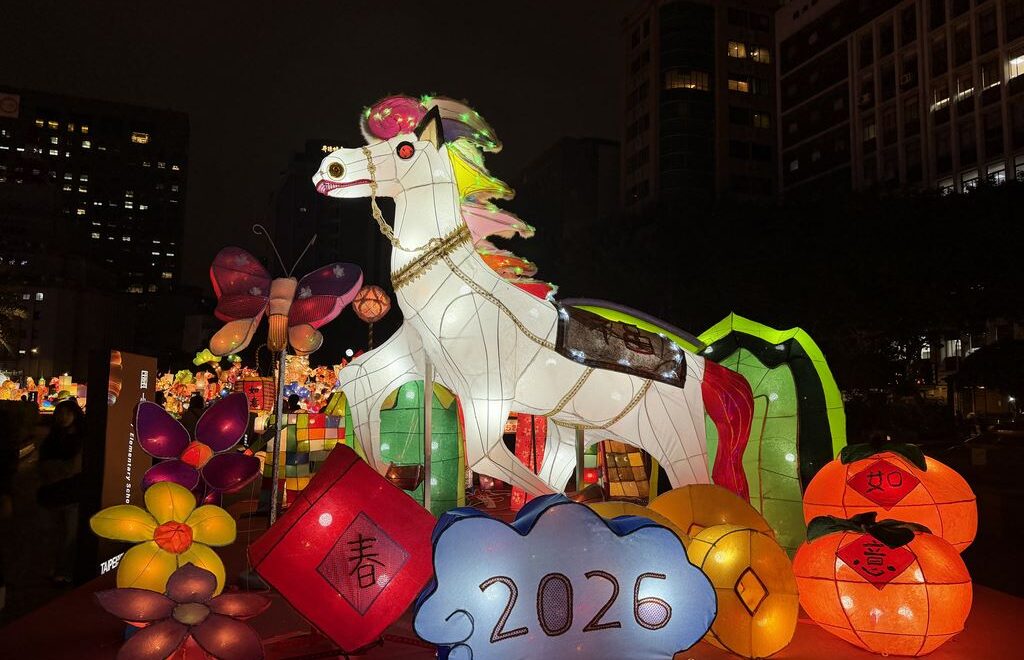
The Lantern Festival is one of Taiwan's most important festivals. It marks the end of the Lunar New Year and is organised each year around a zodiac animal. In 2026, it's the fire horse's turn.
Table of Contents

From 3 to 15 March, the county of Chiayi (1h30 from the capital Taipei by TGV) shifted into a different rhythm. As night falls, the festival site fills up with visitors. The lights take over. Giant lanterns, artistic installations, decorated lanterns, dragon and lion dances, acrobatic shows: all of these make up a dense and joyful itinerary.
The park is transformed into a festive setting. The crowd moves slowly between the illuminated structures. Vendors call out, the smell of fried food and sugar wafts through the air. Announcements in Mandarin alternate with pop music blasting from loudspeakers.

The lanterns gradually light up. Some represent mythological figures, others contemporary characters or more political motifs, sometimes barely hinted at. A group of young people take selfies in front of a monumental installation. A few metres away, a family writes a wish on a traditional lantern. A child asks why. His mother answers simply: «for luck». In China, lanterns often symbolise the light that guides people, chases away evil spirits and attracts good fortune.
Between traditions, spectacle and identity

At the centre of the installation, a 21-metre-high lantern dominates the whole. Inspired by the sun, sacred trees and mist, it is intended to tell a story. According to the Ministry of Transport and Communications, it traces the history of Taiwan, «from its oceanic origins to the rise of human civilisation» and sends «a beacon of light from the island to the world». Around it, other eye-catching creations include «Celestial Dreams of the Horse» and «Radiant Firebird». Some are monumental, others more handcrafted. All play on a mix of references: Chinese mythology, natural symbols and contemporary aesthetics.
The Lantern Festival in Chiayi – Michèle Lasseur
The Lantern Festival remains a deeply rooted tradition, but here it is reinterpreted in a contemporary context, becoming an event that is at once cultural, touristic and identity-building. The lanterns reflect this: they combine traditional motifs with modern shapes, in a setting designed for a wide audience. The crowds that flock to them don't just celebrate an annual festival; they take part in a reinvented form of continuity.
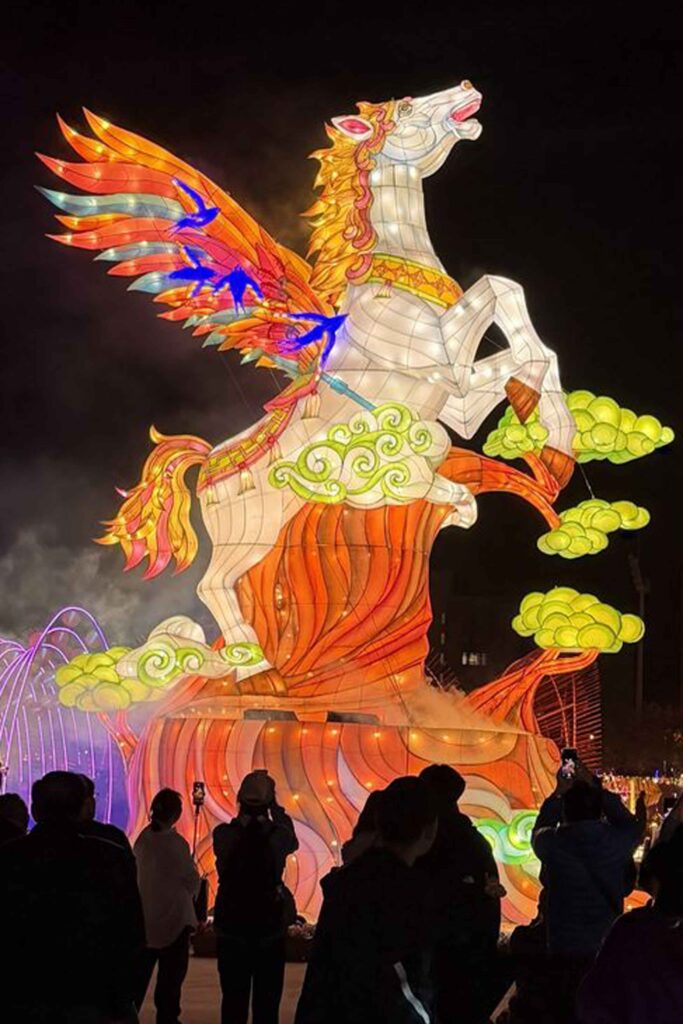
In the centre of the stage, a ten-metre mechanical white horse captivates the crowd. It unfurls its steel wings and comes to life under the lights. The performance, presented by the French company Quidams, lasting about thirty minutes. Street theatre, machinery and lighting effects are combined. The winged horse appears to float above the stage, in a phantasmagorical atmosphere.
Taiwan. Chiayi Lantern Festival © M. Lasseur.
A window on the world

The festival, inherited from a Chinese tradition, is reinterpreted in a pluralist and open context. It is no longer limited to a religious or seasonal ritual: it becomes a cultural marker, a way of asserting a distinct identity without breaking with heritage.
In the crowd, this transformation is visible. The old gestures persist - writing a wish, lighting a lantern - but they coexist with other practices: photographing, sharing, or simply enjoying the spectacle. The festival isn't disappearing, it's just changing form. What we see in Chiayi is not just an annual celebration. It's a tradition on the move, integrated into a society that claims both a heritage and its own way of reinterpreting it.


The Lantern Festival is now a major cultural and tourist event. The authorities support this celebration by preserving know-how and offering visitors a living glimpse of Taiwanese identity. The Deputy Minister of Transport, Lin Kuo-hsien, emphasizes the importance of welcoming international visitors and highlights local products such as coffee, tea and agricultural specialities. He also recalls Taiwan’s position in global tourism rankings, citing its 19th place in the New York Times 2025 list of destinations to visit.
The event, which goes beyond promotion and simple entertainment, is part of a wider evolution in Taiwanese society. Traditional motifs and modern designs coexist in harmony.
But behind the showcase, the issue is also one of identity. Inherited from the Chinese world, the festival is now part of an open and plural Taiwanese society. It doesn't break with the past, but reconfigures it, highlighting a society that is coming to terms with its past in order to tell its own story in a different way.
Text : Michèle Lasseur
Photo opening : Michèle Lasseur
Photos : as indicated
Formalities :
Passport (valid for at least 6 months from the date of entry) and return ticket.
Taiwan Arrival Card (TWAC), which must be completed online before travel.
For information on visas: contact the Representative Office of Tapei in France.
Taiwan Tourist Office
C/O AVIAREPS - 122 avenue des Champs Elysées - 75008 Paris
Tel : +33 (0)1 53 43 33 97
taiwantourisme.france@aviareps.com
www.taiwantourisme.com
www.facebook.com/taiwantourisme
www.instagram.com/taiwantourisme
contact@taiwantourisme.com
Getting there
Rated 5 stars by Skytrax for the 10th consecutive year and the first airline in the world to launch the Premium Economy cabin concept, EVA Air is renowned for the excellence of its service. The airline operates a daily flight between Paris-Charles de Gaulle airport and Taipei on board its Boeing 777-300ER.
EVA Air also offers departures from Milan, Munich, Amsterdam, London and Vienna.
The company also offers pre-routing from other airports in France to reach these European airports.
https://www.evaair.com/en-fr/index.html