
Table of Contents
The exhibition dedicated to Igor Mitoraj in Sicily ended in October 2025. But does an exhibition still need to be on display to merit our attention? Certainly not when it comes to an artist of such magnitude. By dialoguing his monumental sculptures with the remains of Antiquity, Igor Mitoraj (1944-2014) It invites us to reflect on the beauty, the time and the fragility of civilizations. It is an opportunity to revisit an exceptional encounter between contemporary art and the memory of centuries, and to discover, or rediscover, the work of a sculptor who continues to fascinate us.
Amid the remains of the ancient Syracuse, Giant faces seem to emerge from a past that has never quite disappeared. Fragmented bodies, enigmatic faces, silhouettes whose classic beauty contrasts with the injuries they bear. These bronze or marble figures are not, however, archaeological discoveries. They were born from the imagination of’Igor Mitoraj, a Franco-Polish sculptor who dedicated a large part of his work to reinventing the figures of Antiquity.
In the Archaeological Park of Neapolis, In which the Greeks left some of the most remarkable testimonies of their presence in Sicily, the sculptures of Mitoraj found a setting to suit them. Presented from March 2024 to October 2025 as part of the exhibition Lo Sguardo – Humanitas – Physis, They invite us to look at the ruins in a different way, but also to reflect on what civilizations transmit and what they lose. Because at Mitoraj, the gods are not immortal. Like humans, they carry the burdens of time.
It is in this landscape of mineral, Mediterranean vegetation and monuments laden with history that Mitoraj’s sculptures take on their full dimension. A setting that seemed to be meant for them, as the sculptor drew his inspiration from the myths and aesthetics of ancient Greece.
Igor Mitoraj, a sculptor fascinated by beauty
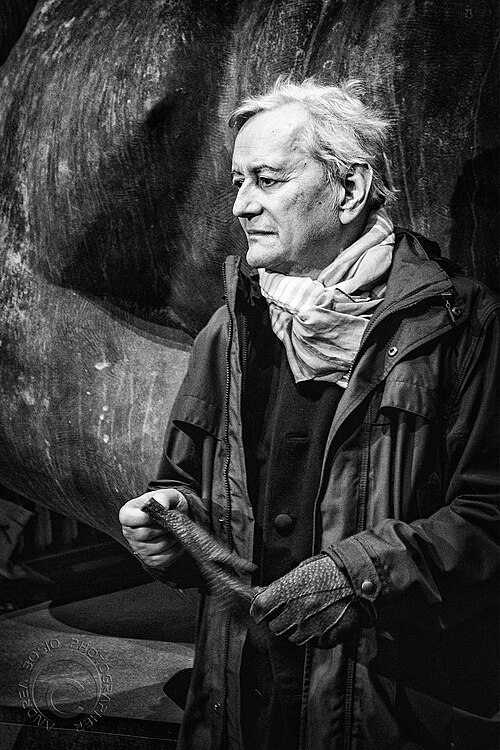
Born in 1944 in Oederan, Germany, to a Polish mother and a French father, Igor Mitoraj grew up in Poland. He studied at the Academy of Fine Arts in Krakow, where he was influenced by the teaching of Tadeusz Kantor, a major figure in theater and the fine arts.
In 1968, he settled in Paris and continued his training in fine arts. His first major personal exhibition, organized in 1976 at the La Hune gallery, helped launch his career. But it was in Italy that he found the environment that would give his sculpture its full scope.
In Pietrasanta, in Tuscany, a city renowned for its marble workshops and foundries, he develops an immediately recognizable artistic language. Faces of an almost ideal beauty, powerful torsos, figures borrowed from Greek mythology. Yet these bodies are rarely intact. They are broken, amputated, sometimes wrapped in bandages or devoid of part of their face.
Mitoraj does not seek to reconstruct the statues of Antiquity. He borrows their forms to express a contemporary concern: human vulnerability, loss, memory, and the impossibility of achieving lasting perfection.
The Fundation Museo Igor Mitoraj Reminds us that the artist often described his creations as works of ’fantastic archaeology«. A particularly enlightening formula for understanding their presence in Syracuse.
Photo: Andrea Bosio/Commons.
Neapolis, a setting suited to Mitoraj's talent
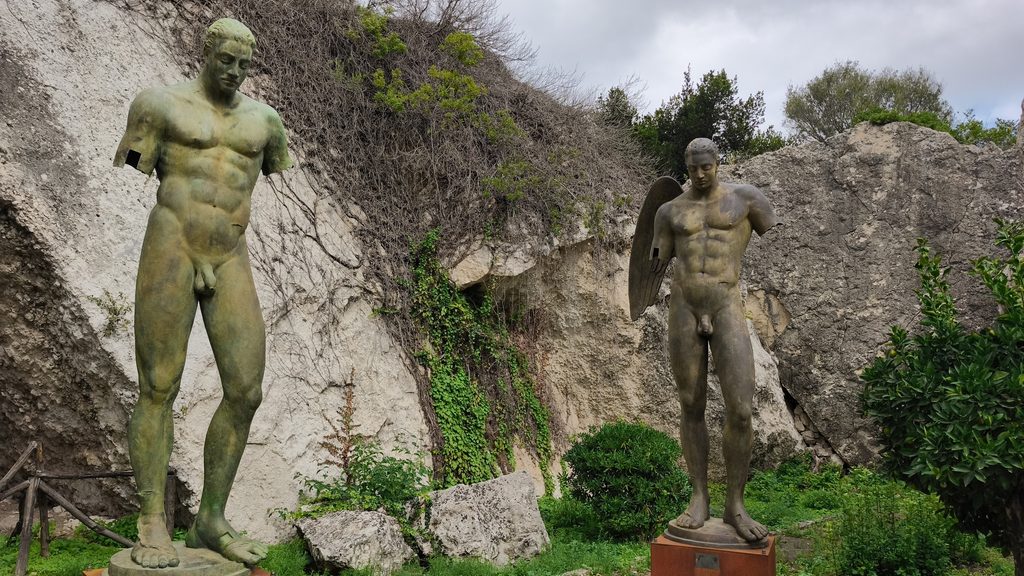
In the archaeological park of Neapolis, the monumental sculptures of Mitoraj have found a setting to suit them. For this artist, absence becomes as expressive as presence. A partially hidden face or a body devoid of its limbs leaves the viewer free to imagine what is missing. « What is rendered invisible gains greater visibility »He said,« Despite the antique appearance of his sculptures, Mitoraj also drew inspiration from the human beings he encountered.« Among antique models, I prefer living models, the characters I encounter on the street, to whom I can steal something, if possible their soul.. »
At the end of a path that winds through the ancient limestone quarries of Latomia del Paradison, one comes upon one of the first monumental sculptures. Dedalo (Daedalus), a bronze statue nearly six meters high. The powerful body, inspired by ancient statues, is devoid of its hands and feet. With its head tilted and its gaze lowered, Daedalus seems to be meditating on his destiny. He who, in Greek mythology, invented wings to escape the Labyrinth finds himself here in front of a rocky cavity, the Ear of Dionysus, which evokes another place of confinement. A meeting where the myth, the sculpture, and the history of Syracuse intersect.
Denys' Ear
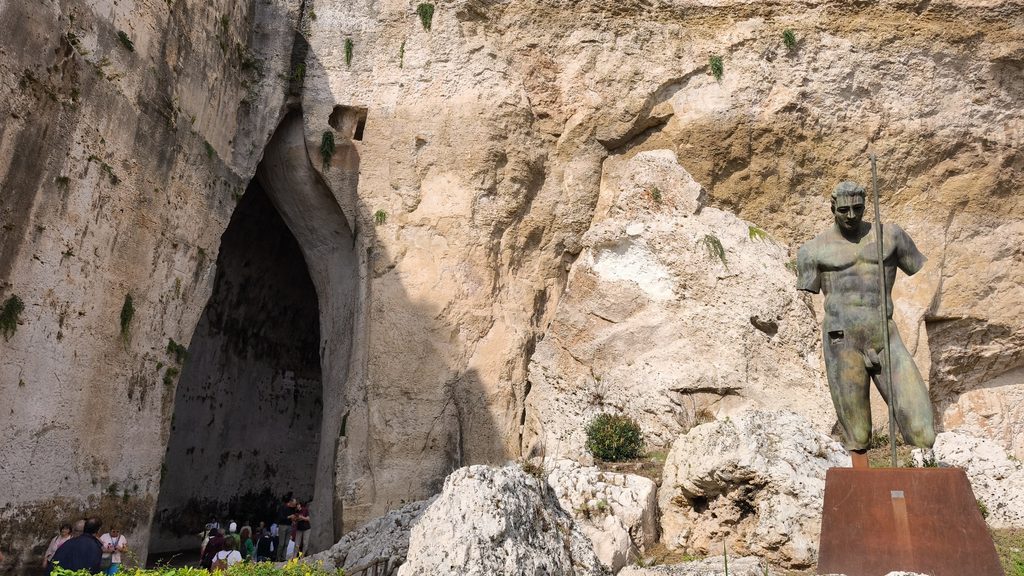
The Ear of Denys is an artificial cave dug in the ancient quarry of Latomia del Paradiso. It takes its name from Denys the Elder, The Oreille de Denys is a geological marvel and a source of legends. Its S-shaped curve recalls the internal structure of a human ear. The cave measures approximately 20 meters in height, with a width ranging from 5 to 11 meters. This cave is renowned for its exceptional acoustic characteristics. According to legend, Denys’s ear was used by Denys Ier to imprison his enemies and listen to their conversations from a small room hidden in the upper part of the cave.
In Denys' Ear, a face emerges from the darkness
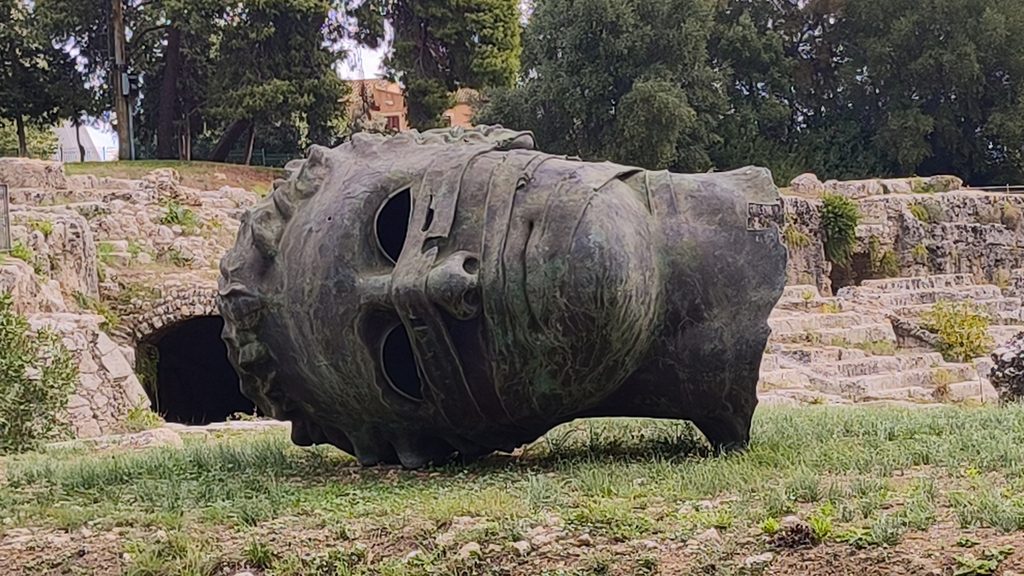
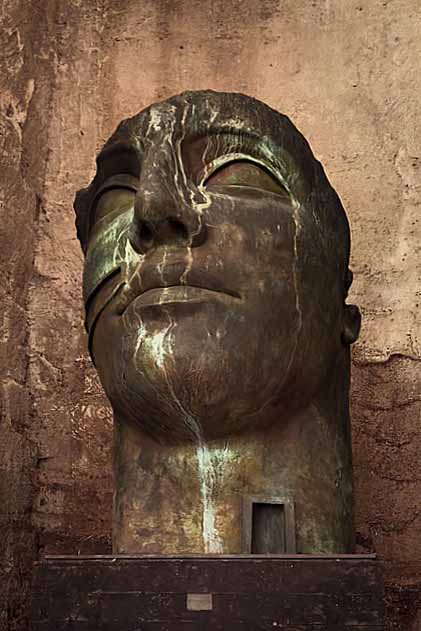
Among the most striking installations is Tindaro, a monumental bronze head placed in the Ear of Denys. In this space marked by the extraction of the stone, the fragmented face imagined by Mitoraj takes on a particular dimension. Its installation plays on the contrast between the dark mass of bronze, the rocky walls and the light penetrating into the cavity. The work seems to belong as much to the cave as it does to it. It is worth noting that Tindaro has, since November 2025, been installed in Caltagirone, At the summit of the famous staircase of Santa Maria del Monte, for a presentation announced until the end of 2026.
The character mentioned here is Tyndare, king of Sparta in Greek mythology, husband of Leda and father of Clytemnestre and, according to some traditions, of Helen.
Bronze statue from 1997. Dimensions: 4.07 m × 2.72 m.
Deities who bear the wounds of men
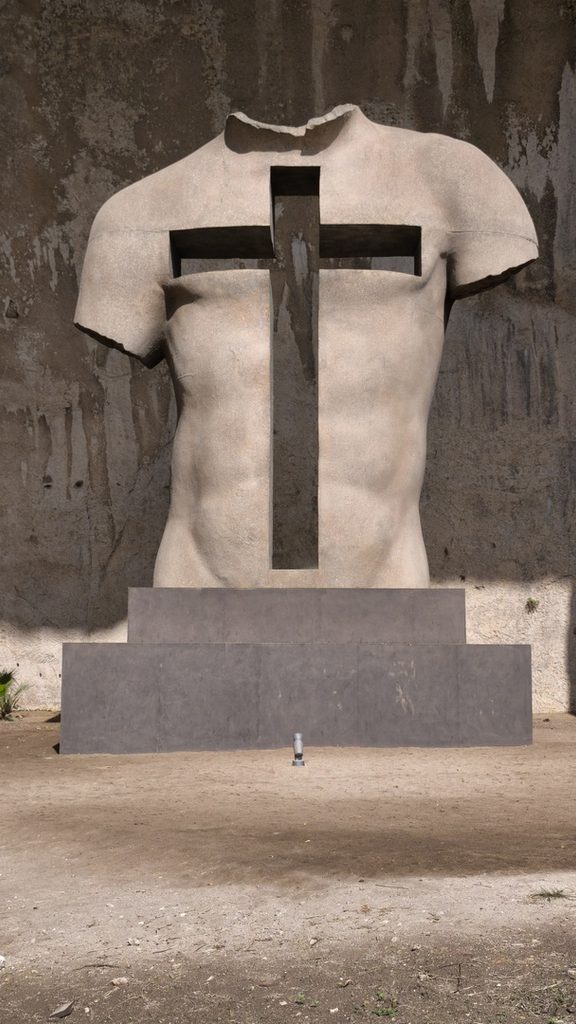
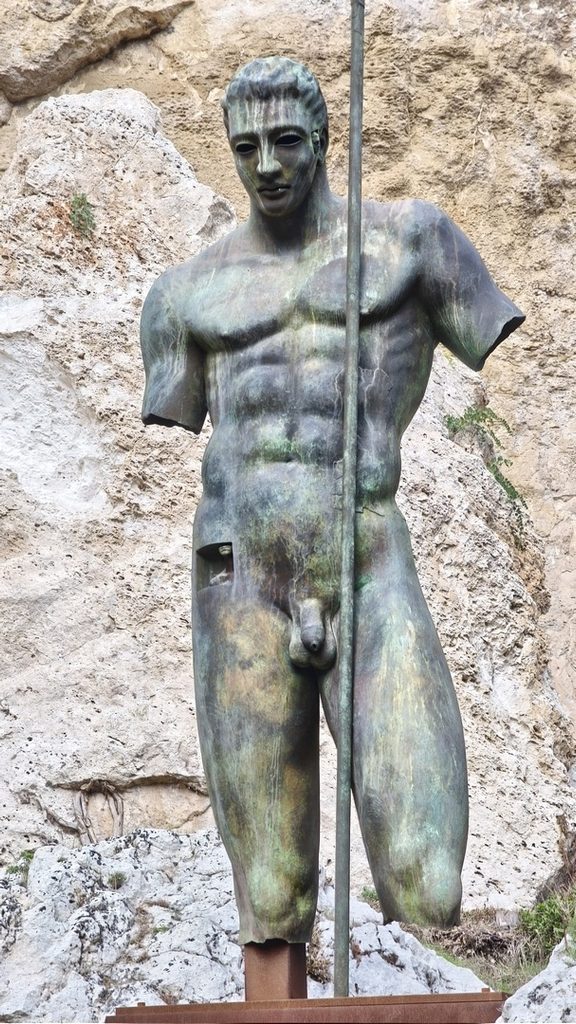
In ancient sculpture, the gods and heroes often embodied an ideal of beauty and power. Mitoraj takes up this tradition to transcend it even further. His characters seem to belong to a vanished world. Their harmonious proportions evoke Greek statues, but their injuries introduce a dissonance. How can such majestic figures appear so vulnerable?
The sculptor constantly plays on this tension. A face retains a peaceful expression despite its mutilations. A torso devoid of limbs retains all its power. A monumental head, detached from its body, seems absorbed in a silent meditation.
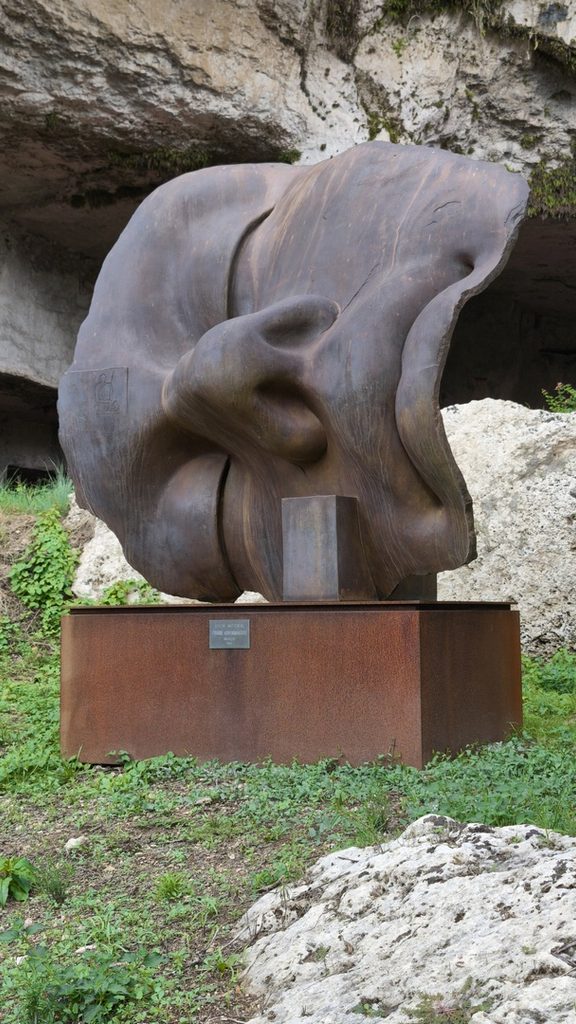
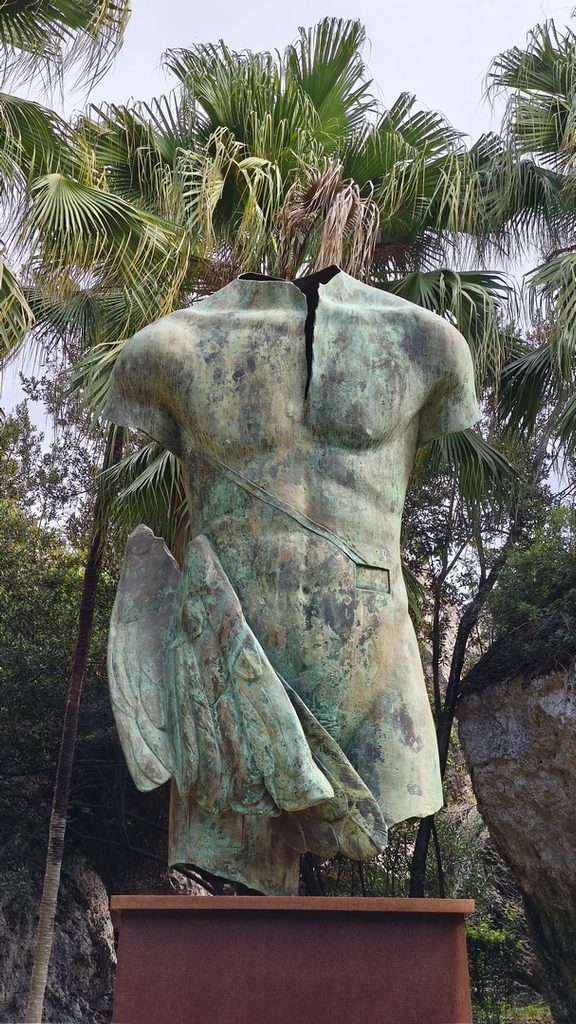
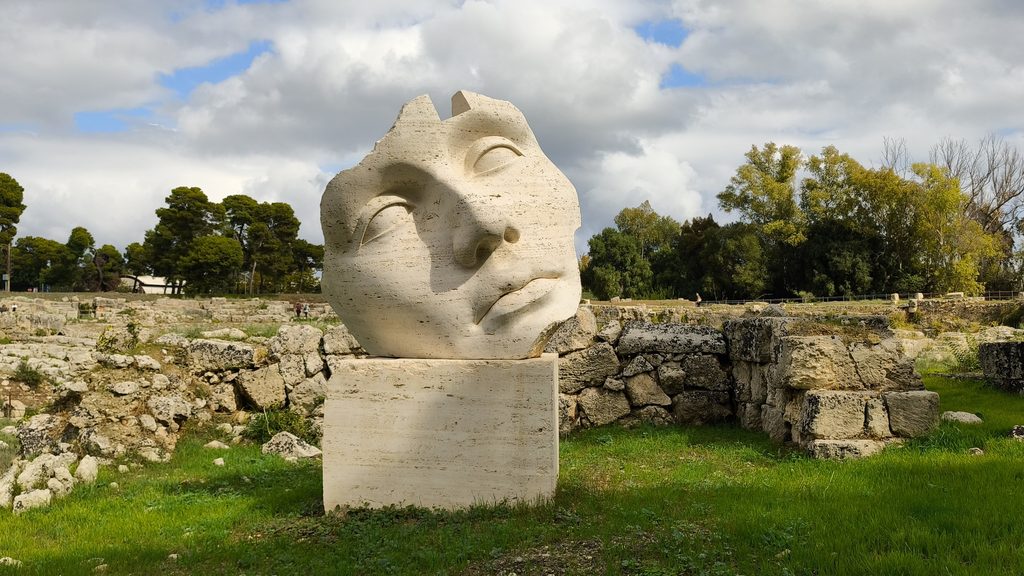
One might think that these fragments were unearthed during archaeological excavations. However, their fractures are not the work of time: they belong to the very conception of the sculptures. Where the archaeologist attempts to restore the integrity of a work from its remains, Mitoraj deliberately chooses fragmentation. Limbed bodies, fissured faces, missing limbs: mutilation does not destroy beauty; it gives it a different dimension. The harmony of the forms remains, but it is charged with a fragility that makes these figures deeply human.
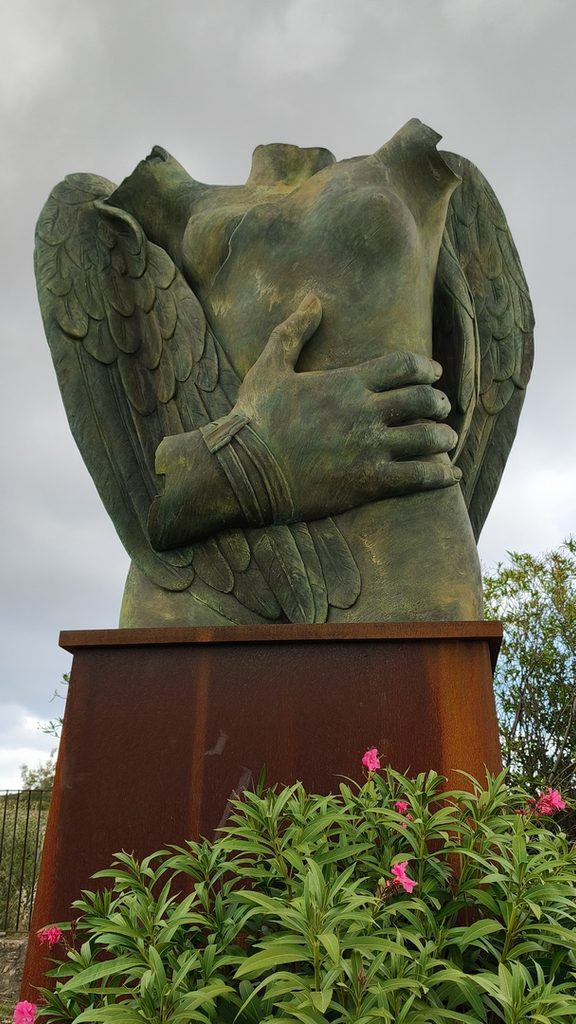
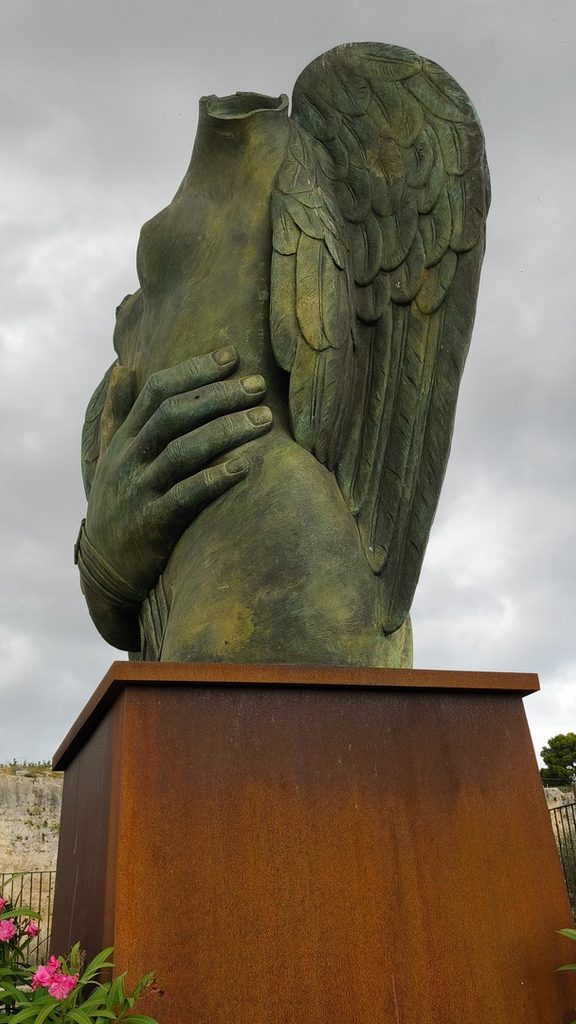
In Syracuse, this approach takes on a particularly resonant meaning. Mitoraj’s sculptures coexist with ancient remains, columns, steps, and fragments of monuments. The forms altered by the centuries correspond to those that the artist has deliberately designed in this way. A unique dialogue is established between the ancient stones and these contemporary figures, where the boundaries between the past and the present seem to fade away.
From D’Ortygie to Etna, the sculpture changes its perspective
The exhibition does not confine itself to the park of Neapolis. Other monumental works have been installed in other Sicilian landscapes, extending the dialogue between sculpture, history and nature.
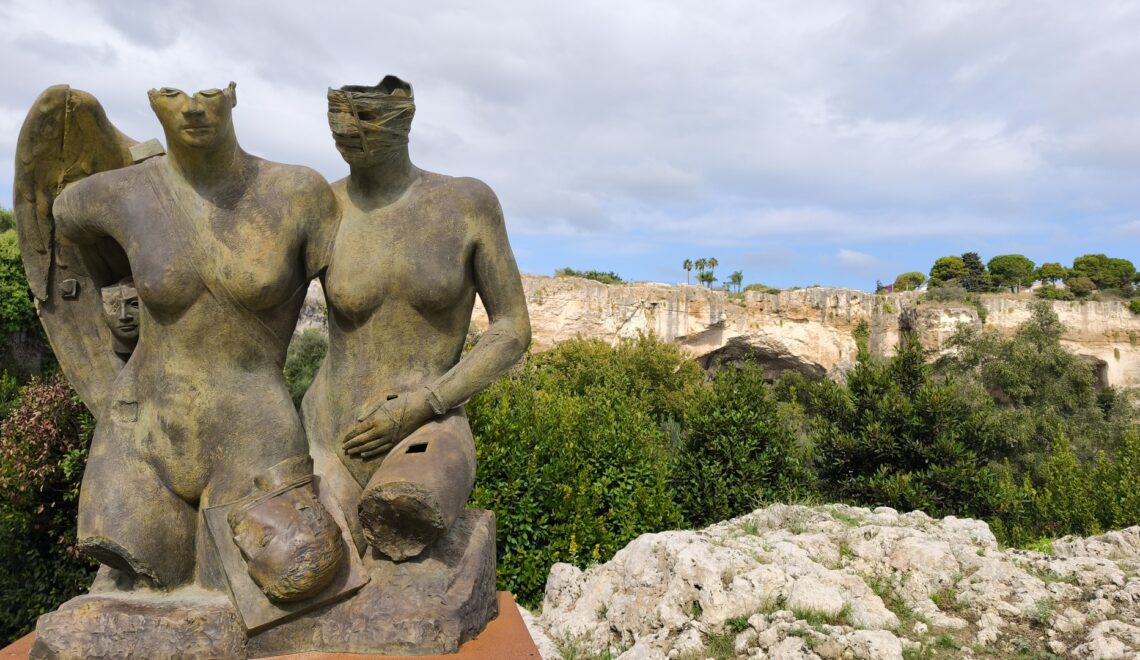
Ikaria Alata, facing the Sea of Otygie
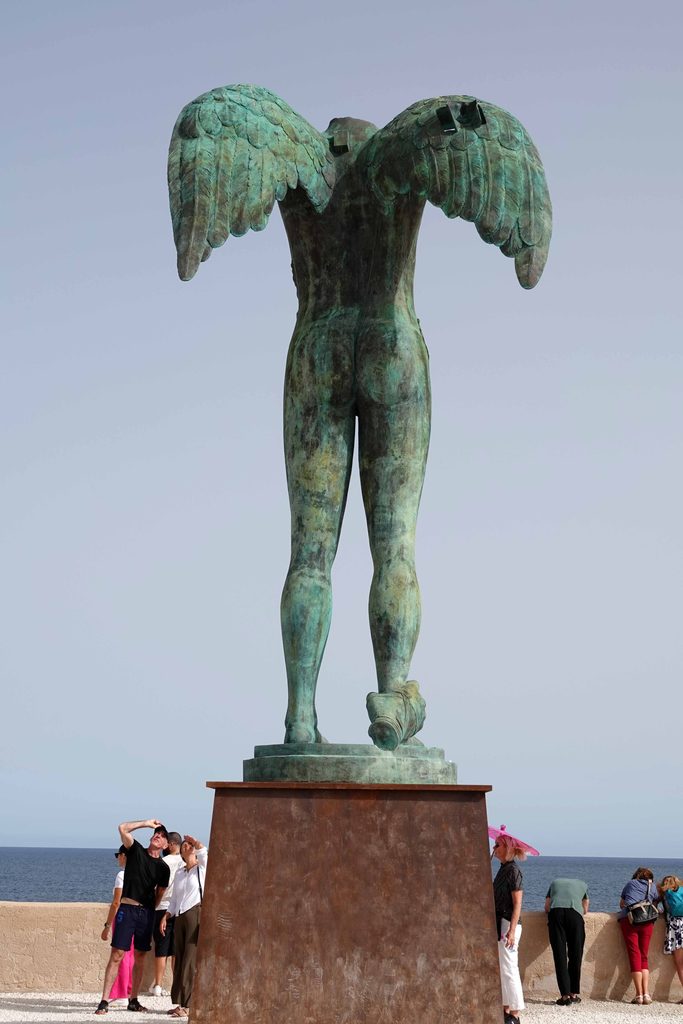
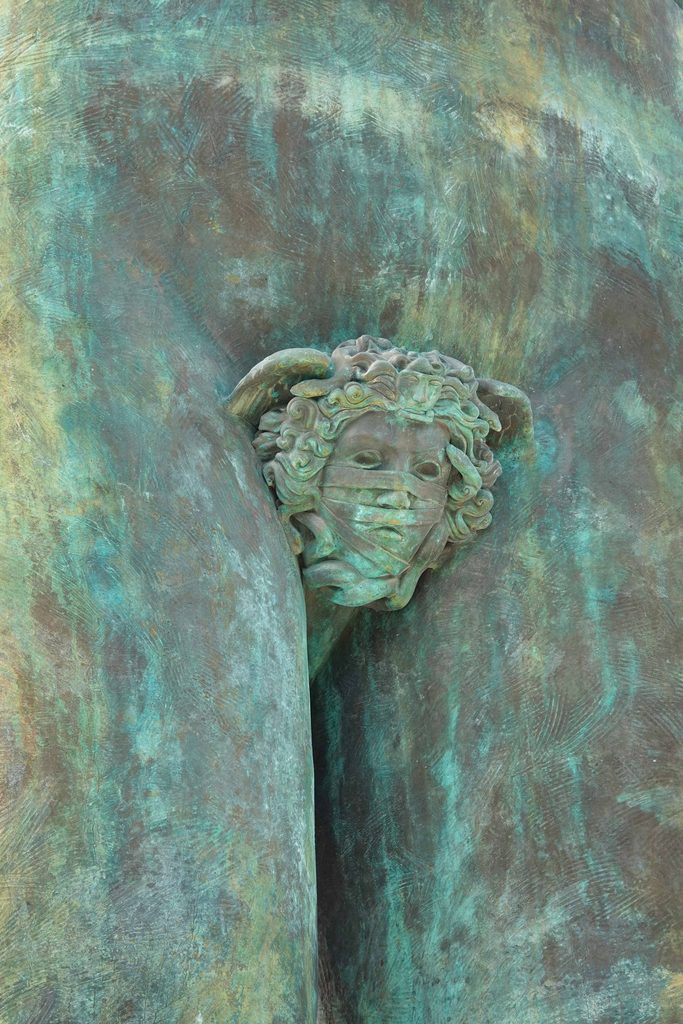
Sicily. Near the Maniace castle, on the island of Ortygie, Ikaria Alata faces the Mediterranean and impresses with its beauty and harmonious proportions. Mitoraj gives a feminine form to the myth of Icare. This winged figure, devoid of head and arms, seems doomed to never take flight. At the height of the pubis appears a small face that evokes a Gorgone mask. In Antiquity, its effigy had a protective function, intended to ward off evil forces.
The marine landscape gives this figure a special strength. The sea, a space of ancient voyages and myths, becomes the backdrop of a sculpture where beauty is always accompanied by a form of fragility.
Teseo Screpolato, on the slopes of Etna
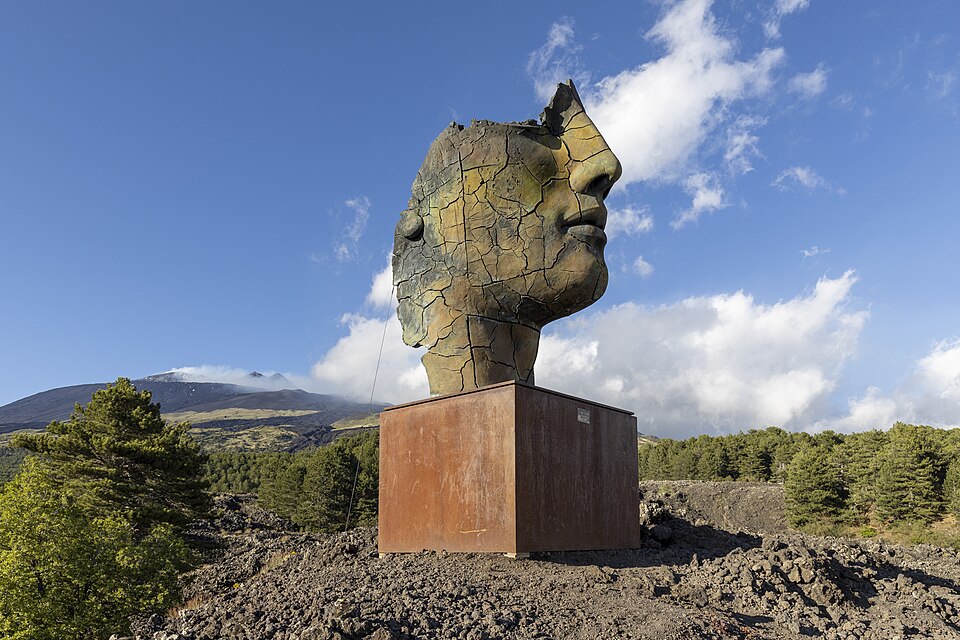
Even more spectacular, Teseo Screpolato (Teseo Fractured) was installed in 2024 at an altitude of approximately 2,000 meters, on the southeastern slope of Mount Etna, in the municipality of Ragalna. Here, the contrast is striking. The sculpted bronze meets the volcanic rock, the fractures imagined by the artist respond to the geological forces that shape the mountain.
The sculpture seems to remind us that fragility does not only affect men and their civilizations. Nature itself is transforming, destroying, and starting over. Unlike the works of Neapolis, Teseo Screpolato is announced on Etna until December 31, 2026.
Sicily, a land of choice for Mitoraj
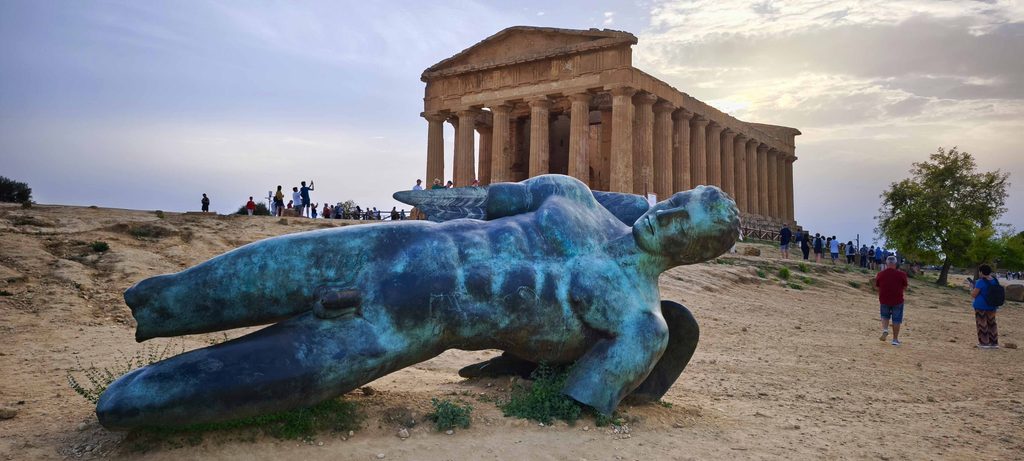
The encounter between Mitoraj and Sicily does not begin in Syracuse. In 2011, his sculptures had already taken over the Valley of the Temples in Agrigento. Among them, Icaro fallen (Icare tombé), installed in front of the Concorde temple, has become one of the most well-known images of his work on the island.
Other exhibitions followed in Noto and at the Roman Villa of Casale, near Piazza Armerina. Each time, the artist, and then the organizers of the exhibitions after his death in 2014, sought a confrontation between his classical figures and places steeped in history.
This loyalty to Sicily is nothing short of remarkable. The island retains the traces of several civilizations that have successively occupied it, from the Greeks to the Romans, from the Byzantines to the Arabs and the Normans. It offers a particularly rich terrain for a work dedicated to the memory and transformations of cultures.
When contemporary art awakens the remains
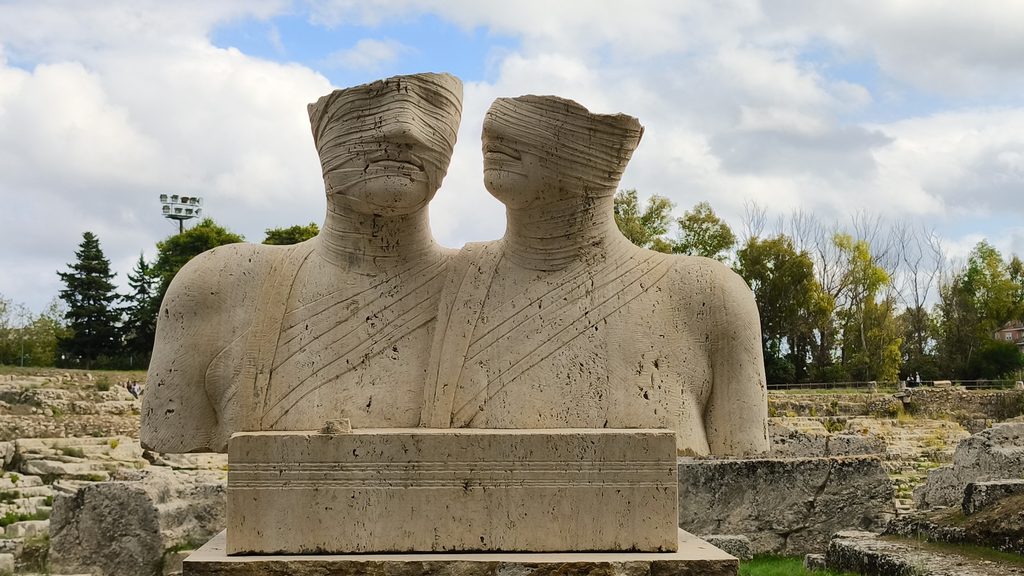
Installing contemporary sculptures in an archaeological site is never a neutral gesture. The works can enrich the perception of the monuments, but also change the way visitors view them.
In Syracuse, the interest of the project lies precisely in this confrontation. The remains of Neapolis testify to the power of an ancient city, its political, religious, and cultural ambitions. The characters in Mitoraj, however, seem to remind us that all power is ephemeral. Their mutilated bodies do not celebrate victory. They rather suggest what remains after the collapse of certainties.
The visitor is thus invited to move between two forms of memory: that of history, inscribed in the stones, and that of the artist, who transforms ancient models into figures of our own time. The sculptures do not seek to explain the ruins; they pose new questions to them.
Mitoraj offers a singular response. He does not represent triumphant gods or invincible heroes. He shows them wounded, incomplete, sometimes stripped of their identity. His beauty, however, does not disappear. It even seems to strengthen in the face of their imperfections.
In the ruins of Syracuse, this vision finds a particularly accurate expression. Civilizations pass, monuments deteriorate, beliefs change. Yet a memory continues to live through their fragments. And perhaps that is what Mitoraj best understood: a work does not need to be intact to endure through the centuries.
Text and Photos : Brigitte Postel unless otherwise stated